
QUICK SUMMARY: President Donald Trump’s Project Freedom launched Monday and produced the biggest U.S.-Iran exchange since the April ceasefire. The U.S. Navy sank six Iranian fast boats in the Strait of Hormuz. A Korean cargo ship caught fire near the UAE. Brent crude jumped 5%. The disputed strait carries 21% of global oil. Pump prices are climbing.
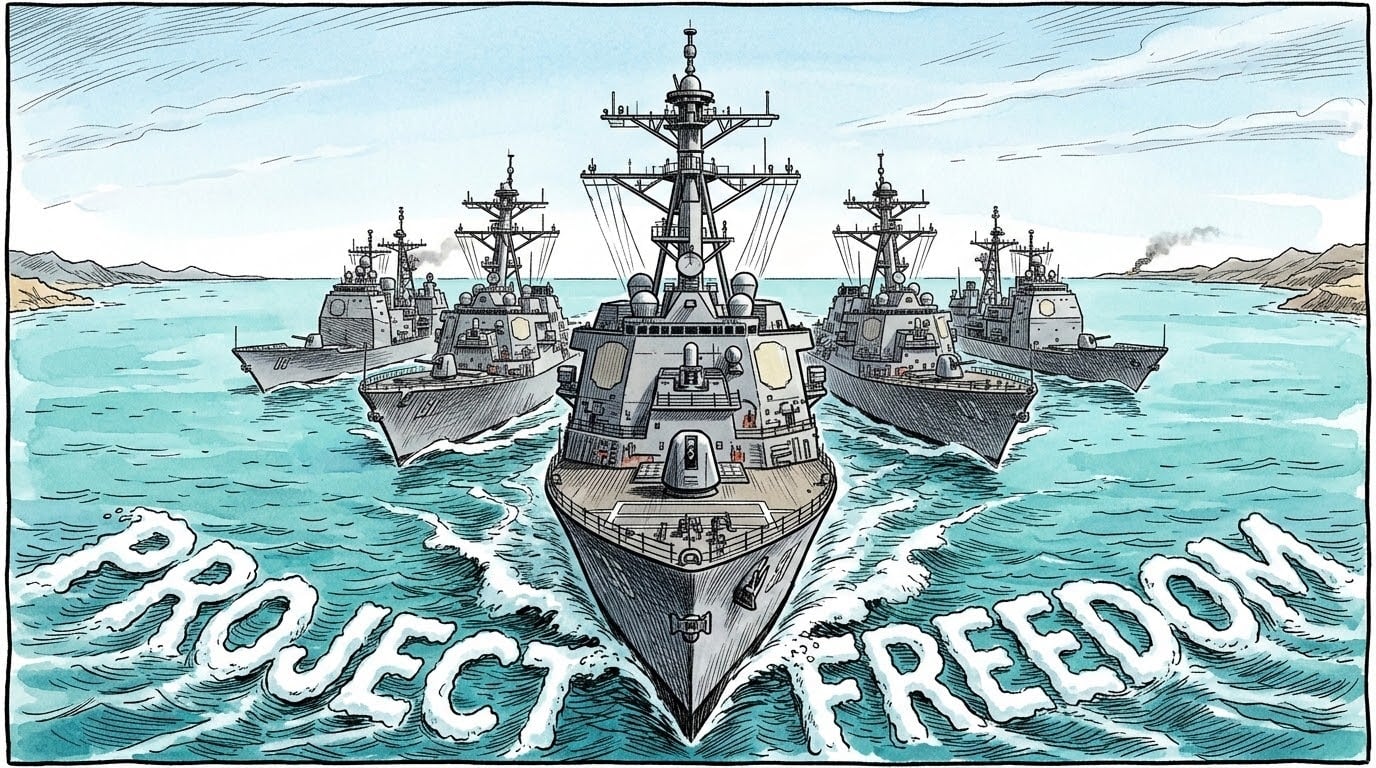
Under Project Freedom, the U.S. Navy sank six Iranian fast boats in the Strait of Hormuz on Monday, U.S. Central Command commander Adm. Brad Cooper told reporters. Iran fired cruise missiles, drones, and small boats at U.S. Navy destroyers and the two commercial ships under U.S. protection. A separate Iranian strike hit the Fujairah Oil Industry Zone in the UAE and set it ablaze.
President Trump said the U.S. shot down “seven small Boats.” CENTCOM officially said six. Asked Monday by radio host Hugh Hewitt whether the U.S.-Iran ceasefire is still in effect, Trump said, “Well, I can’t tell you that.” That contradicts his April 7 letter to House Speaker Mike Johnson and Sen. Chuck Grassley declaring the hostilities “terminated.”
What Is Project Freedom and What Did It Hit on Day One?
CENTCOM deployed 15,000 service members, more than 100 land and sea-based aircraft, guided-missile destroyers, and AH-64 Apache and MH-60 Seahawk helicopters. Two U.S.-flagged commercial vessels transited the strait under U.S. protection.
Iran fired cruise missiles and drones at U.S. Navy destroyers. All were intercepted. U.S. helicopters then sank six Iranian fast boats that attacked the commercial ships, according to Cooper.
Iran also struck the Fujairah Oil Industry Zone in the UAE. The South Korean-operated HMM Namu cargo ship caught fire near the UAE coast. Trump said Iran fired on the Korean ship. Seoul’s Ministry of Oceans and Fisheries is investigating whether the damage came from an attack or a drifting Iranian sea mine. The vessel will be towed to a nearby port for inspection. The cause is not yet confirmed.
Did the U.S. Navy Sink Six Iranian Boats, or Seven?
Trump said seven boats. CENTCOM said six. That is the first gap.
Trump warned Iran on Fox News that any attack on U.S. ships would mean Iran would be “blown off the face of the Earth.” Later in the same interview, he said the war “militarily, is essentially over.” That is the second gap.
Trump’s April 7 letter to congressional leaders declared the hostilities “terminated.” On Monday, when asked directly whether the ceasefire still holds, he refused to answer. That is the third gap.
Foreign Policy reported the operation was structured as a new campaign of Operation Epic Fury. The 60-day War Powers Resolution deadline expired Friday, May 1. Declaring a new campaign extends operations past that deadline without a fresh congressional vote.
Two U.S.-flagged ships transited the strait on Monday. Pre-war traffic was roughly 120 vessels per day. Retired Lt. Gen. Karen Gibson, speaking on CNN, called the first day a “tactical success” but said commercial confidence is the deciding factor. “Iran just needs to continue to present a perception of risk to keep merchant traffic to small numbers,” she said.
For BNA’s prior coverage of how the Iran ceasefire connects to fuel prices, see our earlier reporting on the Iran ceasefire and gas prices.
How Fast Will This Hit American Gas Prices?
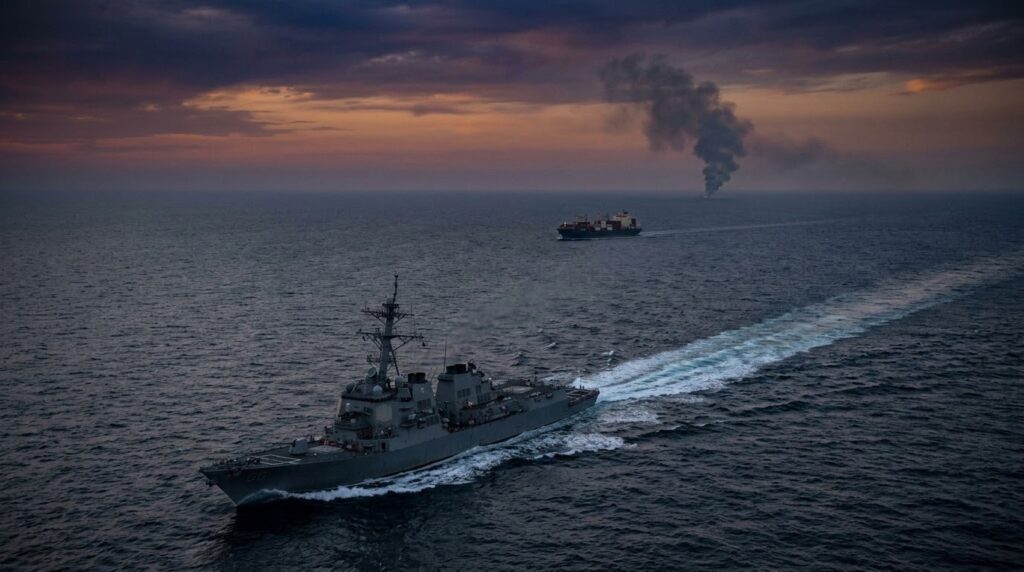
The Strait of Hormuz carries roughly 21% of global oil. That is structural geography. The U.S. cannot drill its way around it.
Brent crude jumped 5% Monday to $114 per barrel. WTI climbed to $107. The U.S. national average for unleaded gas hit $4.46 per gallon, the highest level in nearly four years.Goldman Sachs estimates the closure has reduced global daily oil production by 14.5 million barrels. Citigroup said Brent could reach $150 per barrel if the strait stays closed through the end of June.
That flows to your wallet through fuel, freight, and food. Jet fuel is up roughly 65% since the war began, raising airfares. Trucking costs raise grocery prices. Home heating bills follow.
One analyst quoted in NBC News put it directly: “$4.50 gasoline is around the corner. If the Strait remains closed another month, we will be at $5.00 per gallon.”
For BNA’s archive on rising fuel costs, see our coverage of soaring gas prices since the war began.
With gas at $4.46 and analysts saying $5.00 is one closed month away, the energy story is no longer a Middle East story. It is a household-budget story.
For BNA readers asking where to start with physical precious metals as a hedge against the next 60 days of pricing volatility, the entry point is a single verified gram. Valcambi is one of the largest precious-metals refiners in Switzerland. The Valcambi assay card carries a serial number and a tamper-evident seal. It is the first piece of metal a reader holds in their hand before scaling a position.

What Happens Next in the Hormuz Crisis?
Defense Secretary Pete Hegseth and JCS Chairman Gen. Dan Caine are scheduled to hold a press conference Tuesday morning. Trump is preparing to meet Chinese President Xi Jinping in Beijing. China imports roughly 14% of its oil from Iran and has called for the strait to reopen. Saudi Crown Prince Mohammed bin Salman condemned Iran’s UAE attacks in a call with UAE President Mohammed bin Zayed. Iran’s foreign minister warned against being “pulled into a prolonged conflict by others with bad intentions.”
For BNA’s prior reporting on the diplomatic track, see our coverage of the Iran peace talks collapse.
Project Freedom enters its second day with the ceasefire question unanswered. The next 72 hours will determine whether Monday’s exchange was the largest single confrontation since the April ceasefire or the opening day of a renewed conflict. Either way, the gas pump and the grocery aisle are already pricing in the answer.
Frequently Asked Questions
What is Project Freedom?
Project Freedom is a U.S. military operation launched Monday to guide commercial ships through the Strait of Hormuz. It involves 15,000 service members, more than 100 aircraft, and guided-missile destroyers. CENTCOM commander Adm. Brad Cooper said the mission is defensive.
Did Iran attack the South Korean ship?
The South Korean-operated HMM Namu caught fire near the UAE coast on Monday. Trump claimed Iran fired at the vessel. Seoul’s Ministry of Oceans and Fisheries is investigating whether the damage came from an attack or a drifting sea mine. The cause is not yet confirmed.
Is the U.S.-Iran ceasefire still in effect?
Trump declined to answer when asked Monday by radio host Hugh Hewitt. His April 7 letter to congressional leaders declared the hostilities “terminated.” The Pentagon press conference scheduled for Tuesday morning may clarify the official position.
How fast will gas prices rise?
The national average gas was $4.46 per gallon Monday, which is a four-year high. Brent crude jumped 5%. Analysts say the pump will hit $4.50 within days and $5.00 if the strait stays closed another month. Households on fixed fuel budgets are most exposed.
Did the operation violate the War Powers Resolution?
The 60-day War Powers deadline for Operation Epic Fury expired Friday, May 1. Foreign Policy reported the operation is structured as a new campaign of Epic Fury, which extends operations past the deadline without a fresh congressional vote.