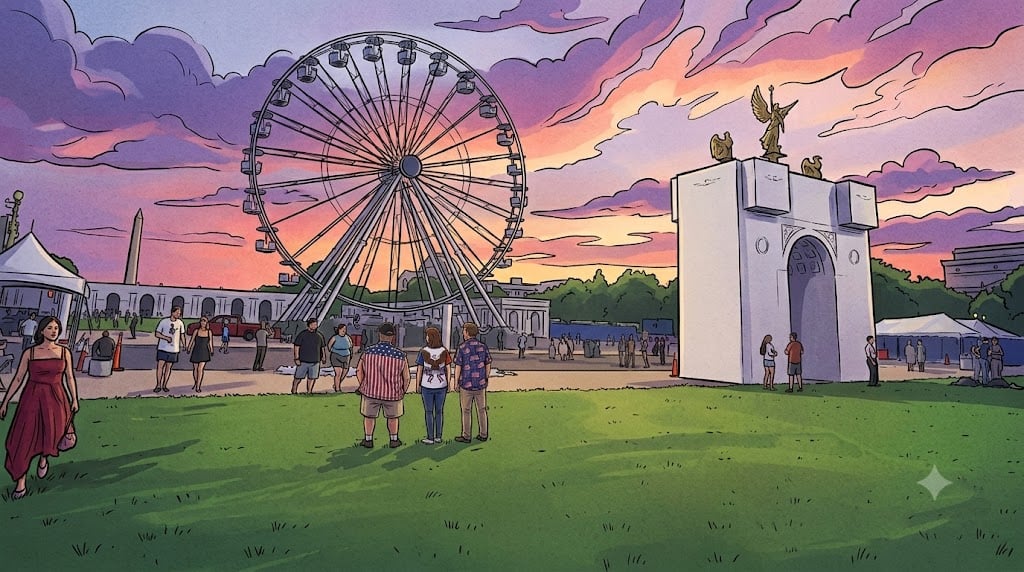

America’s 250th birthday was always going to be a big deal. A decade of planning, a bipartisan congressional commission, and a National Mall footprint stretching from the Capitol to the Washington Monument. The only question was whether Freedom 250’s flagship event would deliver on that scale.
Five days into its 16-day run, the answer is complicated. The crowds that were supposed to fill ten blocks of the Mall have not materialized. The performers who were supposed to fill the main stage are gone. And the Americans who most wanted to be there, the ones who planned road trips, who followed the announcements, who genuinely wanted to mark the moment, have mostly stayed home.
This is not a partisan story. It is a logistics story with three documented problems.
The Show That Wasn’t There
On May 27, Freedom 250 announced a nine-act concert lineup for the fair’s opening night. Within 48 hours, the first acts started walking. By opening day, eight of the nine had withdrawn.
Martina McBride was first to explain why. “I will not be performing at the Great American State Fair,” she wrote on Instagram on May 28. “I was presented with an opportunity to perform at a nonpartisan event but that turned out to be misleading.” Bret Michaels of Poison followed: “What was presented to us as a celebration of our country has evolved into something much more divisive than what I agreed to be a part of.” Morris Day, Young MC, and The Commodores exited within days, according to the Daily Beast, citing variations of the same concern. Fab Morvan, who performs under the Milli Vanilli name, initially defended his participation before reversing course on CNN on June 1. “This is not what I signed up for,” he said. “It turned into a circus.”
Vanilla Ice stayed. His Friday night performance was canceled by weather before it started. He remains the only announced performer for a fair with no confirmed major entertainment through July 4.
The opening night concert was replaced by a Trump speech. Transportation Secretary Sean Duffy introduced the president by calling the departed performers “libtards” while his daughter stood behind him on stage. Within 30 minutes of Trump beginning to speak, The Bulwark documented crowds heading for the exits on video. One person was photographed asleep on the lawn. NBC News put total attendance at more than 1,000. Trump later posted on Truth Social that 45,000 people attended. NBC News called that claim false.
The entertainment failure cut across both sides of the political divide. NBC News reported that roughly half the opening night crowd wore Trump slogans or his likeness. They came for the president. The other half came for America. Neither got a show.
Matt Walsh, whose Daily Wire audience is among the most loyal in conservative media, put it plainly on X: “I’m actually pretty pissed at how badly they’ve bungled America 250. This should have been a massive, raucous celebration of the country and its 250-year history. Now it will be a political rally identical to the ten million other ones we’ve already seen.”
That sentence captures the core problem. Trump supporters have already seen the rally. They have seen it in arenas, in parking lots, in airplane hangars across the country. A trip to DC in peak summer heat to see it again, with no performers and a Ferris wheel that broke down on opening day from a generator failure, does not clear the bar. And the Americans who wanted a genuine nonpartisan celebration saw the political association and made the same calculation in reverse.
Freedom 250 built an event that gave Trump supporters another rally and gave everyone else a reason to stay home.
The Cost of Showing Up
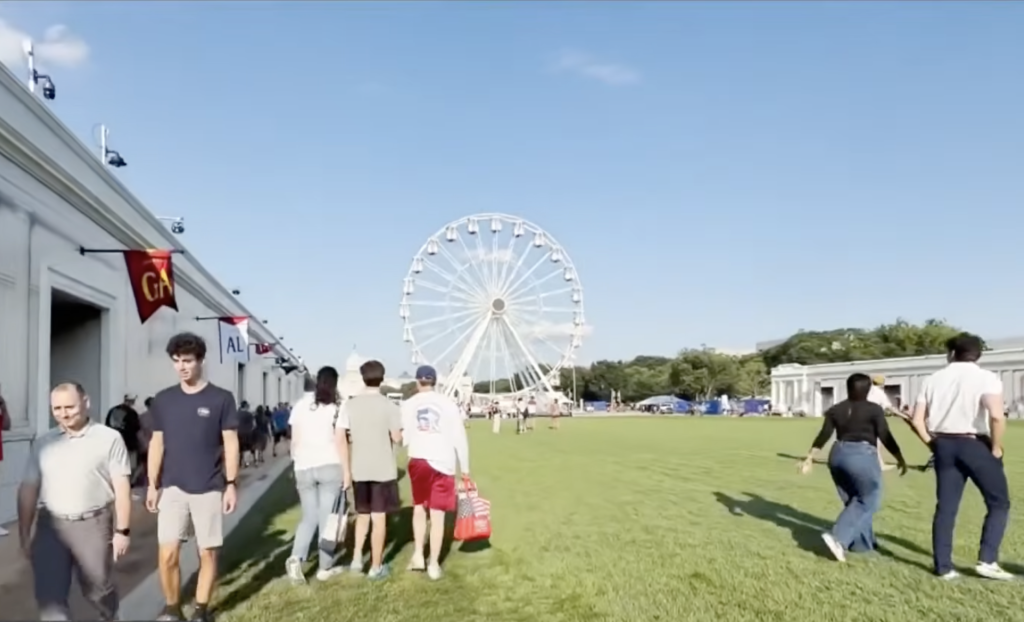
For the Americans who did consider making the trip, the logistics compounded the problem.
Attending requires navigating stadium-level security on a ten-block stretch of the National Mall fenced off since mid-June. Water bottles are prohibited. Umbrellas are prohibited. Coolers are prohibited. Backpacks above a certain size are prohibited. The walk from the nearest Metro entrance to an entry point runs more than a mile each way, according to the Washingtonian, which attended opening day and reported a single food vendor in the food hall selling personal pizzas and chicken Caesar salads. The only lemonade available was Minute Maid by the plastic bottle at $5 each.
The Washington Post noted the one thing strangely absent at a fair billed as a celebration of American tradition: nostalgia. No champion hogs. No pie-eating contests. No butter sculpture. No corn dogs or funnel cakes. In their place: defense contractors, a Fox and Friends presence, a Truth Social booth with an iPad scrolling Trump’s feed, and a Department of Agriculture exhibit featuring a prominently displayed poster of the president.
For anyone outside the DC metro area, the trip also requires a hotel, gas, and time off work during a summer when, according to the National Energy Assistance Directors Association, the average household is already spending $792 to keep air conditioning running through September, up 10.5 percent from last year.
That math is not favorable for a discretionary road trip to watch Vanilla Ice get rained out.
The states themselves made the same calculation. Time magazine confirmed that eight states declined to send official delegations, citing costs ranging from $100,000 to $500,000 to participate in a federally funded national celebration. Pennsylvania Governor Josh Shapiro tried to recruit businesses across the state to sponsor his state’s booth and found none willing. “The president has politicized this to a degree that businesses don’t want to participate,” Shapiro told The Hill.
States were being asked to spend six figures of their own money to participate in a celebration that was supposed to be funded by $150 million in federal appropriations.
Donna Chobat, a retired Massachusetts teacher who disagreed with her state’s decision to skip the fair, drove herself to DC on three tanks of gas, paid her own hotel fare, collected pamphlets from local maple syrup producers, and staffed her state’s booth herself. “I didn’t want an empty space where our state booth should be,” she told NPR. That level of personal commitment is what it took to get Massachusetts represented. It is not a replicable model for a national audience.
What Was Supposed to Be There
The political perception problem did not begin with the opening night speech. It began with the institutional decision that created Freedom 250. To understand that decision, you need to know that two organizations are claiming to run America’s 250th birthday. Only one of them was created by Congress.
America250 was established by an act of Congress in 2016 as the official, nonpartisan commission for the nation’s semiquincentennial. It is subject to congressional oversight, required to submit annual reports to Congress, and overseen by a bipartisan panel that includes both Democratic and Republican members. Freedom 250 was created by President Trump via executive order on January 29, 2025, nearly a decade later. It is housed inside the National Park Foundation as a private LLC, answers to a White House task force chaired by Trump, and is not required to disclose its donors or submit to bipartisan oversight.
The names are similar. The structures are not.
America250 describes itself as “a national bipartisan initiative working to engage the American public in celebration of the 250th anniversary of the U.S.” Its mission statement reads: “We aim to inspire our fellow Americans to reflect on our past, strengthen our love of country and renew our commitment to the ideals of democracy through programs that educate, engage and unite us as a nation. America250 will foster shared experiences that spark imagination, showcase the rich tapestry of our American stories, inspire service in our communities, honor the enduring strength and celebrate the resilience of the United States of America.”
Freedom 250 has sought to celebrate the same anniversary. Its backing by President Trump and the White House is what led to the pushback from artists and states documented above.
A Smithsonian employee who worked on the original America250 planning described what that vision looked like in a Reddit post last week that drew 923 upvotes. The Smithsonian had secured millions in private philanthropy for a month-long Festival of Festivals: major headliners willing to perform under the Smithsonian banner, programming representing the best of American creative traditions from across all 50 states, events designed to draw national audiences without a political frame attached.
The permits to host it on the Mall were never granted.
“Our nation was robbed of what would have been a once in a generation cultural moment,” the staffer wrote.
What replaced it was Freedom 250. Federal records obtained by NOTUS show the Interior Department directed $68.3 million to the National Park Foundation. America250 received $25 million of the $100 million it had been promised and filed a commission report documenting a $100 million funding shortfall. Interior also instructed staff to remove America250 branding from federal websites and email signatures and replace it with Freedom 250 as the primary branding for all official 250th communications.
The result, documented in attendee interviews, performer withdrawal statements, and community discussion alike, was a celebration that felt like it belonged to one person rather than to the country. “I’m very patriotic about my country and this is something I would love to go to,” one Washington-area resident wrote on Reddit last week. “But I don’t wanna go because I know when people think of this they think of Trump. And I don’t wanna be associated with anything with that image right now.”
That is not a partisan statement. It is a description of a perception problem with a documented institutional cause.
Researched and fact-checked by the BreakingNewsAlerts.com editorial team. Primary documents verified. See our editorial standards.
Frequently Asked Questions
Why did performers drop out of the Great American State Fair?
Eight of the nine originally announced performers withdrew before opening day. Most cited being misled about the event’s nonpartisan nature. Martina McBride wrote that she was “presented with an opportunity to perform at a nonpartisan event but that turned out to be misleading.” Bret Michaels cited both political concerns and safety issues. Fab Morvan of Milli Vanilli initially defended his participation before withdrawing on June 1, telling CNN: “It turned into a circus.”
How many people attended the Great American State Fair opening?
NBC News estimated attendance at the June 24 opening rally at more than 1,000. President Trump later posted on Truth Social claiming 45,000 people attended. NBC News called that figure false. The Washington Post described the crowd as thinly covering an area smaller than some summer outdoor movie screenings.
What is the difference between America250 and Freedom 250?
America250 was created by Congress in 2016 as the official, bipartisan commission for the semiquincentennial, subject to congressional oversight and required to submit annual reports. Freedom 250 was created by President Trump via executive order on January 29, 2025, and operates through the National Park Foundation as a private LLC with no bipartisan oversight and no donor disclosure requirement. Federal records show the Interior Department directed $68.3 million to Freedom 250’s parent organization while America250 reported receiving only $25 million of the $100 million it was promised.
Why are states skipping the Great American State Fair?
Eight states declined to send official delegations, citing participation costs ranging from $100,000 to $500,000. Pennsylvania Governor Josh Shapiro said businesses refused to sponsor the state’s booth because “the president has politicized this to a degree that businesses don’t want to participate.”