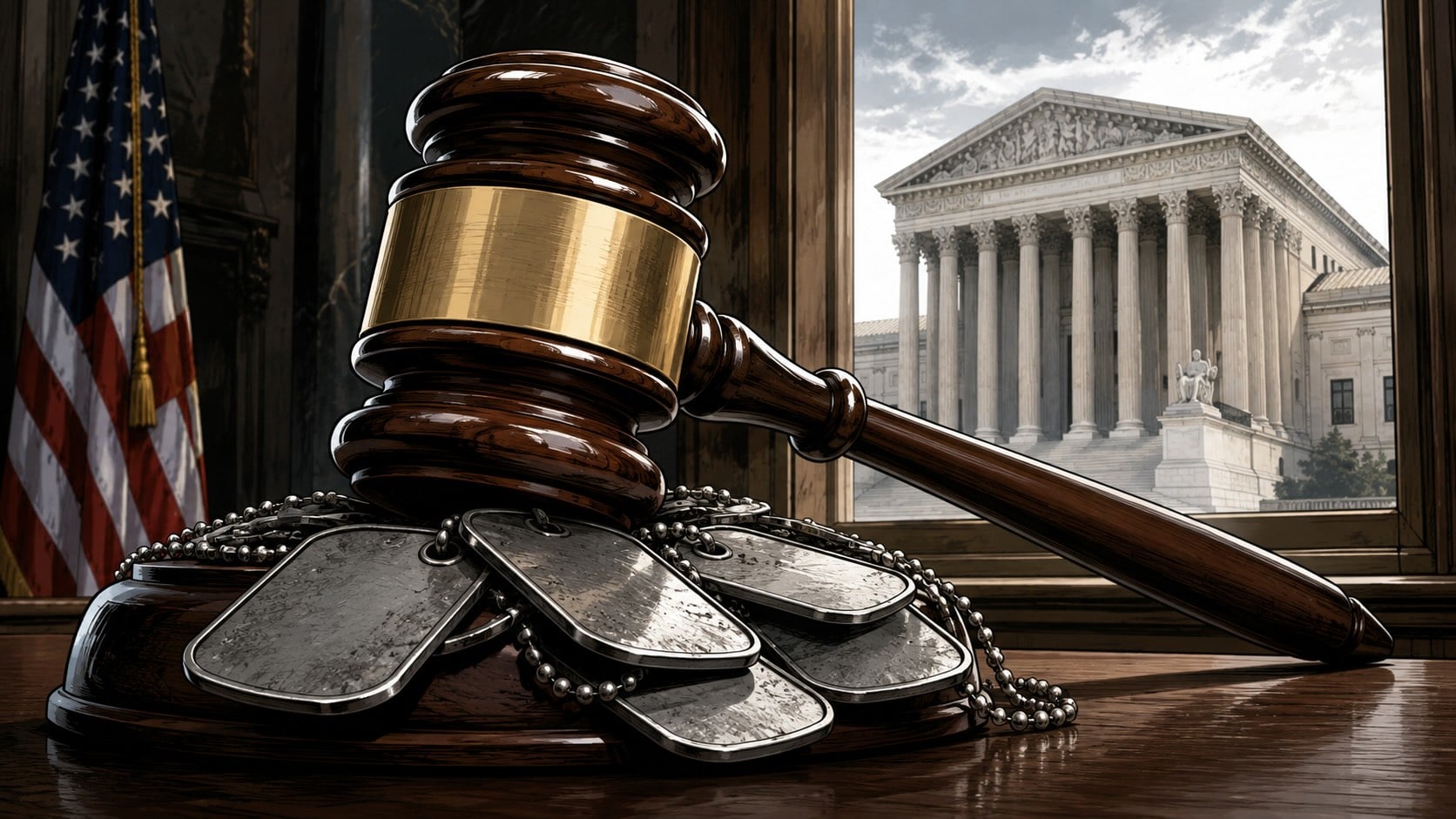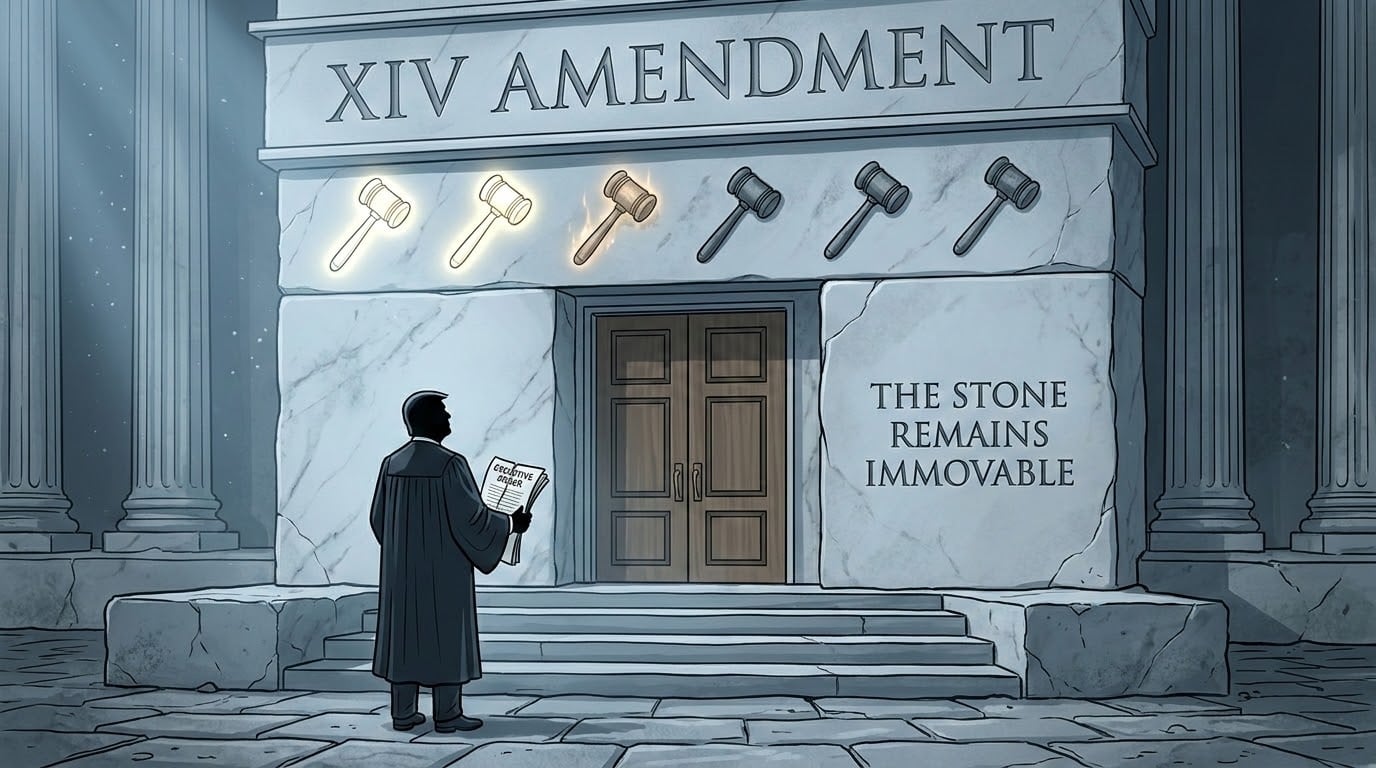

The Supreme Court ruled 6-3 on June 30, 2026 that birthright citizenship is guaranteed by the 14th Amendment, striking down President Donald Trump’s Day 1 executive order and closing the door on any executive path to end the practice. Chief Justice John Roberts wrote the majority opinion. Trump’s order, which would have stripped citizenship from children born to undocumented immigrants and temporary visa holders, never took effect. Every federal court that reviewed it had already blocked it. Tuesday’s ruling makes that block permanent on constitutional grounds.
The case, Trump v. Barbara, is now the governing precedent: children born in the United States to parents who are unlawfully or temporarily present are citizens at birth under the Citizenship Clause of the 14th Amendment.
How Did the Justices Vote in Trump v. Barbara?
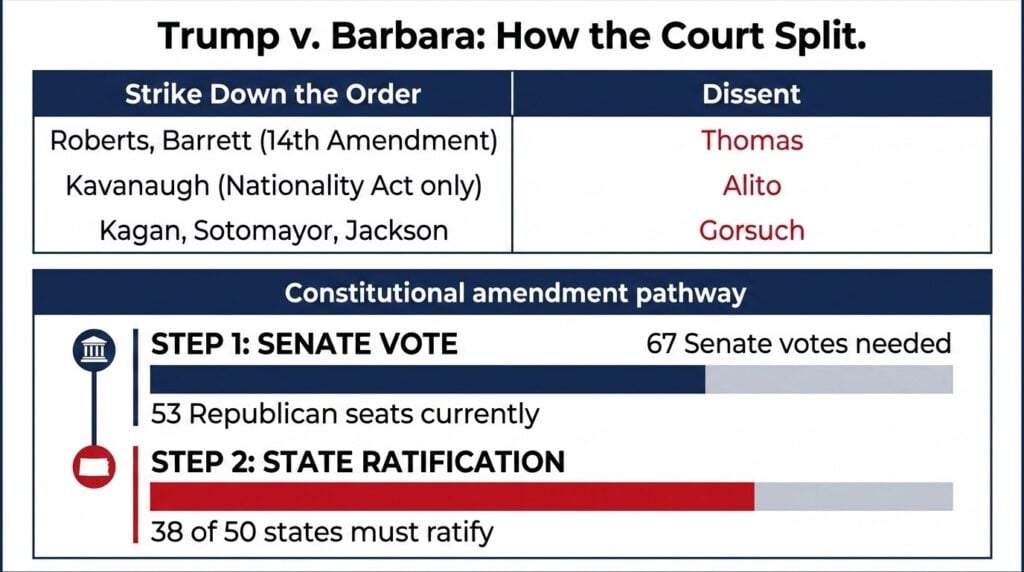
Roberts was joined in the constitutional majority by Justice Amy Coney Barrett, a Trump appointee, along with Justices Elena Kagan, Sonia Sotomayor, and Ketanji Brown Jackson. That is five justices who found Trump’s executive order unconstitutional under the 14th Amendment itself.
Justice Brett Kavanaugh, also a Trump appointee, voted to strike down the order on different grounds. Kavanaugh said the order violated the Immigration and Nationality Act of 1952 (INA § 1401(a)), the federal statute that codified birthright citizenship, but he declined to join the constitutional holding. That made the final tally 6-3 in result, but 5-1-3 in reasoning.
Justices Clarence Thomas, Samuel Alito, and Neil Gorsuch dissented. Alito called it “a serious mistake” and described it as one of the most important decisions in the court’s history. Thomas wrote a 91-page dissent arguing that the majority had “devalued” citizenship as the framers of the 14th Amendment understood it.
It was not the only major ruling Roberts handed down on June 30: earlier the same day, the court let Trump fire agency officials at will, handing the White House a significant executive power win. The birthright ruling shows the same Roberts court drawing a firm line at the Constitution’s text.
What Would Trump’s Executive Order Have Done?
President Donald Trump signed Executive Order 14160 on January 20, 2025, hours after taking the oath of office. It directed federal agencies to stop issuing citizenship documents, including Social Security numbers, to children born in the United States if neither parent was a citizen or lawful permanent resident. The Migration Policy Institute estimated the order would have affected approximately 255,000 children born annually. Under the order, a U.S. birth certificate alone would no longer have been sufficient proof of citizenship.
Every district court judge who reviewed Executive Order 14160 blocked it. Two federal appellate circuits upheld those injunctions. The Supreme Court is now the last stop, and it has ruled.
Can Congress Pass Legislation to End Birthright Citizenship?
Trump posted on Truth Social shortly after the ruling: “The Supreme Court upheld Birthright Citizenship, which is too bad for our Country. But we can easily make it up in Congress through Legislation, with the support of the President, that has now been determined during this process. No long and unwieldy Constitutional Amendment is necessary! Congress should start TODAY to work on ending expensive and unfair to our Country, Birthright Citizenship. They will have my Complete and Total Support!”
That claim does not hold up against the text of the ruling. Five justices in the majority rested their decision on the 14th Amendment, not on the INA. The Cato Institute’s Thomas Berry stated the problem plainly: no act of Congress can override a constitutional ruling. “The majority opinion explicitly rested its decision on the Fourteenth Amendment rather than on the narrower grounds of the citizenship statute,” Berry said. “The only way to limit birthright citizenship going forward would be by constitutional amendment.”
Kavanaugh’s statutory concurrence is the narrow exception. He found that the executive order violated the INA § 1401(a), not the Constitution itself, which leaves open the theoretical possibility that Congress could rewrite the statute. But as Berry and other legal scholars noted, any such legislation would face immediate constitutional challenge and return to a Supreme Court that has now explicitly ruled on the 14th Amendment question.
Trump’s claim that ordinary legislation can override this ruling contradicts the majority opinion directly. Five justices ruled on constitutional grounds. No statute overrides a constitutional holding.
Why Did Conservatives on the Court Split?
The ruling exposed a documented fracture within the court’s conservative bloc. Roberts and Barrett sided with the three liberal justices on the constitutional holding. Thomas, Alito, and Gorsuch dissented. Kavanaugh occupied a middle position that blocked the executive order but left the constitutional question open from his perspective.
For conservative observers tracking the court’s alignment, this result was notable. White House Deputy Chief of Staff Stephen Miller called the decision “one of the most destructive and outrageous decisions in the long history of the Supreme Court.” Heritage Foundation President Kevin Roberts called it “a tremendous betrayal” of the republic, adding that “the Justices in the majority have inflamed the all-out assault on our sovereignty and cheapened the sacred value of American citizenship.”
Ben Shapiro called it “a legal abomination,” adding: “It’s just more evidence that Congress and multiple presidents, in abdicating their duty on immigration for decades, have screwed America irredeemably.” Matt Walsh said on X that Barrett was a “terrible pick,” questioning whether Republican presidents have ever successfully seated a reliably conservative justice.
The Roberts and Barrett votes represent a direct break from the conservative bloc on one of Trump’s signature Day 1 priorities, and the conservative movement’s reaction made that fracture public immediately.
That frustration extends to the federal courts more broadly. A federal judge blocked proof of citizenship requirements for voter registration just five days before Tuesday’s ruling, and illegal border crossings have hit a 55-year low under Trump’s enforcement push. The judiciary continues to be the wall the administration runs into most consistently on immigration.
What Does a Constitutional Amendment Actually Require?
Several Republican lawmakers announced within hours of the ruling that they would pursue a constitutional amendment. Sen. Eric Schmitt of Missouri filed one on June 30, framing it around Trump’s executive order language. He said: “If we can’t fix it with ordinary legislation, then we must do what the Constitution commands in moments of national crisis: We must amend the Constitution.” Sen. Rand Paul had already introduced a separate proposal earlier this year. Sen. Ted Cruz, Sen. Katie Britt, and others called for congressional action.
A constitutional amendment requires approval by two-thirds of both the House and Senate, then ratification by three-fourths of state legislatures: 38 of 50 states. Republicans currently hold 53 Senate seats. Passing a constitutional amendment through the Senate alone would require 67 votes, meaning 14 Democratic senators would need to vote yes. There is no credible path to that number in the current Senate.
Speaker of the House Mike Johnson said he was “very disappointed” and that Congress would “do everything that is possible.” He acknowledged he did not know what that remedy looked like or what the timeline would be.
The fight over birthright citizenship continues in the political arena. It is settled in the constitutional one. Roberts made sure of that. However, the constitutional amendment pathway will require 67 Senate votes. Republicans hold 53. The math doesn’t currently exist.
Frequently Asked Questions
What did the Supreme Court rule about birthright citizenship?
The Supreme Court ruled 6-3 in Trump v. Barbara on June 30, 2026 that children born in the U.S. to undocumented or temporary-visa parents are citizens under the 14th Amendment. Chief Justice John Roberts wrote the majority opinion. Trump’s executive order is permanently struck down.
Can Congress pass a law to end birthright citizenship?
No. Five justices in the majority grounded the ruling in the 14th Amendment itself. No act of Congress can override a constitutional holding. Only a constitutional amendment requiring two-thirds of both chambers and ratification by 38 states could change the rule. Republicans currently hold 53 Senate seats, far short of the 67 needed.
Who were the dissenting justices in Trump v. Barbara?
Justices Clarence Thomas, Samuel Alito, and Neil Gorsuch dissented. Thomas wrote a 91-page dissent. Alito called it one of the most important decisions in the court’s history. Justice Kavanaugh concurred in the result but on statutory rather than constitutional grounds, citing the Immigration and Nationality Act of 1952.
What was Trump’s executive order on birthright citizenship?
Signed January 20, 2025, Executive Order 14160 directed federal agencies to stop issuing citizenship documents to children born in the U.S. if neither parent was a citizen or lawful permanent resident. The Migration Policy Institute estimated it would have affected approximately 255,000 children born annually. Every court that reviewed it blocked it before the Supreme Court’s ruling made that block permanent.