
President Trump signed the Schedule F Order Wednesday afternoon, stripping civil service protections from 8,000 senior federal workers and converting their roles to at-will status. The order finalizes a campaign promise Trump made on the day he returned to office, and it advances the workforce restructuring that has defined his second term.
Three federal worker protections fall under Schedule Policy/Career
Workers reclassified into Schedule Policy/Career lose the right to challenge a firing before the Merit Systems Protection Board, see their whistleblower complaints routed to their own agency rather than the Office of Special Counsel, and can be removed without cause. That last standard, removal without cause, is the same one that applies to political appointees.
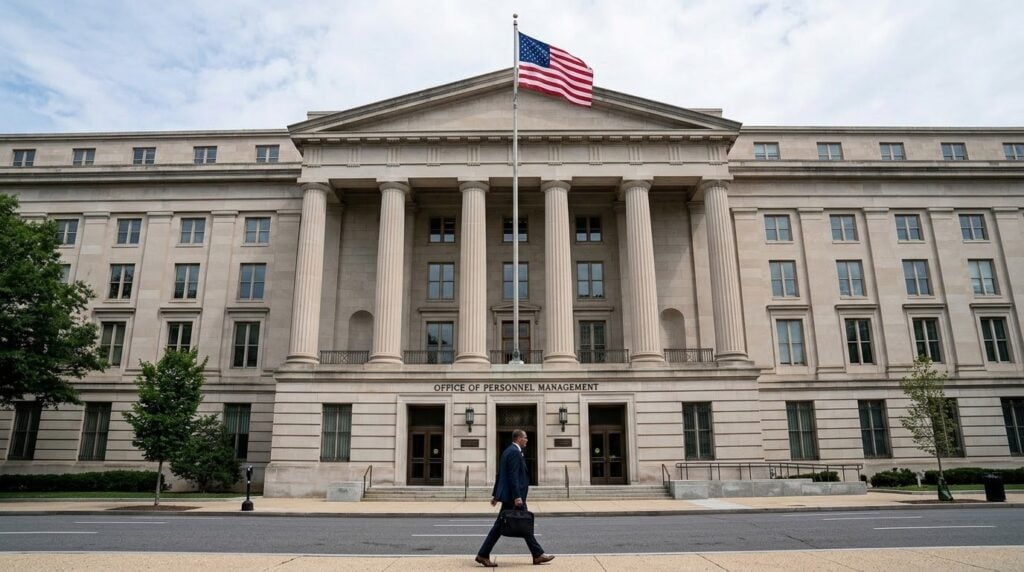
OPM Director Scott Kupor confirmed the affected number on Wednesday’s press call. Of the original 50,000 positions OPM had projected could be reclassified, the administration chose to focus on the most senior career policy officials. Around 97 percent of the 8,000 affected positions hold GS-15 or senior leader rank, the highest tier of career civil service, with some earning up to $200,000 annually.
Senior policy positions are the first targets under the Schedule F Order
OPM confirmed 8,000 positions in Wednesday’s order, with 97 percent at GS-15 or senior leader rank. The covered roles include agency office and division heads, chief information officers, regional officers and their chiefs of staff, program managers, attorneys involved in writing federal regulations, senior public affairs officers, and officials overseeing federal spending and grants.
These are not rank-and-file workers. They are the layer immediately below political appointees, the layer that translates White House policy into agency action.
Kupor framed the change as a structural correction. “This is very much about accountability,” he said on the Wednesday call. “It’s also about a restoration, in our mind, of the democratic process.”
Six years of legal maneuvering preceded the Schedule F Order signing
OPM published its final rule on February 6, 2026, and Wednesday’s signing is the last step before agency conversions can begin. Trump first created Schedule F in October 2020, in the final months of his first term. The original order went largely unimplemented. President Biden revoked it on his first day in office. In 2024, the Biden administration finalized regulations designed to block any future president from reviving the category.
On January 20, 2025, his first day back in office, Trump signed an executive order rescinding the Biden regulations and restarting the process. The OPM rule took effect on March 9. Wednesday’s signing is the formal designation of which positions get converted and when conversions can begin.
That timeline matters because the courts are already involved. A coalition of federal worker unions and good-government groups, led by Democracy Forward, has filed multiple lawsuits to block the reclassification. The administration relied on a presidential power to nullify the Biden-era regulations, a legal theory that has not yet been tested in court.
The administration says the rule is not about loyalty
American Federation of Government Employees president Everett Kelley, who represents roughly 800,000 federal workers, called the order “a blatant attempt to corrupt the federal government by eliminating employees’ due process rights so they can be fired for political reasons.”
OPM has stated publicly that Schedule Policy/Career will not be used for loyalty tests. The order itself includes language stating that federal workers cannot be removed for failure to support a particular political party or president. Whistleblower protections, the administration says, remain in place even though the appeal route has changed.
Federal worker unions are not reassured. Kelley’s statement followed the Wednesday signing within hours.
Agency conversion lists come next, and so do the lawsuits
Kupor told reporters Wednesday that the administration has not ruled out expanding the pool beyond 8,000 at a later time. Agencies must now finalize the lists of positions they have designated for conversion. Workers who receive notice of reclassification will see an erosion of their workplace protections starting immediately, including the loss of recruitment, retention, and relocation incentives.
They will also lose eligibility for the Presidential Rank Awards, the highest honor available to career federal employees. The 50,000 figure OPM originally projected may not be the final number.
Frequently Asked Questions
What is the Schedule F Order President Trump signed?
Trump signed the Schedule F Order on Wednesday, June 3, 2026. The order formally activates Schedule Policy/Career, a federal employment category that reclassifies senior policy-influencing workers from protected civil service status to at-will status. Workers under the new classification can be fired without cause.
How many federal workers are affected by Schedule F?
OPM confirmed 8,000 federal positions are reclassified under Wednesday’s order. The agency originally estimated up to 50,000 workers could eventually be moved into the category. Around 97 percent of affected employees hold GS-15 or senior leader rank.
What protections do federal workers lose under Schedule Policy/Career?
Reclassified workers lose three protections at once. They can no longer challenge terminations before the Merit Systems Protection Board. Their whistleblower complaints go to their own agency for review rather than the Office of Special Counsel. They can also be removed without cause, the same legal standard that governs political appointees.
Can federal workers sue to stop Schedule F?
Yes. A coalition led by Democracy Forward has filed multiple lawsuits challenging the reclassification. The cases are moving through federal courts. The legal theory the administration used to rescind Biden-era regulations has not yet been tested by a judge.
Who is OPM Director Scott Kupor?
Scott Kupor directs the Office of Personnel Management under the second Trump administration. He announced Schedule F conversion details on a press call Wednesday. Kupor described the order as restoring democratic accountability and stated that loyalty tests will not be used.