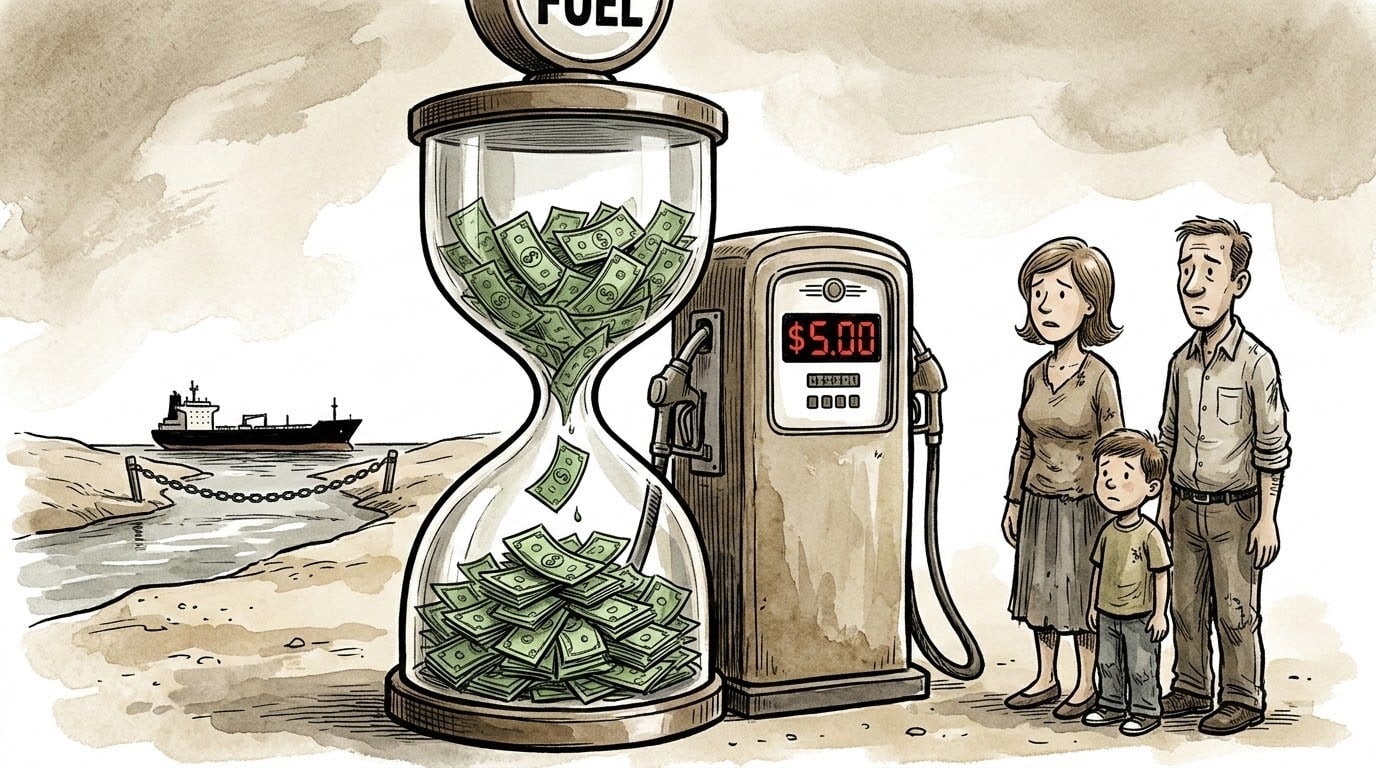

QUICK SUMMARY: GasBuddy’s Patrick De Haan says $5 gas by Memorial Day is possible if the Strait of Hormuz stays closed. The national average hit $4.45 on May 3; diesel sat at $5.64. For a two-car household, that runs about $165 more per month at the pump.
Patrick De Haan, head of petroleum analysis at GasBuddy, told Sherwood News on April 30 that $5 gas is possible by Memorial Day if the Strait of Hormuz remains closed. He did not declare its certainty. He said it’s the next stop on a curve that has run nearly straight up since the war with Iran started on February 28.
The condition is the entire story. Roughly 20 percent of the world’s seaborne oil and refined products move through that strait. It has been effectively closed since early March. Refiners have shifted capacity toward diesel and jet fuel because of shortages in Europe and Asia, which has tightened motor-gasoline supply at the same time. Even when the war ends, ship traffic does not return overnight and refiners need time to rebalance. Most forecasters do not see meaningful relief until the winter-blend transition around November 1.
Cross-verification holds. Prediction market Kalshi is pricing 52 percent odds that gas tops $5 a gallon at some point in 2026, and Citigroup analysts told clients that international Brent crude could hit $150 a barrel if the Strait remains closed through the end of June. The AAA daily national average sat at $4.45 on May 3, up roughly $1.47 since the war started.
What the forecast does not say is that $5 gas is guaranteed by May 25. What it says is that the supply pressure is real, the chokepoint is still closed, and the math from $4.45 to $5 is one bad week of headlines.
What Does $5 Gas Cost a Two-Car Household Per Month?
A two-car household covering 24,000 miles a year at 25 miles per gallon burns about 960 gallons. At $5 a gallon, that is $4,800 in annual fuel. At $2.93 a gallon, the AAA national average the day before the war started, it was about $2,800. The gap is roughly $2,000 a year, or $165 more every month.
For a single-driver pre-retiree covering 12,000 miles, the same math runs about $80 a month higher than pre-war. That is close to one week of groceries in many households.
A 70-year-old art teacher in Charlotte, Michigan, told Reuters last month that the squeeze is not just at the pump. “It’s gas. It’s grocery prices, it’s healthcare costs.”
That compounding is the second wave, and the freight number is where to watch it.
Why is Diesel at $5.64 the Number That Drives Grocery Prices?
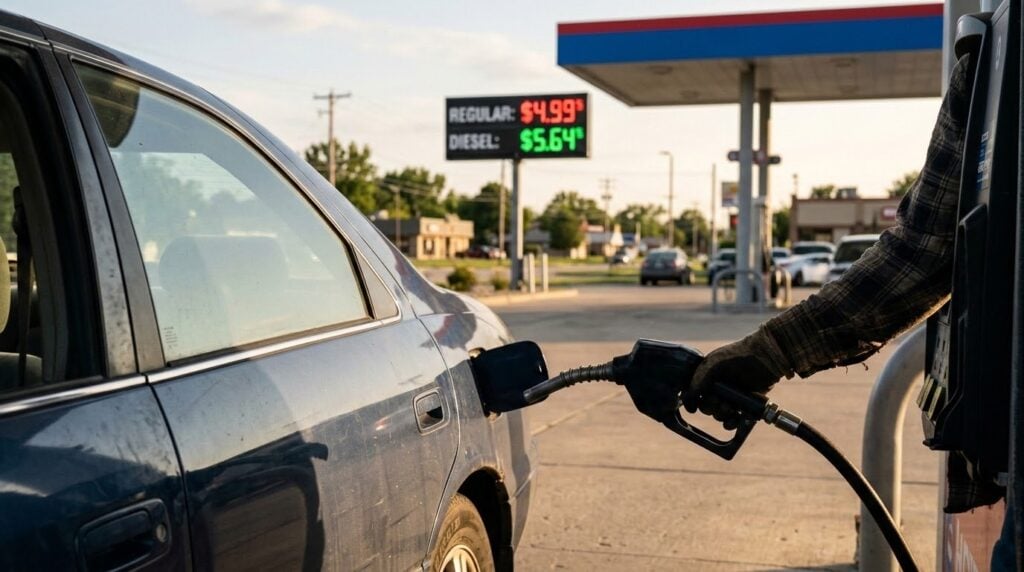
Diesel currently sits at $5.64 a gallon, up about $2.09 from a year ago. That is the price tag on the fuel that runs trucks, tractors, and the long-haul logistics behind your grocery aisle. When diesel prices rise, the cost of bringing food and goods to the store rises with them. The pump is the headline. The grocery aisle is the lag.
A Numerator survey of more than 1,000 drivers, released May 1, found that 73% of drivers said they were spending less on things like dining out, traveling, and entertainment, and a quarter of those drivers said they were also cutting back on everyday items, including groceries and household goods. That behavior change is already in the data, and it shows up in the same households now watching their retirement purchasing power move with the same inflation print.
Which Officials Are Behind the Iran Blockade?
President Trump ordered the blockade of Iranian ports on February 28 and reaffirmed last week that he wants it kept in place. Adm. Brad Cooper, the U.S. Central Command commander, said in a Wednesday statement that 41 tankers carrying 69 million barrels of Iranian oil are sitting unsold under enforcement.
The administration’s own messaging on when prices come down has shifted three times in three weeks. Energy Secretary Chris Wright told CNN in mid-April that sub-$3 gas might not arrive until 2027. Within days, he walked it back, saying summer was an “aggressive” time frame. Treasury Secretary Scott Bessent then moved the goalpost to “sometime between June 20 and September 20.” President Trump publicly contradicted his own energy secretary, calling the 2027 number “totally wrong.”
That gap between the AAA print on Saturday and the Washington messaging on any given Monday is the documented record. It is also why the GasBuddy forecast carries weight that the official numbers do not. Prior BNA coverage of the Iran blockade and its pump-price cascade tracks how this gap has widened week over week.
What Should Drivers Watch Before May 25?
Three things are worth tracking between now and Memorial Day.
First, Strait of Hormuz traffic. Vessel transit data is publicly trackable, and any meaningful return of tanker movement is the leading indicator that the supply pressure is easing.
Second, the EIA’s weekly retail gas print. The next release lands May 5. That is the official survey number, and it will tell you whether the Saturday spike has held or rolled back.
Third, the summer-blend transition. It is already in effect at most stations, and it adds roughly 10 to 30 cents a gallon, depending on the region. Industry analysts have said relief is unlikely until the November switch back to winter blend. If you are planning a Memorial Day road trip, the math you do this week is the math you live with through Labor Day.
$5 gas is not a guarantee. It’s the named forecast, under the named condition, from the analyst who tracks this market for a living. The condition is what to watch.
If you keep a can in the garage for the mower or the generator, this is the week to fill it. Today’s $4.45 covers the same fuel you’ll burn in three weeks at $5. The can below is the one we recommend: CARB-compliant, fast-pour, auto-stop nozzle.

- Thumb button control for precise pouring
- 7/8-inch funnel spout fills even the smallest equipment
- Attached dust cover keeps your spout clean
- Integrated 20 mesh stainless steel screen
- The nozzle automatically stops the fuel flow when the target tank is full, preventing overfilling
Frequently Asked Questions
Will gas really hit $5 a gallon by Memorial Day?
GasBuddy’s Patrick De Haan says it is possible if the Strait of Hormuz remains closed. The national average sat at $4.45 on May 3, 2026, per AAA. The forecast is conditional, not guaranteed.
Why are diesel prices higher than regular gas right now?
Diesel and gasoline come from the same crude oil but in fixed proportions per refining run. With Europe and Asia paying premium prices for diesel and jet fuel, U.S. refiners are exporting more of their diesel output overseas. That pulls supply out of the domestic market and pushes prices up faster than gas. Diesel also carries higher federal taxes and costs more to refine, which is why it sits 50 cents above the gas average even when crude is steady.
Will gas prices come down quickly if the Iran war ends?
Industry analysts including GasBuddy say no. Strait of Hormuz traffic does not return overnight, summer-blend pricing is already in effect, and refiners need time to rebalance to gasoline. Most forecasters do not see meaningful relief until the November winter-blend transition.
What does $5 gas mean for someone on a fixed income?
For a single driver covering 12,000 miles a year at 25 miles per gallon, $5 gas adds roughly $80 per month versus the pre-war pump price. That is close to one week of groceries for many households. The 2027 Social Security cost-of-living adjustment is partially tied to this inflation, which one independent analyst now estimates about 2 percentage points higher than her January forecast.
When will gas prices fall back below $4 a gallon?
Industry analysts including GasBuddy do not expect meaningful relief until the November winter-blend transition. Even if the Strait of Hormuz reopens before Memorial Day, tanker traffic, refiner rebalancing, and summer-blend pricing all delay pump-level recovery.