
QUICK SUMMARY: US national debt held by the public reached $31.27 trillion in March 2026, hitting 100.2% of GDP — the first crossover since 1946. Annual interest now tops defense spending. With Social Security trust fund depletion projected for 2032, the squeeze on retiree benefits has shifted from a future risk to a near-term reality.
Listen up: the country now owes more money than it makes. That is what the federal government’s own numbers said on Thursday, and the math affects every American counting on a Social Security check, a Medicare card, or a fixed retirement income.
The Bureau of Economic Analysis confirmed that debt held by the public reached $31.27 trillion at the end of March. The entire US economy over the same twelve months was $31.22 trillion. That puts the debt-to-economy ratio at 100.2 percent. The last time the country reached this point, the year was 1946 and the United States had just finished paying for World War II.
This time, no war explains it. There were thirty years of spending choices that no administration was willing to reverse.
Why Did the US National Debt Cross 100% of GDP Now?
The single biggest pressure point sits one layer below the headline number: interest payments now exceed the entire defense budget. The Committee for a Responsible Federal Budget tracks the federal debt the way an accountant tracks a household ledger. Their president, Maya MacGuineas, said in a statement Thursday that the national debt is now larger than the US economy. She called the cause a bipartisan abdication that has been building for decades.
The single most important fact for working Americans is buried under the trillion-dollar headline numbers. The country now pays more than $1 trillion a year just in interest on what it has already borrowed. That is more than the entire defense budget. Every dollar going to bondholders is a dollar that cannot go to Social Security, Medicare, the VA, or anything else that touches an American household. The interest cost works out to roughly $14,700 a year per American household before a single dollar pays for any actual program.
Almost three out of every four federal dollars is already promised before Congress votes on anything. Social Security, Medicare, Medicaid, interest payments, and other mandatory programs run on autopilot. The fights you see in Washington over government shutdowns are fights over the remaining quarter.
How Did Three Decades of Spending Get Us to More Than 100%?
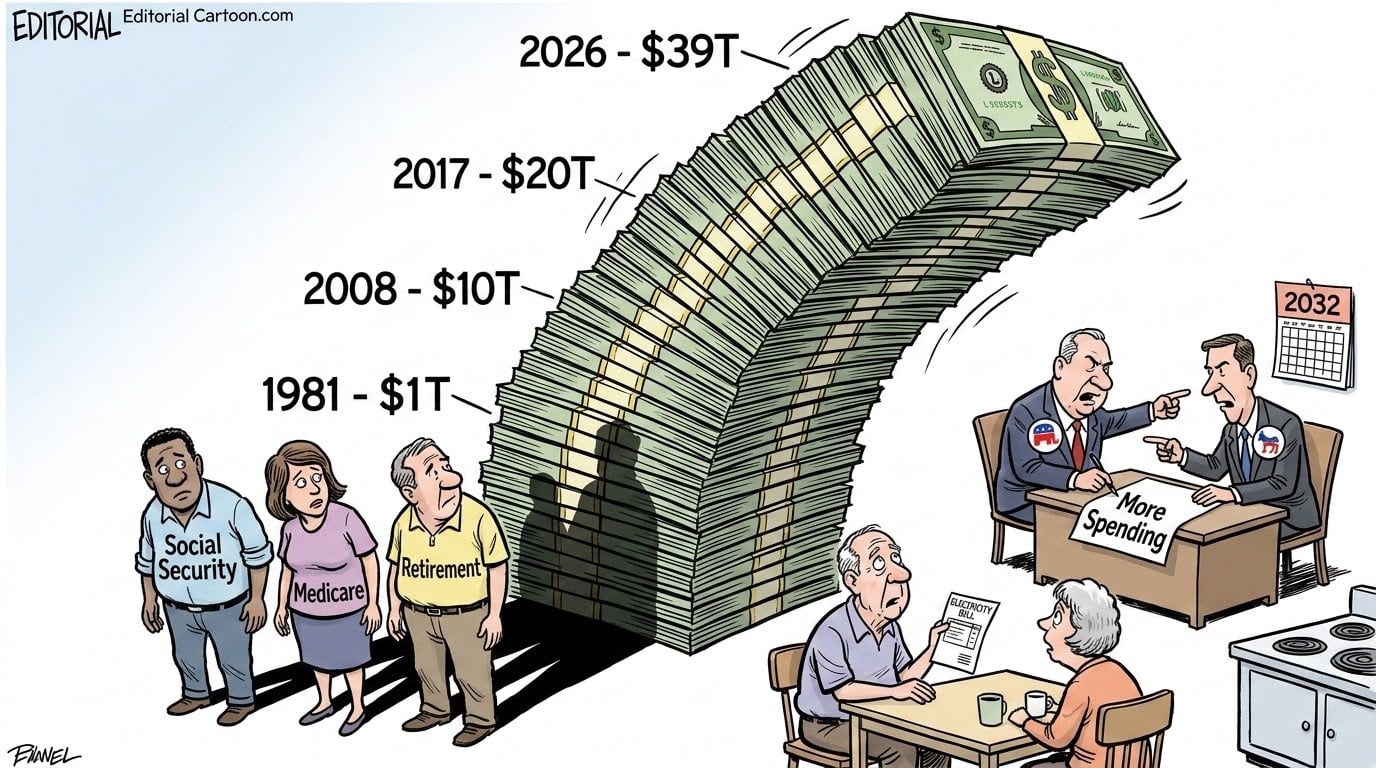
Three Republican administrations and two Democratic administrations contributed to the climb, and the bill from all of them is now arriving at the same time. The debt crossed $1 trillion in 1981. It hit $10 trillion in 2008. It reached $20 trillion in 2017. As of March, it stands at over $39 trillion when intragovernmental obligations are included. That works out to roughly $289,000 per American household, according to the Senate Joint Economic Committee.
Voters in Trump-supporting districts have been saying so out loud. A Texas voter named Chad told Fox News last year: “It’s like running up a credit card.”
The most recent named decisions made the trajectory steeper. The One Big Beautiful Bill Act, signed in July 2025, is projected by the Congressional Budget Office to add $2.4 trillion to deficits over ten years. President Trump’s fiscal year 2027 budget proposal, released in early April, increases defense spending by more than 40 percent and leaves the debt-to-economy ratio above 100 percent throughout the forecast window. The Senate adopted a budget resolution last week that, in CRFB’s assessment, came about a year too late and contains no plan to address the structural problem.
What Does the US National Debt Mean for Your Retirement?

If you are between 55 and 67, the math now lands inside your retirement window. CBO projects debt at 108 percent of the economy by 2030 and 120 percent by 2036. That second number lands inside the retirement window of every American currently between those ages.
Three things are exposed.
- First, the Social Security trust fund. Federal trustees already project depletion around 2032. By law, when the fund runs out, scheduled benefits face an across-the-board cut of roughly 23 percent unless Congress acts. The 100 percent debt milestone makes the political path to acting harder, not easier.
- Second, Medicare. Federal health spending grows from $1.9 trillion to $3.1 trillion by 2036 under current law. As interest payments crowd out the budget, pressure on Medicare premiums and cost-sharing follows.
- Third, the cost-of-living adjustment that is supposed to protect retirees from inflation. The 2025 COLA was 2.5 percent. Residential electricity rose 9.5 percent over the same period. The gap between what retirees actually pay and what their COLA covers is already widening, and the structural debt problem makes closing it harder.
What Should You Watch Between Now and 2032?
The watchlist for working Americans is shorter than the headlines suggest. The Peterson Foundation projects the gross debt will hit $40 trillion before this fall’s midterms. CBO projects the country will break the all-time WWII record of 106 percent by 2030. The Social Security trust fund clock runs out in 2032.
The country reached 100 percent of GDP because every administration in three decades made it easier to add to the debt than to address it. The bill is now arriving during the years today’s pre-retirees were planning to spend at the kitchen table, not at work.
Watch the FY27 budget. Watch the debt limit fight. Watch the 2032 date.
Frequently Asked Questions
When did the US national debt cross 100 percent of GDP?
The Bureau of Economic Analysis confirmed Thursday that debt held by the public reached 100.2 percent of GDP at the end of March 2026. Debt held by the public was $31.27 trillion against a 12-month GDP of $31.22 trillion. The previous time the ratio crossed 100 percent was in 1946, immediately after World War II.
How much does the federal government now pay in interest on the national debt?
Net interest on the federal debt has crossed $1 trillion in fiscal year 2026, according to CBO. That number now exceeds total US defense spending for the first time in modern history. It is the third-largest line item in the entire federal budget, behind only Social Security and Medicare.
Will the national debt force cuts to Social Security or Medicare?
The Social Security trust fund is already projected by federal trustees to deplete around 2032. By law, when the trust fund runs out, scheduled benefits face an automatic 23 percent reduction across the board unless Congress acts. The 100 percent debt milestone does not directly cut benefits, but it narrows the political and fiscal room available to prevent the 2032 cuts.
Why is the national debt rising even with high tariff revenue and tax collections?
Three structural reasons. First, mandatory spending on Social Security, Medicare, and Medicaid grows automatically as the population ages. Second, interest costs on the existing debt rise as rates stay elevated. Third, recent legislation including the One Big Beautiful Bill Act and the FY27 budget proposal added new spending and tax cuts faster than tariff revenue and growth could offset.