
The Department of Government Efficiency pushed about 7,500 employees out of the Social Security Administration, roughly 13 percent of its staff and the largest one-year cut in the agency’s history. President Donald Trump’s administration says the agency is now faster than ever. Watchdog data and a federal court record tell a more complicated story, including a data breach still in active litigation. DOGE itself stopped operating as a central body in November 2025, eight months early, with its work absorbed into other offices. That leaves a simple question with no clean answer: who cleans this up? More importantly, did the DOGE social security cuts amount to anything?
The DOGE Social Security Cuts Landed Hardest Here
No agency felt DOGE more than the one that touches almost every American eventually. According to the Center on Budget and Policy Priorities, the Social Security Administration shed more than 8,000 workers in 15 months, a 14 percent cut, leaving it with fewer employees than at any point since 1967. Back then the agency served 52 million fewer people and had not yet taken on the Supplemental Security Income program.
The losses hit where you feel them. That analysis of federal personnel data found 42 states and the District of Columbia each lost more than 10 percent of their Social Security staff. The agency also thinned the ranks of the judges who hear disability appeals, and it stopped publishing the monthly numbers that would let any of us check the damage for ourselves. It even skipped its May 2026 performance update.
Did the DOGE Social Security Cuts Promise Efficiency But Deliver Understaffing?
Here is the part the word “efficiency” was built to hide. Your benefit amount is set by law. Cutting staff does not shrink your check. It shrinks your ability to reach a human being to claim it.
That matters because running Social Security is already cheap. Administrative costs come to about 0.5 percent of what the program spends. The other 99.5 percent goes out as benefits. So when you cut the people, you are not trimming fat off the check. You are putting a longer line between you and the money you already paid for.
Keep one thing straight here. This is a different problem from the one you usually hear about. Social Security’s trust fund is projected to run short around 2032, and federal debt costs are climbing toward the top of the budget. Those are about whether the money is there. This is about whether you can reach anyone to get the money you are owed.
The administration sees it differently, and its case deserves a hearing. Commissioner Frank Bisignano, who now also runs the IRS, told a House hearing on June 10 that the agency is delivering its best service ever. He said the average wait to answer the national 800 number dropped to under five minutes in May, down from a high of 42 minutes, that field office wait times fell, and that the disability backlog is down by roughly a third. He insists, in his words, that “exactly zero field offices closed.”
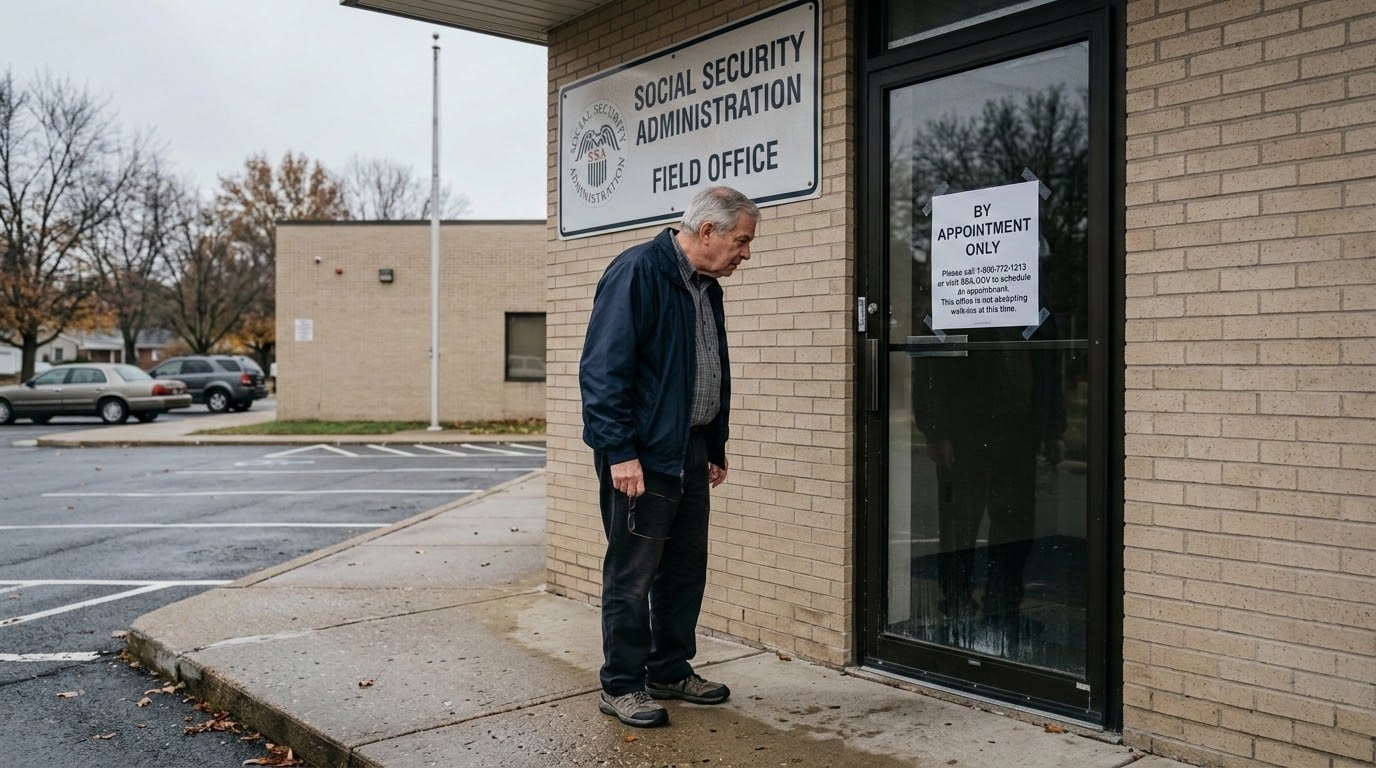
The watchdog numbers complicate that story. The agency’s own inspector general found that callers who accepted a “callback” waited more than 100 minutes on average in fiscal 2025, even though the headline wait looked short. At the June hearing, Democrats pressed Bisignano on exactly that gap, arguing a callback gets counted as a zero-minute wait. The plan going forward is to cut in-person field office visits by about half. If you are someone who would rather handle your benefits face to face, that is the trade being made for you.
The Data Nobody Can Fully Account For

The job cuts are not the only thing left on the books. So is your Social Security number.
In a January 16, 2026, Notice of Corrections to the Record, the government admitted it had given the court inaccurate information about what DOGE could see at the agency. The corrected record showed DOGE had broader access than disclosed, that sensitive data was moved onto a server outside the agency’s control, and that access continued even after a court restricted it. The filing also revealed a DOGE team member had signed a “Voter Data Agreement” with an outside political group in March 2025, a disclosure that drew Hatch Act referrals.
The fight over that data is not settled. The Supreme Court let DOGE keep access in mid-2025. On April 10, 2026, the full Fourth Circuit vacated an injunction that had limited access, sending the case back down. Days later, on April 14, the district court in Maryland lifted its pause and let the plaintiffs begin discovery, a coalition of unions and retiree groups. One appeals judge wrote that the corrected facts looked far worse than the court had been told. A separate, contested whistleblower declaration in June 2026 alleged a plan to mark living immigrants as “dead” in agency records to pressure them to self-deport. Bisignano flatly denied the agency has done any such thing.
If your data sat inside that system, you cannot unring the bell. What you can do is lock down the parts still in your control. A credit freeze is free, and identity-protection monitoring watches the accounts that a leaked Social Security number is most likely to be used against.
Who is Accountable Now?
This is where it gets slippery. Ask who answers for all of this, and the answer keeps moving.
In November 2025, the head of the Office of Personnel Management, Scott Kupor, told Reuters that DOGE “doesn’t exist” anymore as a central body, and that its functions had been folded into OPM and Russ Vought’s Office of Management and Budget. The White House pushed back the same week, insisting DOGE and the U.S. DOGE Service both still operate through the July 4, 2026, sunset written into the original order. Amy Gleason remains the acting administrator. Elon Musk left in May 2025. So the group that did the cutting has, depending on who you ask, either dissolved or simply scattered into other offices where it is harder to name.
That is the accountability vacuum. The people are gone. The damage stayed. And a bill in Congress, the Reorganizing Government Act, would make this kind of fast reorganization a permanent presidential power, letting a president abolish or merge agencies on an up-or-down vote with no filibuster. It cleared a House committee on a party-line vote. It is not law yet.
A real fix is not complicated to describe. It means rehiring the front-line staff who process your claim, restoring the public wait-time numbers so the agency can be checked, accounting fully for where your data went, and naming one official who owns the repair. None of that happens on its own, and the clock on the sunset runs out July 4.
So before you vote this fall, ask your representative the one question that cuts through all of it: who is responsible for making sure my Social Security still works when I need it, and what is your plan to fix what got broken?
Frequently Asked Questions
Did DOGE cut Social Security benefits?
No. Benefit amounts are set by law, so DOGE did not shrink anyone’s check. What the staffing cuts hit is access: longer phone waits, harder-to-get appointments, and a slower path to claim what you already paid for.
How many workers did Social Security lose?
About 7,500, roughly 13 to 14 percent of staff, in a 15-month stretch. The Center on Budget and Policy Priorities calls it the largest one-year cut in the agency’s history and notes it left fewer employees than at any time since 1967.
Is DOGE still operating?
It depends who you ask. In November 2025 the head of OPM said DOGE “doesn’t exist” as a central body and that its work moved to OPM and OMB. The White House disputes that and says it runs through a July 4, 2026 sunset. Amy Gleason is still its acting administrator.
Was my Social Security data exposed?
The government admitted in a January 2026 court filing that DOGE had broader access than disclosed and that sensitive data was moved to a server outside the agency’s control. The case is in active litigation. If you are worried, a free credit freeze and identity monitoring are the practical steps.
When does the DOGE authority expire?
A sunset is written into the original order for July 4, 2026. The White House and OPM disagree on whether DOGE still operates as a central body until then, but that is the date on paper.
What would actually fix it?
Rehiring front-line staff, restoring the public wait-time reports, fully accounting for where the data went, and naming one official who owns the repair before the sunset date.