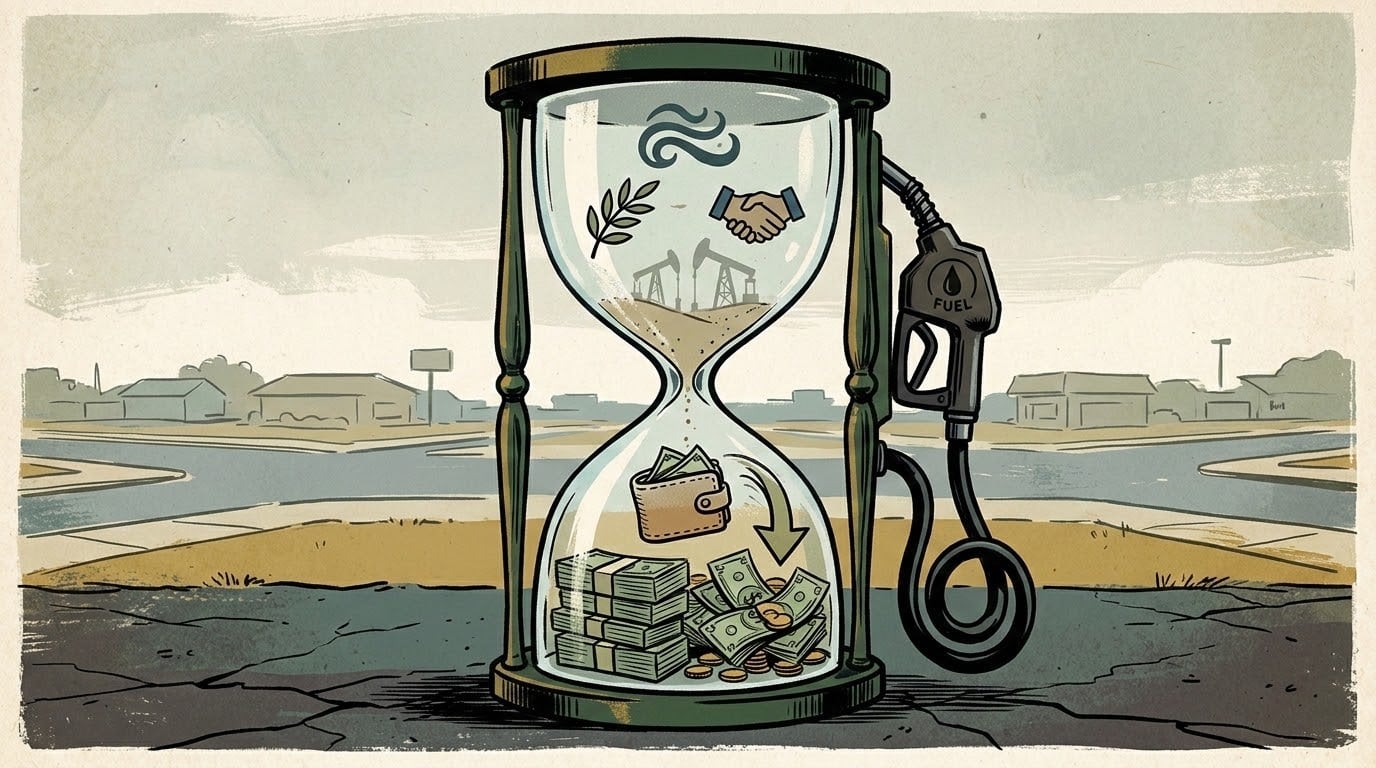

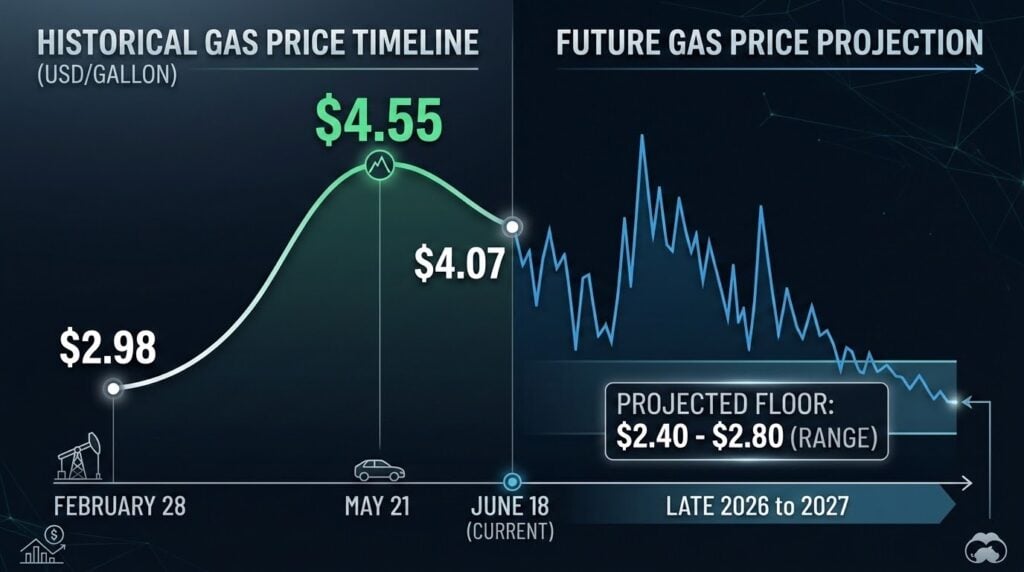
A gallon of regular gasoline costs $4.07 nationwide, $1.09 more than it did the morning of February 28, the day before the war started. The US-Iran deal is set to be signed tomorrow in Switzerland, and prices are already being sold to the public as the next thing to fall.
President Donald Trump said on Sunday that prices would “drop like a rock” once the agreement was finalized and the Strait of Hormuz reopened. He has made that promise, in different words, several times over the past three months. The U.S. Energy Information Administration, the federal government’s own energy forecasting agency, projects something different: gas prices remaining well above pre-war levels through the end of 2027.
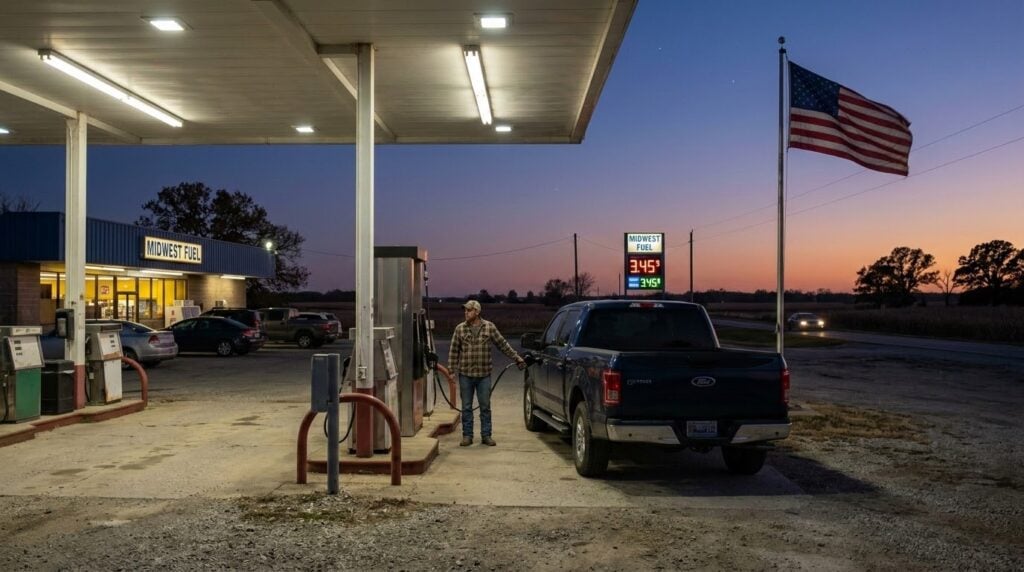
For anyone filling up three times a week, the math is not abstract. At $4.07 versus the pre-war $2.98, a 15-gallon fill costs $16.35 more than it did in February. That number does not go away when a memorandum of understanding gets signed in Switzerland.
What the US-Iran Deal Actually Covers on Gas Prices
The deal set to be signed tomorrow is a memorandum of understanding covering an end to military operations and the reopening of the Strait of Hormuz to commercial shipping. It opens a 60-day negotiation period on broader issues, including Iran’s nuclear program. It is not a comprehensive agreement and does not guarantee anything.
Denton Cinquegrana, chief oil analyst at Oil Price Information Service, a Dow Jones company, put it plainly in an interview with Newsweek: Americans “can kiss that number goodbye for the rest of 2026,” referring to the $2.98 pre-war price. He estimates it may take until the second half of 2027 for prices to return to pre-conflict levels, and that is under the assumption the deal holds.
Patrick De Haan, head of petroleum analysis at GasBuddy, was similarly measured. “The real test now shifts to the Strait of Hormuz,” he said. “Only once we start seeing confidence and ships move will prices plummet.” As of June 17, just two ships had transited the Strait in a 24-hour period, against a pre-war daily average of 60.
Three Reasons the US-Iran Deal Doesn’t Flip a Switch
Signing the agreement and actually restoring the global oil supply are two different events on two different timelines. The deal addresses the politics. Three separate structural problems, none of them solved by a signature, are what actually determine when you pay less at the pump.
1. Despite the Conclusion of the US-Iran Deal, The Strait of Hormuz Is Not Yet Open for Commercial Shipping
Mine clearance is required before commercial shipping can resume at scale. The International Energy Agency stated in its May 2026 oil market report that “following the clearance of any mines, a minimum of two to three months will likely be required to re-establish steady export operations.” Shipping and insurance companies are watching to see whether the ceasefire holds before committing vessels to a route where the threat has not fully passed. John Deal, managing director of capital markets at the Post Oak Group, said shipping capacity is “perhaps the most significant constraint” on price recovery. “My sense is that there’s going to be sustained high demand through the summertime, and we probably won’t get back to pre-war levels until after the summer, maybe September or October,” he told Al Jazeera.
2. The Infrastructure Damage Is Severe and the Repair Bill Runs Into the Tens of Billions
More than 80 energy facilities across the region have been attacked since February 28. More than a third are severely damaged, according to Fatih Birol, executive director of the International Energy Agency, who called the conflict “the greatest global energy security challenge in history” at an Atlantic Council event in Washington. Energy research firm Rystad estimates the total repair bill at a minimum of $34 billion, with full restoration of oil and gas production taking up to two years. Qatar’s LNG complex, struck by Iran in retaliation for Israeli bombing of South Pars, faces a five-year repair timeline and $20 billion in lost revenue. Israeli strikes on Iran’s South Pars gas field have curtailed condensate output by 100,000 to 120,000 barrels per day for at least the next six months, a shortfall no deal can reverse overnight.
3. The Strategic Petroleum Reserve Is at a 43-Year Low and the Borrowed Barrels Have to Go Back
The SPR fell to 340.3 million barrels this week, its lowest level since 1983, according to Department of Energy data. The Trump administration released 172 million barrels since the war began as part of a coordinated international effort to hold prices down. That release was structured as an exchange: the barrels must be returned, with a premium. Matt Smith, lead oil analyst at energy intelligence firm Kpler, explained the consequence directly: “This isn’t like a cookie jar. Those barrels have got to be put back at some point, and that will lead to higher prices.” The refill obligation does not disappear when the deal is signed. It activates once supply stabilizes, adding sustained upward pressure on prices for months after the Strait reopens.
The Stability Assumption Is the Biggest Variable
The deal is a 60-day MOU. Broader negotiations on Iran’s nuclear program continue. There is no guarantee either side holds.
Mark Jones, a professor of political science at Rice University, noted that producers are unlikely to restart full operations until they are convinced the peace is durable. “The last thing they want to do is carry out the costly effort to restart production only to see the conflict revived and then have to shut it down once again,” he told Al Jazeera.
One S&P Global analyst identified a more structural concern: “Having demonstrated it once, Iran can now credibly threaten to shut down the Strait of Hormuz in the future. Its military capabilities have been degraded but not destroyed. It would take little effort for Iran to deter shippers from resuming traffic.” The threat premium baked into oil prices because the risk of another closure now exists in a way it did not before February 28 does not disappear with a signature.
A Chicago driver captured the ground-level read on the deal when asked about gas prices outside a Skokie station this week: “I think our president is kinda selling us something that probably really can’t happen.”
What the US-Iran Deal Timeline Actually Looks Like for Your Wallet
The optimistic scenario: GasBuddy’s De Haan says prices could dip below $3.75 a gallon before July 4 if the Strait reopens promptly and ships begin moving. That would still leave prices 77 cents above pre-war levels heading into the holiday weekend.
The base case: De Haan also said it may take “many months, if not beyond a year, for global oil inventories to recover to pre-war levels.” The EIA’s official short-term outlook, based on the assumption of a third-quarter Strait reopening, projects prices remaining well above pre-war levels through the end of 2027. Summer driving demand, port bottlenecks, and the SPR restocking obligation all act as a floor, limiting how far prices fall even as crude markets ease.
The downside: Robert McNally, a veteran energy analyst, told CNN he does not believe the price story is over. He still sees Brent crude potentially returning to $120 or $130 a barrel and U.S. gas prices testing the all-time high of $5.02 set in June 2022 if the ceasefire frays or the Strait reopening stalls.
What you pay at the pump this summer sits somewhere in that range. The US-Iran deal sets a ceiling on the worst case. It does not reset the clock to February.
What Sustained Inflation at the Pump Means Beyond the Gas Station
Fuel accounts for roughly 15 to 30 percent of the total cost of food, according to the Independent Grocers Alliance. Every product that reaches a store shelf arrives on a truck. When fuel costs stay elevated for months after a war ends, that pressure works through the food supply chain with a lag. David Ortega, a professor of food economics at Michigan State University, stated that reopening the Strait is unlikely to deliver instant relief at the grocery store. The energy shock from the Iran war will take months to wind through the food supply chain.
For anyone on a fixed income or within a decade of retirement, sustained fuel-driven inflation is not a gas-station problem. It is a purchasing-power problem. Every month prices remain elevated above pre-war levels is a month where the real value of savings, pension payments, and Social Security checks covers less than it should.
If the timeline above has you rethinking how inflation eats into what you have saved, this is the plain-language starting point most financial advisors recommend before making any move into precious metals.


Affiliate disclosure: BreakingNewsAlerts.com earns a commission on purchases made through links on this page. This does not influence our editorial coverage. See our editorial standards.
Frequently Asked Questions
Will gas prices go down after the US-Iran deal is signed?
Some reduction is likely as oil markets react to the deal. The national average has already dropped from its $4.55 peak to $4.07. However, named analysts including GasBuddy, the Oil Price Information Service, and the EIA all project prices remaining well above the pre-war level of $2.98 through at least the end of 2026, and the EIA’s official forecast extends that timeline through 2027.
Why won’t the US-Iran deal bring gas prices down immediately?
Three structural factors are keeping prices up: the Strait of Hormuz requires mine clearance and weeks of confidence-building before normal shipping resumes; more than 80 energy facilities across the region have been damaged and will take months to years to repair; and the Strategic Petroleum Reserve has been drawn down to a 43-year low through an exchange program that requires the borrowed barrels to be returned, adding refill demand pressure once supply stabilizes.
How long will it take for gas prices to return to pre-war levels?
Denton Cinquegrana of Oil Price Information Service told Newsweek that Americans can expect elevated prices through the rest of 2026, with a possible return to pre-war levels in the second half of 2027. The EIA’s official short-term outlook, based on the assumption of a third-quarter Strait reopening, projects prices staying above pre-war levels through the end of 2027.
What is the Strategic Petroleum Reserve and why does it matter for gas prices?
The SPR is the federal government’s emergency crude oil stockpile, currently at 340.3 million barrels — its lowest level since 1983. The Trump administration released 172 million barrels during the Iran war as part of a coordinated international effort to hold prices down. That release was structured as an exchange, meaning the borrowed barrels must be returned at a later date. Refilling the SPR will keep demand elevated and put upward pressure on prices for months after the Strait reopens.
Could gas prices rise again even after the US-Iran deal?
Yes. The deal is a 60-day memorandum of understanding, not a comprehensive agreement. Energy analysts at S&P Global note that Iran has now demonstrated it can close the Strait of Hormuz and could credibly threaten to do so again. Robert McNally, a veteran energy analyst, told CNN he still sees a scenario where Brent crude returns to $120 to $130 a barrel and U.S. gas prices test $5 a gallon if the ceasefire frays.