
The White House transmitted President Donald Trump’s memorandum of understanding with Iran to Congress today. With that transmission, a 30-day legal clock started ticking under a federal law that gives lawmakers the power to vote it down and prohibits the administration from granting Iran sanctions relief while that review is underway. The law is the Iran Nuclear Agreement Review Act of 2015, passed with overwhelming bipartisan support specifically to prevent any president from cutting a nuclear-adjacent deal with Iran without congressional scrutiny.
The 30-day window expires July 19. The July 4 recess leaves the Senate roughly two working weeks to hold hearings, receive briefings, and force a vote if they want to stop Trump’s Iran deal. Whether any of that happens depends on one man who has not yet committed to making it happen.
Senate Armed Services Chairman Roger Wicker issued a statement Thursday saying the MoU “negotiates away the victories of Operation Epic Fury in ways that are completely out of step with the President’s goals.”
What Does INARA Actually Allow Congress to Stop Trump’s Iran deal?
INARA requires the president to transmit any nuclear-adjacent agreement with Iran to Congress within five days of reaching it, along with a package of certifications confirming the deal meets nonproliferation standards and is verifiable. That transmission happened today.
If Congress takes no action by July 19, the review period expires and the administration may proceed with Iran sanctions relief with no further legal constraint under INARA. To block that, Congress must pass a joint resolution of disapproval (stating it does not favor the agreement) by majority votes in both chambers. President Donald Trump can veto that resolution. Overriding a veto requires two-thirds majorities in both the House and Senate, a threshold Republican critics almost certainly cannot reach given current vote counts.
What the review period can do, even without a veto-proof majority, is force the administration to publicly defend the deal’s provisions under oath at congressional hearings, delay sanctions relief for the full 30 days, and create a documented record of whether the MoU meets the certifications INARA requires.
The JINSA analysis published June 17 concluded those certifications may be impossible for the administration to make in good faith, because the MoU commits to “immediate” sanctions waivers, a provision that would itself violate INARA’s prohibition on relief during the review window.
Which Republican Senators Are Opposing Trump’s Iran Deal?
The opposition within Trump’s own party is documented and named. Senate Armed Services Chairman Roger Wicker of Mississippi stated Thursday that the $300 billion reconstruction fund “would make Iran’s payoff under President Obama’s 2015 deal look like a pittance by comparison,” and that he opposes lifting any sanctions in exchange for “Iran’s mere agreement to negotiate for another 60 days.”
Sen. Bill Cassidy of Louisiana called the MoU “the worst foreign policy blunder in decades,” a post that drew more than 2.4 million views on X. Sen. Ted Cruz of Texas told reporters Thursday that Trump is receiving “some really bad advice on this deal.” Sen. John Cornyn of Texas said the $300 billion fund “is not going to be used for constructive, useful purposes.”
The opposition is not unanimous. Sen. Rand Paul of Kentucky stated he stands with Trump on peace, describing critics as “the architects of every failed intervention of my lifetime.” Sen. Lindsey Graham, after a conversation with Trump special envoy Steve Witkoff, said he believes signing the MoU “will be beneficial to the United States, in as much as the Strait of Hormuz will begin to open.” Sen. Eric Schmitt of Missouri said a congressional vote is not necessary under INARA for the current 60-day framework.
The split matters because the path to a resolution of disapproval runs through leadership. Senate Majority Leader John Thune told reporters he expects to receive an administration briefing and called the deal “good for Americans” in its goal of ending hostilities, but has not committed to scheduling a floor vote. Without Thune, the review window runs out regardless of how many senators object publicly.
What Does the Iran MoU Actually Say About Enrichment and Sanctions?
Beyond the political math, what the MoU actually commits to and what it omits is driving the opposition.
President Donald Trump described the agreement as a “major win.” Vice President JD Vance told Fox News that “not a single cent of American money goes to Iran.”
The leaked MoU text, confirmed by CNN, does not include any provision requiring Iran to halt uranium enrichment. It commits the United States to take steps to terminate all statutory sanctions against Iran and describes certain relief as “immediate.” The Strait of Hormuz main shipping route, whose reopening was the deal’s primary deliverable, still has an estimated 80 mines in place, according to Intertanko, the international tanker trade association. Ships have been routing through the narrower northern and southern passages through Iranian and Omani waters.
Wicker’s statement quoted the Iranian regime’s official position directly: “Death to America, Death to Israel.” He added that the regime “will invest every penny it receives to further that aim.”
The White House has not released the full MoU text. The administration’s legal position is that the current 60-day framework may not constitute a “nuclear agreement” under INARA’s definition, which would exempt it from the review requirement entirely. Legal analysts cited by CBS News and The Hill disagree on where that line falls. No court has ruled on the question.
What Happens to the Iran Deal Between Now and July 19?
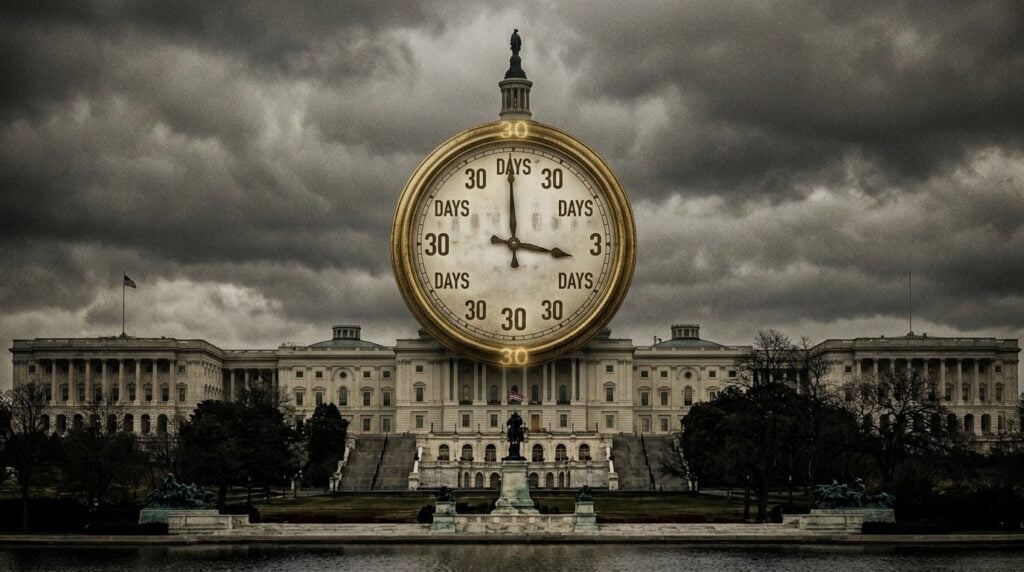
The review window gives Congress until July 19 to act. The Senate’s July 4 recess leaves roughly two working weeks for hearings and a floor vote, provided Thune schedules one.
The White House held a briefing Thursday for Senate and House foreign affairs and armed services committee leadership, including Thune and Senate Minority Leader Chuck Schumer. Schumer told reporters the 14-point MoU shows Iran “has won on just about every one” of the terms. That characterization came from the Democratic leader. Several Republicans said essentially the same thing.
For readers tracking this story since the deal was announced, the gas price picture has not changed despite the MoU signing, and the debate over the $300 billion reconstruction fund remains unresolved. The INARA window is the next institutional mechanism to watch. The Secure America Act locked $70 billion in ICE and CBP funding through 2029 without annual congressional review. The question now is whether Congress uses the review authority it has to stop Trump’s Iran deal before July 19 or lets the clock run out.
Frequently Asked Questions
What is INARA, and does it apply to Trump’s Iran deal?
The Iran Nuclear Agreement Review Act of 2015 requires the president to submit any nuclear-adjacent agreement with Iran to Congress within five days, along with certifications that the deal meets nonproliferation standards and is verifiable. Congress then has 30 days to pass a joint resolution of disapproval. During that window, no sanctions relief may be granted. Whether the current 60-day MoU qualifies as a “nuclear agreement” under INARA is disputed by the White House and legal experts. No court has ruled.
What happens if Congress votes to stop Trump’s Iran deal?
A joint resolution of disapproval requires majority votes in both the House and Senate. President Donald Trump can veto it, and overriding that veto requires two-thirds majorities in both chambers. Even without a veto override, a disapproval vote forces public hearings, delays sanctions relief by 30 days, and creates a documented record of whether the administration’s certifications hold up under scrutiny.
Which Republican senators want to stop Trump’s Iran deal?
Senate Armed Services Chairman Roger Wicker of Mississippi says the MoU “negotiates away the victories of Operation Epic Fury.” Sen. Bill Cassidy of Louisiana called it “the worst foreign policy blunder in decades.” Sen. Ted Cruz of Texas says Trump is getting “some really bad advice.” Sen. John Cornyn of Texas opposes the $300 billion reconstruction fund. Sens. Rand Paul and Lindsey Graham have expressed support for the deal. Sen. Eric Schmitt says a congressional vote is not necessary.
Can Trump grant Iran sanctions relief before Congress reviews the deal?
Not legally during the INARA review window. The law prohibits sanctions waivers from the moment of transmission through the end of the 30-day review period. The JINSA analysis found that the MoU’s language committing to “immediate” sanctions relief may itself constitute a violation of this prohibition. If Congress takes no action by July 19, the prohibition lifts and the administration may proceed.
What does the Iran deal actually say about the nuclear program?
The leaked MoU text, confirmed by CNN, does not include a provision requiring Iran to halt uranium enrichment. It commits both sides to a 60-day negotiation period on Iran’s nuclear activities and U.S. sanctions. Iran’s enriched uranium stockpile and future enrichment levels are described as subjects for future talks, not conditions of the current agreement.