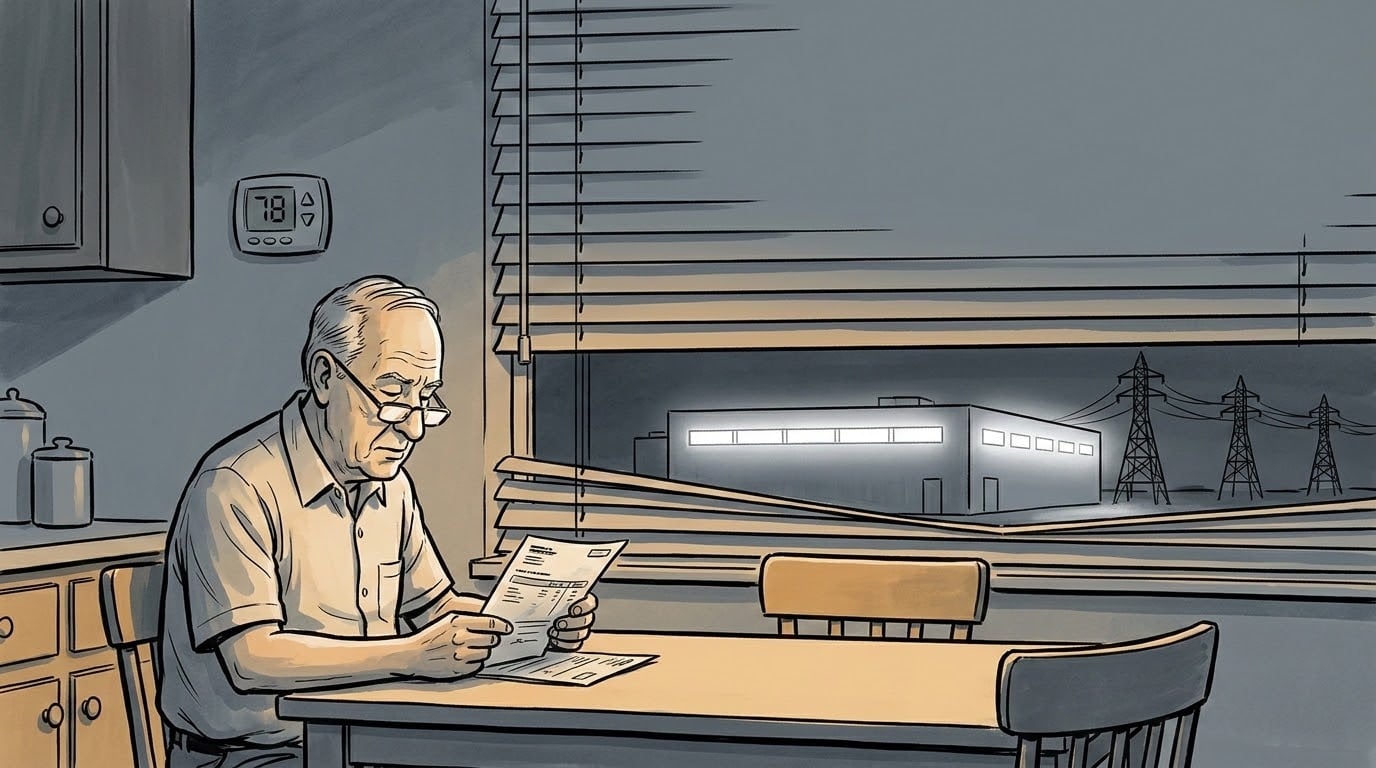

Between 2022 and 2024, utility companies started more than 150 local transmission projects across Illinois, Maryland, New Jersey, Ohio, Pennsylvania, Virginia, and West Virginia. Those projects were needed only to connect data centers.
Last year, $4.3 billion in transmission expansion costs were passed on to consumers in seven of those states.
Nobody asked you. Nobody had to. The analysis found that regulatory cost reviews are practically nonexistent for these transmission-level facilities.
That is how data center electricity costs reach an American who has never seen a server rack in his life.
Who Actually Pays for Data Center Electricity Costs?
Long story short: You pay for the grid. The data centers pay for the electricity.
Start with the capacity market. It is a forward auction that seeks to ensure there is enough power plant capacity on the system to meet projected load. Power plants bid. They promise to be available on the hottest day of the year. Whatever price wins gets added to your bill, whether that plant ever fires up or not.
Now watch the price move. The 2024/2025 auction cleared at $28.92 per megawatt-day. The 2025/2026 auction jumped to $269.92. The 2026/2027 auction cleared at $329.17. The December 2025 auction hit the cap at $333.44.
The capacity price rose close to twelve times in three auction cycles.
Somebody had to explain that. The independent market monitor for PJM Interconnection, the grid operator that runs the power system for 67 million people across 13 states and Washington, D.C., estimated that data centers accounted for 63% of the price increase in the 2025/2026 auction. This translates to $9.3 billion in costs recovered from customers across PJM in higher electric rates. You can read the grid operator’s own auction results and check the clearing price yourself.
The monitor did not hedge. Its report stated that the current conditions are not the result of organic load growth. Its president, Joseph Bowring, said the added peak demand was almost entirely due to existing and projected large data center load additions to the PJM grid.
If you live in Ohio, Virginia, Kentucky, West Virginia, or Tennessee, that’s your electricity grid.
What Does a Data Center Add to an Ohio Electric Bill Each Month?

In Ohio, the capacity charge alone runs about $16 a month.
In western Maryland, capacity market prices are estimated to add about $18 a month to the average residential bill. In Washington, D.C., Pepco residential customers saw bills rise by an average of $21 a month starting in June 2025, and the D.C. Office of Consumers’ Counsel estimates that about $10 of that increase, roughly half, came from the spike in capacity market prices.
That is today. It is already printed on the paper.
What comes next is a projection, and we will label it that way. The Natural Resources Defense Council, an environmental advocacy group, projects that by 2028 an average family in the region will pay around $70 a month extra because of forecasted data center growth, totaling $163 billion in capacity costs through 2033. Treat that as an estimate from a group with a position, not as a bill you have received.
The $16 is not an estimate. Go look at last month’s statement. It sits inside the same structural cost stack we walked through this spring.
Why Doesn’t Turning Down the Thermostat Lower a Capacity Charge?
You can cut your usage. You cannot cut your share of the power plant built for data centers.
Your bill has parts. The part that tracks how much power you actually burn is the supply charge. Yale economist Kenneth Gillingham says supply cost makes up about 30% to 50% of a consumer’s electricity bill, and other components include transmission, distribution, and taxes.
Set the thermostat to 78. Close the blinds. Run the dryer after nine at night. Every one of those trims the part you control.
None of them touch the capacity charge. None of them touch the wires.
And the wires keep coming. Dominion Energy’s own resource plan forecasts that data centers will increase costs by around $22 billion in the next 15 years, including 89 transmission line projects solely driven by data centers.
A woman named Cassandra Lainez, in northern New Jersey, opened a July bill and compared it against the same month a year earlier. She said her bill had gone up, but her usage had gone down.
One envelope. Whole story.
Are Data Centers Really to Blame for Higher Electric Bills?
Not entirely, and the honest answer beats the satisfying one.
Senator Elizabeth Warren said people who live near large data centers have seen electricity bills rise by as much as 267% over five years. PolitiFact checked it. The number referred to wholesale prices, not residential bills.
Others push back harder, and some of them run the grid. Stu Bresler, executive vice president for market services and strategy at PJM, told reporters that ratepayers will see little change in their electric bills because of the December auction, and that capacity costs make up a relatively small part of electric bills. He also said PJM was preparing a new load forecast that could come in significantly lower, based partly on stricter vetting of proposed large loads.
That last point matters more than it looks. Of the $6.5 billion in capacity costs the market monitor tied to data centers in the December auction, about $6.2 billion is related to data centers that have not been built and may never be.
Independent studies push the same direction. One found no meaningful link between the number of data centers in a state and that state’s electricity prices, pointing instead to state energy policy. Pollster Dan Cassino, who studies how voters react to this issue, calls data centers only a small part of why energy prices have risen. Dominion spokesman Aaron Ruby notes that cost allocations change every two years, and there has been significant reallocation of costs away from residential customers.
They are not wrong. Steel costs more. Transformers cost more. Old plants are shutting down.
But you are being billed today for buildings that do not exist. Across the grid’s last three capacity auctions, costs tied to data center forecasts above existing data center load totaled $21.3 billion, or 45% of the $47.2 billion cost of the cleared capacity.
And here is the part nobody mentioned. A temporary price cap, negotiated with Pennsylvania’s governor, reduced capacity costs by $13.1 billion across the two auctions where it applied. That cap has expired. It was not used in the auction for the 2028/29 delivery year, which PJM ran from June 30 through July 4, while the federal government had the grid under an emergency order.
President Donald Trump has signed executive orders aimed at accelerating permits for data centers and other AI infrastructure. That is a national strategy. It is not a rate design. Somebody still decides who gets the invoice.
How Can Homeowners Push Back on Data Center Electricity Costs?
Twenty-three states have already decided who pays. Not one of them decided it in Washington.
Rasmussen found that 56% of conservatives said decisions about data center construction should be left to state and local governments. That instinct is right, because that is where the lever sits.
Oregon pulled it. The POWER Act created a separate rate class for data centers at 20 megawatts and above, requiring them to pay 100% of the distribution upgrades their projects require, minimum demand charges of 90% of contracted capacity whether they use it or not, and contracts running 10 to 30 years. Portland General Electric estimates the result is data center electricity rates up 29%, with residential rates down 1.3% and small business rates down 3.7%.
Read that again. Residential rates went down.
Virginia pulled it too. The State Corporation Commission approved a new data center rate class requiring 14-year minimum contracts for loads of 25 megawatts and above, payment for 85% of contracted transmission demand and 60% of generation demand regardless of actual use, and collateral of $1.5 million per megawatt.
Texas Governor Greg Abbott said it plainest. He told the Legislature that data centers must bring their own power, reuse their own water, and reduce electricity costs for residential and small business customers, and urged lawmakers to eliminate tax breaks and other incentives.
Your state public utility commission holds rate cases. They are public. They accept written comments from anyone. Nobody in your house has ever filed one, and that gap matters most for households living on a fixed check.
The transmission owners send lawyers to every single hearing.
Find your commission’s name. Look up the next rate case. File a comment before the record closes.
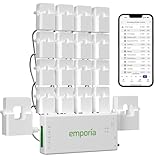
A monitor will not lower your capacity charge. Nothing you plug in will. What it does is show you, second by second, exactly where the line falls between the part of the bill you control and the part that was decided for you at an auction you never attended. Emporia’s Vue 3 clamps into your electrical panel and reports to a phone app. It is UL Listed, and Emporia recommends a licensed electrician for the install. That is the right call. Working in a live panel is dangerous.
BreakingNewsAlerts.com participates in the Amazon Services LLC Associates Program. We may earn a commission on qualifying purchases made through links on this page, at no additional cost to you. Product selection is editorial and independent of commission rates.
Researched and fact-checked by the BreakingNewsAlerts.com editorial team. Primary documents verified. Claims resting on a single source are flagged in the text. Diane Voss is a former federal benefits analyst covering Social Security, Medicare, and what Washington’s decisions do to retirement security.
Frequently Asked Questions
If I use less electricity, will my capacity charge go down?
No. Lower usage reduces your supply charge, which Yale economist Kenneth Gillingham puts at roughly 30% to 50% of the bill. Capacity, transmission, and distribution costs are allocated across all customers, so conservation cannot remove them.
How much are data centers adding to the average electric bill right now?
It depends on the state. Capacity market prices are estimated to add roughly $16 a month in Ohio and $18 a month in western Maryland. In Washington, D.C., consumer advocates estimate capacity price spikes account for about $10 of a $21 monthly increase.
Do data centers pay anything toward the grid, or is it all on ratepayers?
They pay for the electricity they consume. The dispute is over capacity and transmission. PJM’s market monitor attributed $6.5 billion of the December auction’s $16.4 billion cost to data center load, and roughly $6.2 billion of that traces to data centers that have not been built yet.
Which states have made data centers pay their own costs?
Oregon created a dedicated rate class through the POWER Act, and Portland General Electric estimates it cut residential rates by 1.3%. Virginia’s State Corporation Commission approved a similar class requiring 14-year minimum contracts and $1.5 million per megawatt in collateral.
Who decides whether data centers pay their own way in my state?
Your state public utility commission and your state legislature. Both hold public proceedings and accept written comment from residents.
What is a capacity charge, and why is it on my electric bill?
A capacity charge pays power plants to stay available for the hottest day of the year. An auction sets the price, not your meter. You pay it whether the plant ever runs. In the most recent PJM auction, the price hit $333.44 per megawatt-day, up from $28.92 three cycles earlier.
Reader Poll