
If the Social Security trust fund hits its projected depletion date in late 2032 without a vote from Congress, the average retiree loses $458 a month. That is roughly 22 percent of the $2,081 average monthly benefit reported by the Social Security Administration in May, and it happens automatically the moment the trust fund reserves are exhausted. No hearing. No new law. Just a reduced check on the first of the month.
Eight senators from both parties introduced a bill on July 14 designed to prevent that. It is called the Protecting Retirement Opportunities and Maintaining Income Security for Everyone Act, or the Social Security PROMISE Act. Sponsors include Republicans Bill Cassidy of Louisiana, Thom Tillis of North Carolina, John Cornyn of Texas, and Alan Armstrong of Oklahoma, Democrats Dick Durbin of Illinois, Tim Kaine of Virginia, and Chris Coons of Delaware, and independent Angus King of Maine. Three of the Republican sponsors are leaving the Senate in January. Cassidy lost his primary. Tillis retired. The bill has a political expiration date.
What the PROMISE Act Actually Does
The Social Security PROMISE Act will not raise payroll taxes. It will not cut benefits. It definitely won’t change the retirement age. The bill itself does none of the things Washington has been unwilling to vote on for a decade. Instead, it forces a vote.
It instructs the Social Security Advisory Board, a seven-member bipartisan panel, to submit a base bill designed to restore solvency for at least the next 50 years. Congress then has to consider, amend, and vote on that bill under a mandated procedure that strips away the usual committee-level tools that let lawmakers quietly bury unpopular legislation. If the Advisory Board fails to submit a plan, the majority leaders of the House and Senate can put forward their own. If they will not, any bipartisan pair in either chamber can. The floor vote is mandatory.
The Committee for a Responsible Federal Budget, a nonpartisan fiscal watchdog, has endorsed the bill. So has the Bipartisan Policy Center. CRFB president Maya MacGuineas called the situation what it is in her statement supporting the legislation: “Social Security is only six years from insolvency; we need action to save it, yesterday.”
Why Congress Hasn’t Fixed Social Security Already
The 2026 Social Security Board of Trustees report, released June 9, moved the Old-Age and Survivors Insurance trust fund depletion date one full year earlier than last year’s projection. It now sits in the fourth quarter of 2032. The report also showed the 75-year solvency gap widening from 3.82 percent to 4.42 percent of payroll. CRFB described the underlying finances as having “substantially worsened.”
As BreakingNewsAlerts.com reported last month, the political response from Washington has been notably cold. Speaker Mike Johnson, asked about entitlement programs on the Moon Griffon Show on June 8, said his plan for Social Security is “next year.” He later clarified he was speaking about waste and fraud rather than benefit cuts, citing $186 billion in improper federal payments identified by the Government Accountability Office in its April 2026 report on fiscal 2025.
The Speaker’s timeline conflicts directly with the timeline the PROMISE Act would create. Sen. Cassidy has made the tradeoff explicit in his own statements: “The longer Congress does nothing, the larger the tax increase workers will face and the deeper the benefit reductions retirees will endure.” Every month the Speaker defers is a month the mandated vote does not happen, and the underlying math gets worse. That is not motive attribution. That is calendar arithmetic.
The deferral is also not the only pressure on the program. As BNA has reported on DOGE-driven administrative cuts to the Social Security Administration, the workforce processing claims has thinned even as the trustees report projects rising benefit demand.
What Happens to Your Check if Congress Doesn’t Act
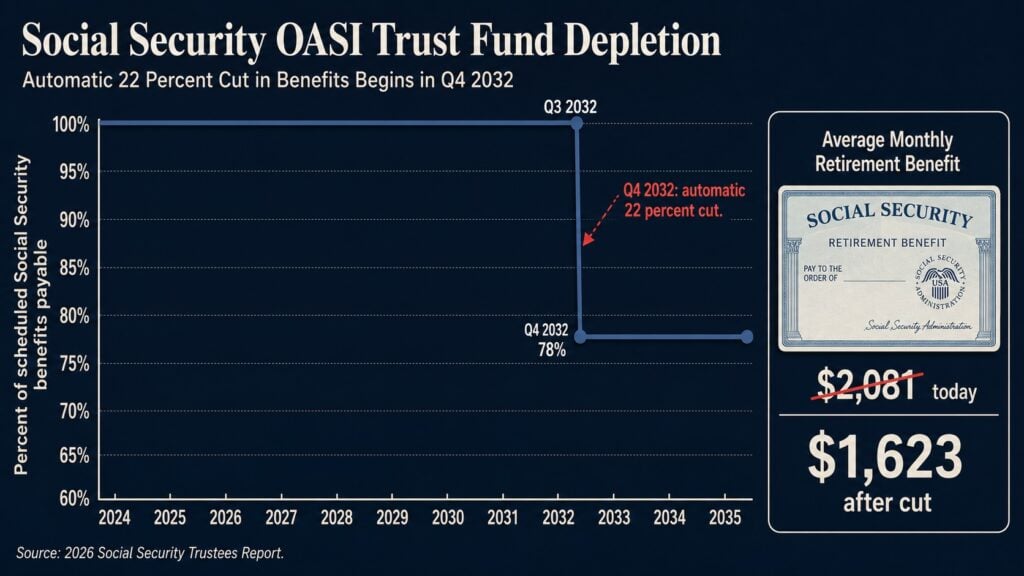
For a retiree already receiving benefits, the 22 percent cut hits every monthly deposit starting the month the trust fund reserves run out. For a 57 year old still working and expecting to claim benefits in the mid-2030s, the math is different but not better. The full retirement age is rising. The 2026 COLA came in at 2.8 percent, mostly absorbed by a 9.7 percent Medicare Part B premium increase and other rising costs that hit retirees before the check even lands.
The PROMISE Act does not guarantee a particular outcome. Independent budget analysts have mapped the usual menu of fixes: raising the payroll tax rate, lifting or eliminating the taxable wage cap ($184,500 in 2026 per the Congressional Budget Office), slowing benefit growth, raising the eligibility age. Any combination of these could pass under the PROMISE Act procedure. None of them will pass without a vote. The bill is designed to make sure the vote actually happens.
Americans for Tax Reform, the conservative anti-tax group founded by Grover Norquist, has organized opposition to any Social Security fix that would raise the payroll tax cap. Their position: the fix should come from benefit adjustments, not tax hikes. That position now has a mandated forum in which to be argued, if the bill passes.
The broader budget context makes the pressure clear. BNA has also covered how the administration’s proposed $1.5 trillion War Department budget puts Medicare and Medicaid under fiscal pressure at the same moment the Social Security trust fund is approaching depletion. Retirement-window Americans are staring at compounding stresses across the whole federal benefit stack.
What You Can Do While Congress Argues

You cannot make Congress vote. You can make your own retirement decisions with clearer information. Delaying your Social Security claim, if you can afford to, still increases your monthly benefit under current law, regardless of what Congress does about 2032. Reviewing your Social Security statement at ssa.gov confirms your work history is correctly recorded. Understanding how the current benefit formula works matters more, not less, when the future of the formula is contested.
For a plain-language guide to how the Social Security system actually works today, Mike Piper’s Social Security Made Simple is one of the clearer reference books available. It walks through the claiming rules without an agenda.
This article is for informational purposes only and does not constitute financial advice.
Frequently Asked Questions
What is the Social Security PROMISE Act?
The Social Security PROMISE Act is a bipartisan Senate bill introduced July 14, 2026. It creates a mandatory legislative process requiring Congress to vote on a plan restoring Social Security solvency for at least 50 years. The bill itself does not raise taxes, cut benefits, or change the retirement age.
Who introduced the Social Security PROMISE Act?
Eight senators: Republicans Bill Cassidy, Thom Tillis, John Cornyn, and Alan Armstrong; Democrats Dick Durbin, Tim Kaine, and Chris Coons; and independent Angus King. Cassidy and Tillis are leaving the Senate in January 2027.
Does the Social Security PROMISE Act cut my Social Security benefits?
No. The bill itself does not cut benefits, raise taxes, or change eligibility rules. It requires Congress to vote on a separate solvency plan drafted by the Social Security Advisory Board. What that plan contains has not been determined.
When would the Social Security PROMISE Act take effect?
The bill has been introduced but not yet voted on. If it passes, the Social Security Advisory Board would then have a mandated timeline to submit a base bill, followed by a mandated congressional vote. No specific date is set for either step.
What happens if Congress does not act before 2032?
The Social Security Old-Age and Survivors Insurance trust fund is projected to be depleted in the fourth quarter of 2032. If Congress takes no action, an automatic 22 percent cut to scheduled benefits takes effect. That is roughly $458 per month on the current $2,081 average benefit.
Why did Speaker Mike Johnson say he would defer action?
On the Moon Griffon Show on June 8, 2026, Speaker Johnson said his plan for entitlement programs is next year. He later clarified he was referring to waste and fraud rather than benefit cuts, citing $186 billion in improper federal payments identified by the GAO in fiscal 2025.
How is the Social Security PROMISE Act different from Cassidy’s sovereign wealth fund proposal?
The PROMISE Act is a procedural bill. It forces Congress to vote on a solvency plan but does not specify what that plan should be. Cassidy’s sovereign wealth fund is a separate policy outline, not a formal bill. It proposes borrowing $1.5 trillion to create an investment fund. That proposal could be one option considered under the PROMISE Act process, but the two are distinct.