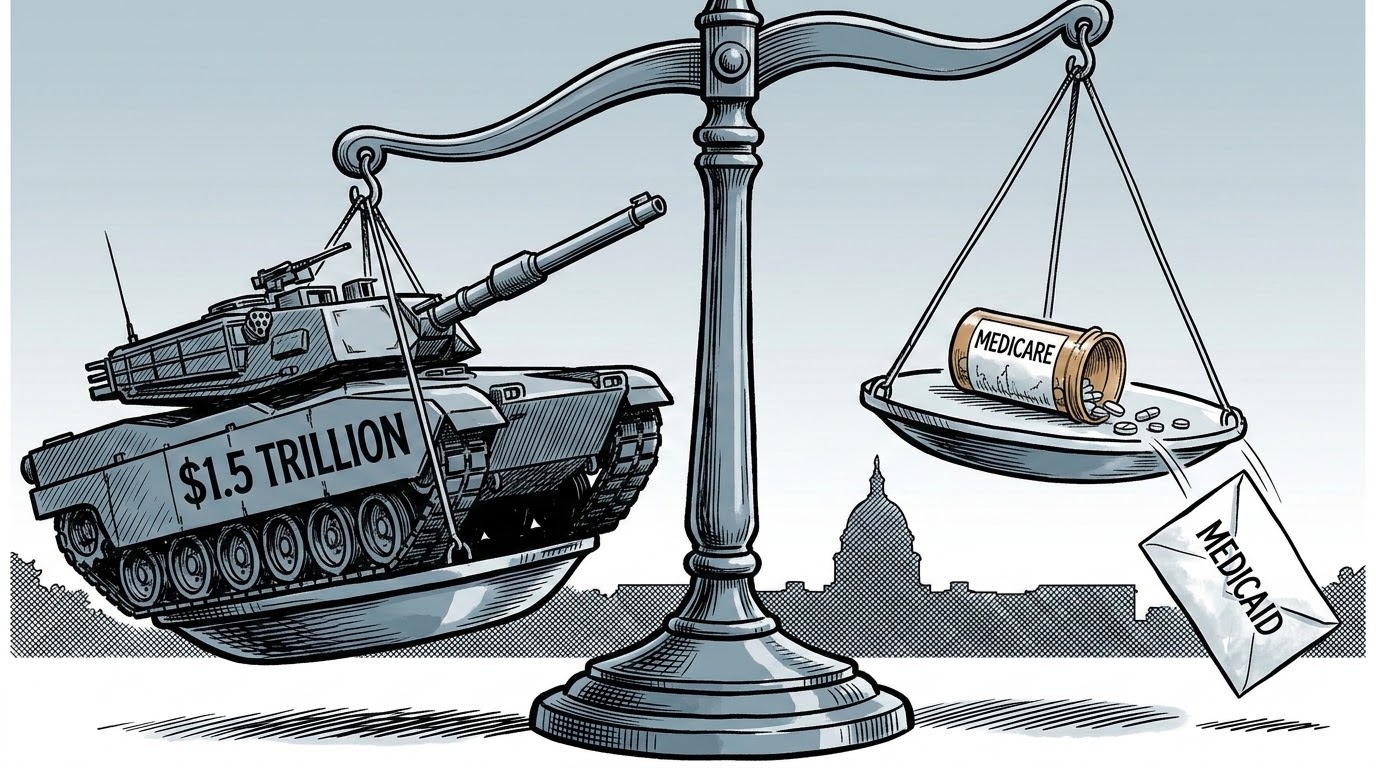

QUICK SUMMARY: The $1.5 trillion War Department budget request is the largest in U.S. history, a 42 percent jump from 2026. President Trump told Americans the federal government can’t afford to fund Medicare and Medicaid. Your benefit checks aren’t being cut. But the Social Security Administration is flat-funded after DOGE workforce reductions, and the Department of Health and Human Services faces a $15 billion cut. Here is what the War Department budget actually does to the benefits you’re counting on.
The War Department budget Secretary Pete Hegseth is asking Congress totals $1.5 trillion. The same week, at a private White House event reported by the Associated Press, President Trump told an audience the federal government can’t afford to fund Medicare and Medicaid. “It’s not possible for us to take care of day care, Medicaid, Medicare,” he said. “They can do it on a state basis. You can’t do it on a federal.” The budget request and the quote arrived inside the same news cycle.
First, let’s look at what isn’t being cut. Social Security retirement, disability, and survivor benefits continue automatically. Medicare benefits continue. VA benefits continue. By law, these are mandatory programs. The 2027 budget does not propose changes to eligibility, cost-of-living adjustments, or benefit amounts. If you are receiving a check, the check still arrives.
What is being cut is the machinery that delivers it. The Social Security Administration is flat-funded in this budget after DOGE already reduced its workforce earlier this year, which means longer claim processing times, longer disability determinations, and harder-to-reach field offices. The Department of Health and Human Services, which runs Medicare and Medicaid, faces a $15 billion cut.
In addition, the Low Income Home Energy Assistance Program, which helps low-income seniors pay their heating bills in winter, will be axed. Senior Employment Services, the program that places older workers in jobs when they need to keep working, is eliminated. As one reader put it on a conservative news forum: “I need to know what this means for my Social Security, not what some economist thinks about it in the abstract.”
Where the War Department Budget Plans to Get the Money

The official line is that there are no direct cuts to Social Security or Medicare. That’s technically accurate. But the President’s own words name the political logic the cuts reflect: Washington, in his telling, can’t take care of those programs. The verifiable record matches the rhetoric. They will squeeze the benefits machinery in the same budget that funds a 42 percent defense increase. Both things are true at once. The press is treating them as separate stories. They are not.
Here is the structural math. Federal spending is roughly $7 trillion a year. Two-thirds of that goes to mandatory benefits: Social Security, Medicare, and Medicaid. Of the remaining third, defense and non-defense discretionary spending have historically split close to $1 trillion each.
The White House topline fact sheet shows non-defense discretionary spending dropping by $73 billion, or 10 percent, while defense climbs by $445 billion. That $73 billion cut is not coming from one place. It is spread across every federal agency that is not the War Department, including the Social Security Administration’s claim-processing workforce and the Health and Human Services staff that manages Medicare and Medicaid. The discretionary squeeze and the agency capacity squeeze are the same. The arithmetic is in the document itself.
So why is the requested War Department budget hitting $1.5 trillion? This is not happening from nowhere. The Iran war has burned through $25 billion in 60 days, mostly in munitions, and the administration has not sent Congress a separate supplemental request to cover it. That means the $1.5 trillion ask is doing two jobs at once. It funds the War Department’s ongoing operations, and it absorbs the cost of a war the administration is fighting without formally asking Congress to pay for it. The DOGE workforce cuts that started earlier this year get locked in by flat-funding what is left. The connection is the story most outlets are missing.
The Markup Is the Fight
Secretary Pete Hegseth defended the War Department budget before the House Armed Services Committee on April 29 and will testify before the Senate Armed Services Committee today. The appropriations markup window opens this summer. A presidential budget request is a proposal and not law. Last year, Congress kept non-defense spending roughly flat against Trump’s proposed cuts. The fight over the War Department budget happens in the markup, not the request. Vote in our poll below and tell us where you stand.
Frequently Asked Questions
Is Trump cutting Social Security or Medicare benefits?
The 2027 War Department budget request does not propose direct cuts to Social Security retirement, disability, or survivor benefits, or to Medicare benefits or eligibility. Both are mandatory programs that continue automatically. What the budget does propose: flat funding for the Social Security Administration after DOGE workforce reductions, and a $15 billion cut to the Department of Health and Human Services that affects the workforce administering Medicare and Medicaid.
What does flat-funding the SSA actually mean for me?
The Social Security Administration’s workforce processes retirement claims, disability determinations, and customer service. Flat funding after DOGE workforce cuts means longer wait times to reach a representative, longer claims windows, and reduced field office capacity. Your check will still arrive on time. However, getting questions answered or resolving a claim issue will get harder.
Did Trump really say the federal government can’t afford Medicare and Medicaid?
At a private White House event reported by the Associated Press, the President said: “It’s not possible for us to take care of day care, Medicaid, Medicare — all these individual things. They can do it on a state basis. You can’t do it on a federal.” The quote was confirmed across multiple wire services on the same day.
Will Congress actually pass the War Department budget?
A presidential budget request is a proposal and not law. Congress controls federal spending through the appropriations process. Last year, Congress rejected most of the administration’s proposed non-defense cuts and kept that spending roughly flat. War Secretary Pete Hegseth testifies before the Senate Armed Services Committee today. The appropriations markup is where the request becomes, or doesn’t become, law.