
QUICK SUMMARY: Rising gas prices hit a national average of $4.09 this month, up 37% from $2.98 in late February. Electricity is up 7.4% year over year, with utilities in 41 states filing for rate hikes. Mainstream coverage is leading with coupon apps and loyalty cards. The real story is what’s driving the spike, why it’s going to stay, and what it means for anyone already watching their retirement math get tighter every week.
The American Automobile Association (AAA) confirmed Monday the national average for a gallon of regular unleaded sits at $4.09, down just 7 cents from a peak of $4.17 earlier this month. That is a 37% jump in roughly five weeks, the first time U.S. drivers have paid more than $4 a gallon since August 2022.
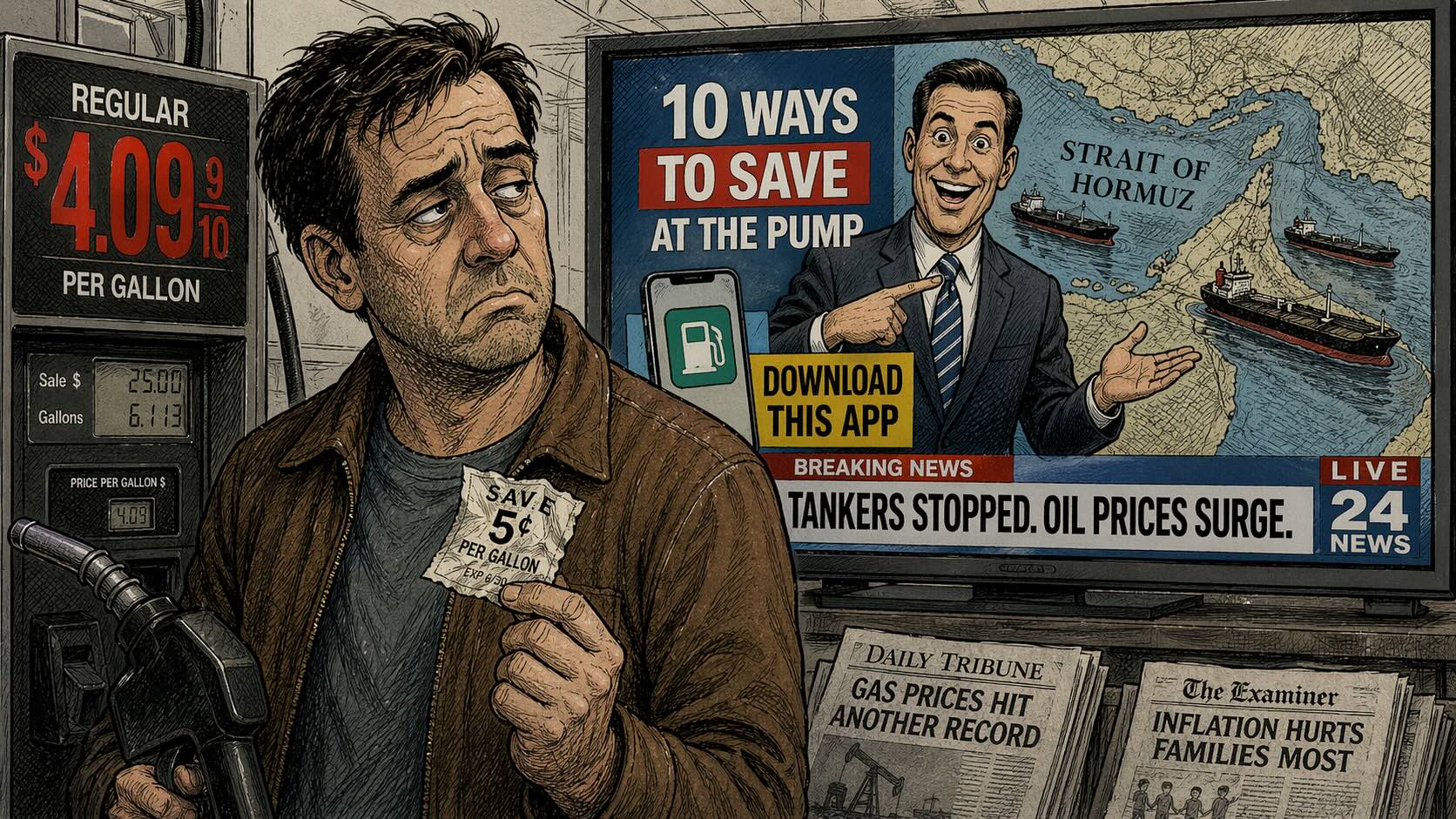
To help survive the rising gas prices, the national press shared extremely important advice: download an app.
Meanwhile, CNN’s consumer piece shared tips on loyalty programs, Costco memberships, and BP’s discount for Amazon Prime customers. The Detroit News ran a column the next day on rewards credit cards for gas stations. A Houston station’s April 6 coverage offered 12 ways to save at the pump, starting with Swagbucks surveys. Not one of these pieces led with the question most readers are actually asking: why did this happen, and why isn’t it going away?
Here is the structural story the national press is skipping.
The Strait of Hormuz carries roughly one-fifth of the world’s oil supply. When tanker traffic stopped moving through it after the U.S.-Israeli conflict with Iran began on February 28, crude repriced globally within days. Refined gasoline followed within a week. GasBuddy petroleum analyst Patrick De Haan told PBS News that $4.50 a gallon is a realistic ceiling if the strait stays closed for several more weeks. The 2022 record of nearly $5 a gallon is the tail risk if the disruption extends through summer.
That’s the gas half. The electricity half is worse.
Residential electricity rates climbed 7.4% nationwide since last September, with more than a dozen states posting double-digit year-over-year increases. The Center for American Progress tracked 102 gas and electric utilities across 41 states that have either raised rates or filed proposed increases taking effect in 2025 or 2026. Power bills are being driven up by increases in natural gas costs, aging grid infrastructure, and a permanent new demand floor from AI data center expansion. One consumer advocate quoted by CNN put it this way: Electricity prices are the new eggs.
None of that shows up in a coupon-tips article.
What rising gas prices mean for your household budget

The same PBS article cited an AP-NORC poll in early April that found 45% of U.S. adults are extremely or very concerned about affording gas in the next few months. This figure is up from 30% after the 2024 election. For retirement-window households living on fixed or semi-fixed income, the squeeze is compounding fast.
More importantly, gas doesn’t stay at the pump. It seeps into groceries because trucks cost more to run. It seeps into shipping, services, heating, and every other line item on your monthly budget. One financial writer tracking the spike put the math plainly: the real damage isn’t the extra $30 at the pump, it’s the credit card balance it quietly builds over six months when households start putting essentials on plastic to stay current on bills.
That is the story mainstream outlets are burying under rewards-program explainers.
Why rising gas prices are a structural problem and not a monthly one
There are two things you need to understand if you plan to forward this email to his kids.
First, the Strait of Hormuz situation is a geopolitical lever that is not going away. Iran has closed it before and will again. Every closure reprices global energy inside a week. U.S. domestic production can blunt the shock but cannot eliminate it as long as global crude sets the benchmark.
Second, the AI data center demand curve is permanent. Utilities are building rate hikes into filings now that assume that load. State public utility commissions in 41 states have those filings sitting in front of them. Your electric bill in 2030 reflects decisions being approved in 2026.
If you want to understand the structural forces behind what you’re watching at the pump and on your power bill, geopolitical strategist Peter Zeihan’s book The End of the World Is Just the Beginning is the clearest map of why global supply chains, energy, and food systems are repricing permanently. It’s not a panic read. It’s the explanation the coupon articles are missing.


What to do in the next 60 days
Three concrete actions that don’t require waiting on Washington.
One: audit your household energy bill. Call your utility and ask specifically which line items reflect 2026 rate adjustments. Most people never read the delivery charge details.
Two: build a fuel budget buffer of 15% for the next 90 days. If the strait reopens fully and prices settle, you’ve saved. If it doesn’t, you’re not absorbing the hit on credit.
Three: stop taking the mainstream coverage at face value. If your news source is leading with Upside app tutorials while 41 states quietly approve utility hikes, you’re being kept busy instead of kept informed.
That’s the job of a real news digest. Not coupons. Context.
Frequently Asked Questions
Why did gas prices jump so fast in 2026?
The closure of the Strait of Hormuz after the February 28 conflict stopped tanker traffic carrying roughly 20% of the global oil supply. Crude oil prices repriced globally within days, and refined gasoline followed within a week. That’s why prices moved 37% in five weeks, not over months.
Will electricity prices keep rising as well?
Yes, and the reasons are structural. Utilities in 41 states have filed rate hike requests for 2025 and 2026. The demand curve from AI data center expansion is a permanent new floor. Natural gas supply costs and aging grid upgrades are also pushing rates higher. Most analysts expect continued increases through 2027.
How much are rising gas prices costing the average household?
A household driving 12,000 miles a year in a vehicle averaging 25 mpg is spending roughly $530 more on gas annually at $4.09 a gallon versus $2.98. Add rising electric and heating bills, and the total annual hit to a typical household budget lands in the $900 to $1,500 range before groceries and services reprice.
What can I do to combat rising gas prices in the next 60 days?
Audit your utility bill for line-item rate changes. Build a 15% fuel budget buffer for the next 90 days. Read news sources that explain structural drivers, not just savings tips. Short-term app tricks save pennies. Understanding what’s actually happening saves hundreds.