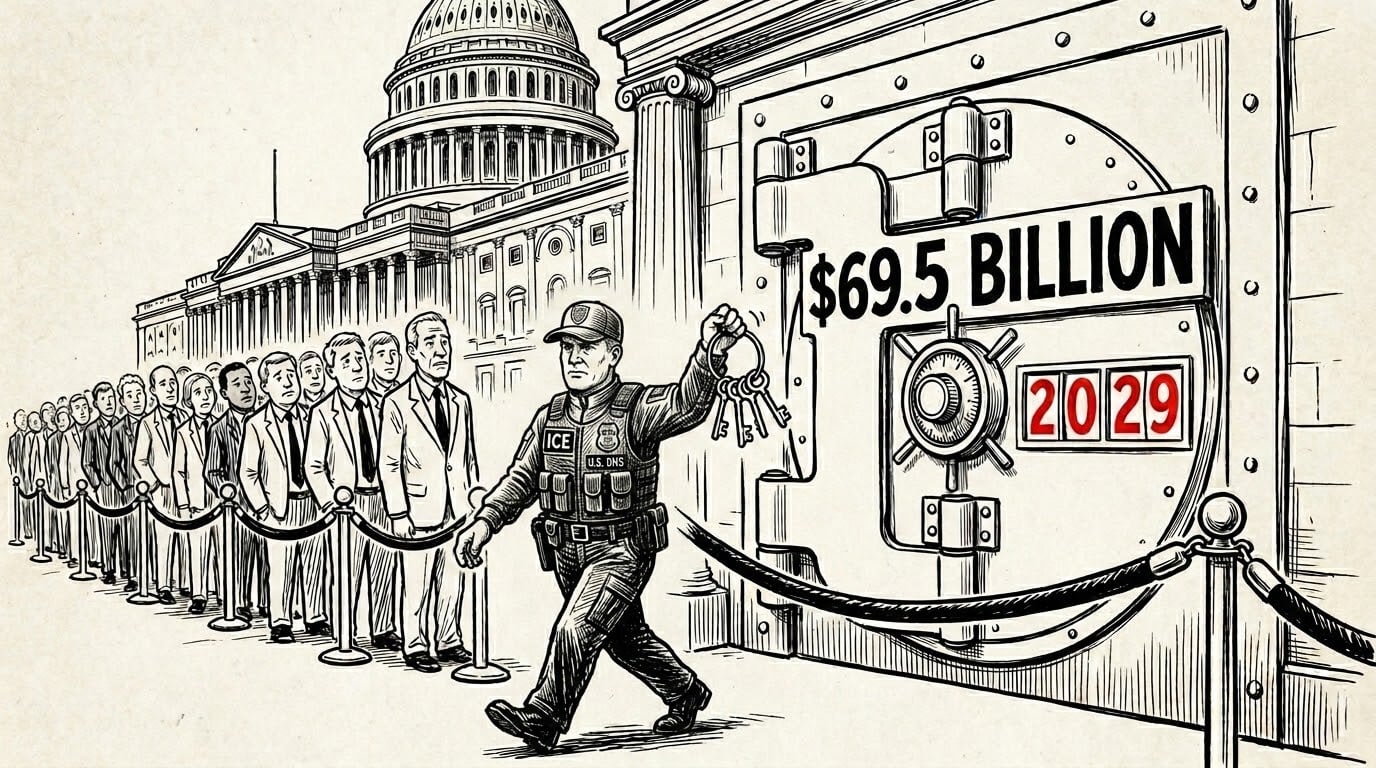

President Trump signed the Secure America Act on June 10, giving ICE $38.5 billion and CBP $26 billion in lump-sum funding through 2029 — with no annual congressional review. Combined with last year’s reconciliation package, total DHS enforcement funding now stands at roughly $240 billion outside normal appropriations oversight. The CBO projects a $94.5 billion deficit impact over ten years.
The fight to fund ICE and CBP lasted 115 days and ended the only way Republicans had left: without Democratic input.
On June 5, the Senate passed the Secure America Act 52-47, with every Democrat voting no and a single Republican, Sen. Lisa Murkowski of Alaska, joining them. The House cleared the identical bill 214-212 on June 9. Trump signed it the next morning in the Oval Office. “This morning I’m thrilled to sign the Secure America Act to immediately and fully fund the Department of Homeland Security through the end of my term, so we won’t have that to be talking about it anymore,” he said.
He was right about one thing. They won’t be talking about it anymore. The funding is locked.
How Much Does ICE Get Under the Secure America Act, and How Does That Compare to Its Normal Budget?
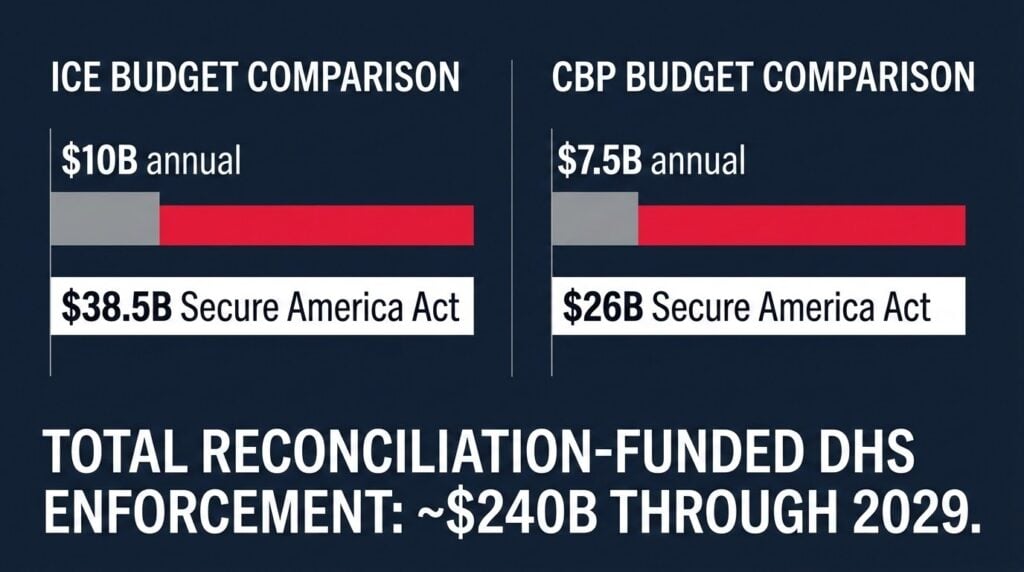
The dollar breakdown from S.2, the bill text filed with Congress: ICE receives $38.5 billion to hire, pay, train, and equip officers and fund operations and maintenance through September 30, 2029. CBP receives $26 billion for border security operations, personnel, surveillance technology, and screening systems. DHS receives an additional $5 billion for broad enforcement purposes. Total: $69.5 billion, which administration officials and congressional leaders have rounded publicly to $70 billion.
ICE’s normal annual appropriation is roughly $10 billion. This law hands it nearly four times that amount in a single legislative instrument.
The law does not require DHS, ICE, or CBP to spend any of this money in any specific fiscal year. The agencies can deploy it quickly or slowly, at their discretion. There is also no provision preventing the agencies from requesting additional funds through the regular annual appropriations process on top of what this law provides.
Why Did Congress Use Budget Reconciliation Instead of a Regular Spending Bill?
Budget reconciliation is a Senate procedure that allows certain spending legislation to pass with 51 votes rather than 60. It bypasses the filibuster, which means the minority party has no leverage point. Republicans used reconciliation because Democrats had one: they controlled enough Senate seats to block any DHS funding bill that did not include operational conditions on ICE and CBP.
Reconciliation removed that leverage permanently through 2029.
This is not the first time. Last year’s One Big Beautiful Bill Act used the same procedure to give DHS $170 billion in enforcement funding through 2029. Add the Secure America Act’s $69.5 billion and the total reconciliation-funded DHS enforcement budget now stands at roughly $240 billion, operating outside the annual appropriations process that normally requires agencies to return to Congress each year and justify their budgets.
For ICE and CBP specifically, that annual justification requirement is gone until fiscal year 2030. No annual vote. No annual leverage point. No annual accountability gate.
What Triggered the 76-Day DHS Shutdown That Led to This Law?
On January 7, 2026, a federal ICE agent shot and killed Renee Good, a 37-year-old U.S. citizen, during immigration enforcement operations in Minneapolis. On January 24, federal officers shot and killed Alex Pretti, a 37-year-old ICU nurse, in the same city. His death was ruled a homicide by the county medical examiner.
Democrats responded by refusing to approve any DHS funding that included ICE and CBP unless Republicans agreed to operational conditions — stronger warrant requirements, restrictions on enforcement in sensitive locations, professional standards for agents in the field. Republicans refused those conditions.
What followed was the longest partial DHS shutdown in U.S. history: 76 days. TSA, FEMA, the Coast Guard, and the Secret Service all got funded in April through a bipartisan vote. ICE and CBP did not. Republicans deliberately split the bill, isolating the two enforcement agencies so they could be funded separately and alone through reconciliation.
We covered the mechanics of that split in May, when the reconciliation bill was still pending. The Secure America Act is its resolution.
What Will the New ICE Funding Produce?
Tom Homan, the administration’s Border Czar and the official with operational deployment authority over ICE enforcement, was direct about what the new funding produces. “You’re going to see targeting increase, you’re going to see arrests increase,” Homan said. “We’re also going to be able to pay our vendors, our medical contractors.”
That is the administration’s stated objective from the named official who controls how the enforcement money gets used. It is not a confirmed outcome. It is a declared operational intent from the person who decides where agents go.
House Budget Committee Chairman Jodey Arrington of Texas, who managed the bill on the House side, put it plainly: “Our brave men and women who stand on the thin line to defend our sovereign borders and safety finally have the funding and certainty they need to do their jobs.”
What Does the CBO Say the Secure America Act Will Cost Taxpayers?
The Congressional Budget Office scores the Secure America Act as raising primary deficits by $69.5 billion over fiscal years 2026 through 2035. Including interest costs, the total deficit impact reaches $94.5 billion over ten years.
That figure did not lead the coverage of this bill in mainstream outlets, most of which focused on the partisan vote margins and the Minneapolis backstory. It is in the CBO score, which is a primary public document.
Congress has now used the reconciliation process twice in under a year to fund the same two agencies — for a combined $240 billion, outside the normal annual review process. Whether that is sound institutional architecture or a permanent change in how Congress funds enforcement agencies is a question the vote totals alone cannot answer.
Researched and fact-checked by the BreakingNewsAlerts.com editorial team. Primary documents verified. See our editorial standards.
Frequently Asked Questions
What is the Secure America Act and when was it signed?
The Secure America Act is a federal law signed by President Trump on June 10, 2026, providing $69.5 billion in lump-sum funding to ICE ($38.5B) and CBP ($26B) through fiscal year 2029. It was passed using budget reconciliation, requiring only 51 Senate votes.
What does “no annual oversight gate” mean for ICE and CBP?
Under normal appropriations, agencies must return to Congress each year to justify their budgets. The Secure America Act eliminates that annual review for ICE and CBP through fiscal year 2029, no annual vote and no annual leverage point for lawmakers who want to attach conditions.
How much has Congress funded DHS enforcement through reconciliation in total?
Combined with the One Big Beautiful Bill Act passed in 2025, total reconciliation-funded DHS enforcement spending now stands at roughly $240 billion through fiscal year 2029 — all outside the standard annual appropriations process.
What is the deficit impact of the Secure America Act?
The Congressional Budget Office scores the law as raising primary deficits by $69.5 billion over fiscal years 2026 through 2035. Including interest costs, the total ten-year deficit impact reaches $94.5 billion.
What happens to ICE and CBP funding after 2029?
The Secure America Act’s funding authority expires September 30, 2029. After that date, both agencies would return to the standard annual appropriations process unless Congress establishes a new mechanism.