
Source: YouTube
The Trump administration is moving to block the purchase of U.S. farmland by foreign adversaries, with a strong focus on Chinese buyers. Agriculture Secretary Brooke Rollins announced the measure Tuesday, unveiling a sweeping “National Farm Security Action Plan” designed to halt future acquisitions and begin reclaiming land already in foreign hands.
Security and Surveillance Concerns Shape Policy
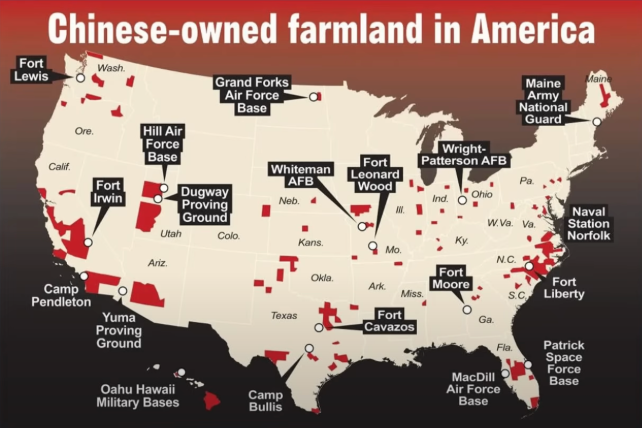
Defense Secretary Pete Hegseth joined Rollins at the announcement, warning that foreign land ownership near sensitive sites could compromise military operations. Officials said the new restrictions respond to concerns raised by lawmakers, who argue that Chinese land deals near strategic areas may pose risks ranging from surveillance to influence over food supply infrastructure.
The move to ban foreign purchases of U.S. farmlands builds on previous government action. In 2024, the Biden administration ordered a Chinese crypto‑mining firm to sell land near a nuclear missile base in Wyoming. That decision was enforced through the Committee on Foreign Investment in the United States (CFIUS). Rollins will now serve on CFIUS to give the Agriculture Department more influence in national security decisions involving U.S. farmland.
Rollins also said the USDA will pursue legal options to “claw back” land already purchased by foreign adversaries. According to USDA data, Chinese‑linked entities currently own about 265,000 acres of U.S. farmland. That figure represents just 0.0003% of all farmland, but some lawmakers argue the small footprint does not reduce the strategic risk.
Escalating Enforcement and Political Support
The administration plans to raise penalties for undisclosed foreign ownership, potentially to 25% of the land’s value. Last year, Arkansas forced Chinese‑owned seed company Syngenta to sell its U.S. farmland holdings after failing to disclose its ties. Syngenta paid a $280,000 fine and later divested the land.
Critics have long warned that adversarial nations could use agricultural holdings to collect intelligence or disrupt critical supply chains. The Agriculture Department cited a recent case in which Chinese researchers were accused of smuggling a dangerous fungus capable of damaging grain crops. Other federal agencies have also raised concerns about foreign influence in biotech, wind power, and food assistance fraud schemes.
At the press conference, Rollins said the department removed over 70 individuals and 550 entities linked to foreign adversaries from government contracts. She said those efforts are part of a broader review to align USDA programs with Trump’s “America First” agenda. The new policy arrives as the administration continues to expand mass deportation programs. Asked how labor shortages in agriculture might be affected, Rollins said deportations will continue. She claimed there are millions of Americans available to take those jobs.
China Pushes Back Against the Proposed Ban on Purchasing U.S. Farmland
China responded to the farmland ban with a sharp rebuke. Foreign Ministry spokesperson Mao Ning accused the United States of weaponizing the term “national security” to mask protectionist policies. “This move will only backfire,” Mao warned, calling the plan a violation of international trade rules. She urged the United States to “stop politicizing economic and trade affairs.”
While Rollins did not address the Chinese statement directly, her office released a follow‑up noting that “U.S. farmland is not for sale to hostile regimes.” In support of the statement, lawmakers from both parties continue to back the push for restrictions. Republican Senator Roger Marshall called on Congress to permanently add the Agriculture Secretary to CFIUS. Other legislation, including the Farmland Act and Agricultural Risk Review Act, seeks to increase transparency and expand federal review of foreign land deals.
Florida and Montana have already banned Chinese land purchases near military sites. National efforts now appear aligned to make those policies uniform across states. The USDA’s plan also includes support for domestic agriculture, protection of research facilities, and new cybersecurity efforts focused on food systems.
Should the U.S. permanently ban U.S. farmland purchases by foreign adversaries for national security reasons? Tell us what you think!
Survey