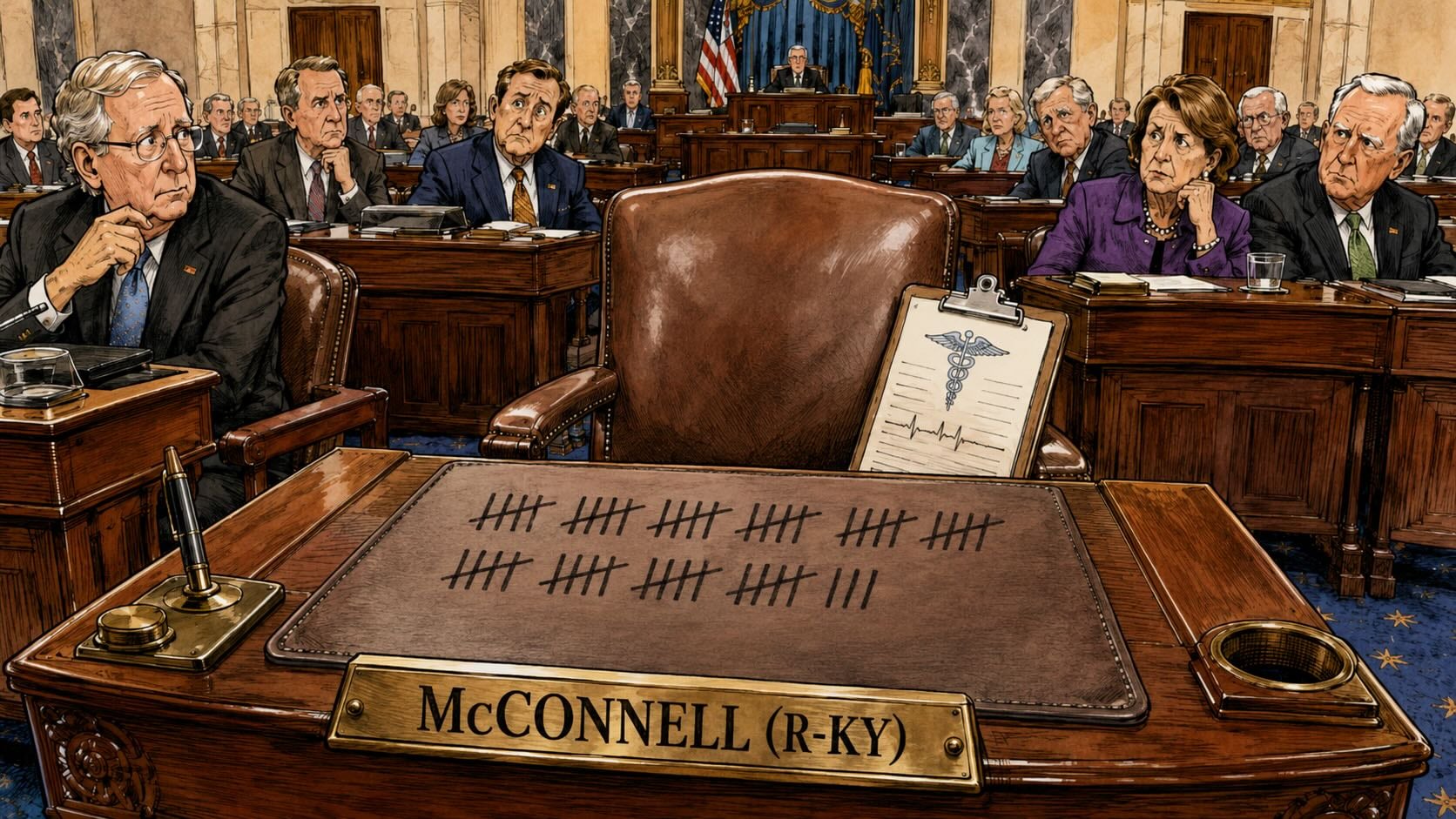

QUICK SUMMARY: Senator Mitch McConnell has been absent from the Senate since June 14, 2026 following a fall. He has missed 38 floor votes. His absence has reduced the working Republican majority to 52, stalling appropriations work, defense budget planning, and the SAVE Act reconciliation strategy. WIth the Mitch McConnell status up in the air, no return date has been announced.
Senator Mitch McConnell (R-KY) has not voted in the Senate since June 14, 2026. Since then, he has missed 38 floor votes, one Appropriations Committee cycle, and the funeral of his closest institutional ally. What the mainstream press covered is his fall, his physician’s statements, and two photographs. What it hasn’t covered is what the missing 53rd Republican vote his absence already cost, and what Kentucky’s rewritten vacancy law would actually do if his seat opened. This piece tries to answer both.
What Is the Current Mitch McConnell Status?
The current Mitch McConnell status is unresolved. According to a statement released by his attending physician on July 27, 2026, the Kentucky senator remains at a rehabilitation facility undergoing what the physician described as a strenuous course of physical therapy and rehabilitation. He is not yet medically cleared to return to the Senate floor. His office offered no return date.
McConnell was hospitalized June 14 following a fall his office later said left him briefly unconscious. He was also diagnosed with a mild case of pneumonia. His team has released two photographs since the hospitalization: one on July 12 showing him holding a copy of the Washington Post, and one on July 26 with his wife Elaine Chao. He is 84 years old.
How Much Is His Missing Vote Costing the 52-Vote GOP Majority?
Senate Majority Leader John Thune told the political news outlet NOTUS on July 23 that his working majority is now 52 votes, not the 53 seats the Republican conference holds on paper. “This is the reality,” Thune said, per NOTUS reporting on how the absence is grinding Senate business to a halt.
The math shift matters more than the number. Before June 14, Republican leadership could lose three moderate senators on a party-line vote and still tie the chamber 50 to 50, with the Vice President as tiebreaker. Now three defectors lose the vote 49 to 51. Senators Susan Collins of Maine, Lisa Murkowski of Alaska, and Rand Paul of Kentucky each hold effective veto power over any GOP-only vote as long as McConnell is out. According to an NBC News review, 38 floor votes have already been affected. Ten legislative weeks remain in the year.
Which GOP Priorities Are Stalled Without His 53rd Vote?
McConnell chairs the Senate Rules Committee. That chair is responsible for drafting SAVE Act voter identification language in a form capable of surviving budget reconciliation’s procedural rules. Without him, President Donald Trump’s reconciliation push has no procedural pathway.
His seat on the Senate Appropriations Committee has already delayed committee work on government funding bills, including work on the $70 billion ICE appropriations package. Republicans hold only a slim panel majority and cannot afford to lose his vote if Democrats unite against increased military spending.
The situation was compounded on July 11 when Senator Lindsey Graham of South Carolina died of aortic dissection. Graham chaired the Senate Budget Committee and was driving the reconciliation strategy alongside McConnell. His sister Darline Graham was appointed by Governor Henry McMaster to fill the seat through January 2027. She is new to the chamber.
Trump’s $1.5 trillion War Department budget increase, Iran war powers procedural votes, and multiple judicial nominations are all sitting on the tighter Senate math. His office has offered no timeline for return.
What Happens to His Seat If He Cannot Return?
If the timeline never comes, the story changes shape, and Kentucky’s answer is not what the mainstream press has told readers.
Kentucky rewrote its Senate succession law in 2024. Under House Bill 622, which passed the General Assembly in April 2024 over Governor Andy Beshear’s veto, the governor no longer has authority to appoint a replacement senator. Any mid-term Senate vacancy in Kentucky must be filled by special election. The winner serves the remainder of the unexpired term.
The 2024 law replaced a 2021 statute that had required the governor to choose from a slate of three names supplied by the vacating senator’s state party. That earlier compromise, itself a step away from a fully free gubernatorial appointment, is now inoperative. Kentucky is one of only four states that bar gubernatorial Senate appointments outright.
Under House Bill 622, if McConnell’s seat opened, Beshear would have to issue a proclamation calling a special election. Under standard timing rules referenced in the statute, the proclamation would typically be required within 30 days of the vacancy, with the election held within roughly 60 to 90 days. Some ambiguity remains about how the special election would interact with the November general election if a vacancy occurred close to it. That ambiguity has not been tested in court.
Any winner would serve through the term ending January 3, 2027. Representative Andy Barr won the May Republican primary to succeed McConnell in November and is favored in the general election.
Have Kirk and Feinstein Absences Ever Blocked the Chamber Like This?
Extended senator absences are not new. Republican Senator Mark Kirk of Illinois was absent for approximately one year after a 2012 stroke. Democratic Senator Dianne Feinstein of California was absent for months in 2023, and her absence blocked Judiciary Committee confirmations. Senator Deb Fischer of Nebraska cited Kirk on record as precedent for medical leave.
What is different in July 2026 is the calendar and the majority size. Ten legislative weeks. Fifty-two working votes. A Rules Committee chairmanship on pause during an active reconciliation push. A Kentucky vacancy statute that no longer gives leadership any control over who fills the seat. Representative Tim Burchett of Tennessee has publicly called for a constitutional mechanism to address prolonged incapacitation. That conversation is now live.
McConnell’s office has not offered a return timeline. Physical therapy statements and staged photographs are not a return timeline, drawing growing calls for transparency from lawmakers in both parties. The audit question for the next 30 days is not whether he is recovering. It is whether the Senate can afford the wait.
Jack Calloway is a federal accountability journalist covering executive power, agency restructuring, and the Washington decisions that affect your benefits. Read more about how BNA reports on Washington under our editorial standards.
Frequently Asked Questions
How long has Mitch McConnell been absent from the Senate?
Senator Mitch McConnell has been absent from the Senate since June 14, 2026. That is 44 days as of July 28, 2026.
Why is Mitch McConnell absent from the Senate?
McConnell was hospitalized on June 14, 2026 after a fall that his office described as leaving him briefly unconscious. He was also diagnosed with a mild case of pneumonia. He is currently at a rehabilitation facility undergoing physical therapy.
Has Mitch McConnell announced when he will return to the Senate?
No. His office has not offered a return timeline. His attending physician stated on July 27, 2026 that McConnell is not yet medically cleared to return to the Senate floor.
How many Senate votes has Mitch McConnell missed?
According to an NBC News review, McConnell has missed 38 Senate floor votes since June 14, 2026.
How does Mitch McConnell’s absence affect the Republican Senate majority?
Republicans hold 53 seats. With McConnell absent, Senate Majority Leader John Thune confirmed to NOTUS on July 23 that the working GOP majority is effectively 52. Three moderate Republican defectors can now block any party-line vote.
Can Kentucky’s governor appoint a replacement if McConnell’s seat opens?
No. Kentucky House Bill 622, passed by the General Assembly in 2024 over Governor Andy Beshear’s veto, eliminated the governor’s authority to appoint an interim senator. Any vacancy must be filled by special election. The winner serves the remainder of the unexpired term.
Is Mitch McConnell running for re-election in 2026?
No. McConnell announced on February 20, 2025, that he would not seek an eighth term. His current term ends January 3, 2027. Representative Andy Barr won the Kentucky Republican primary in May 2026 to succeed him.