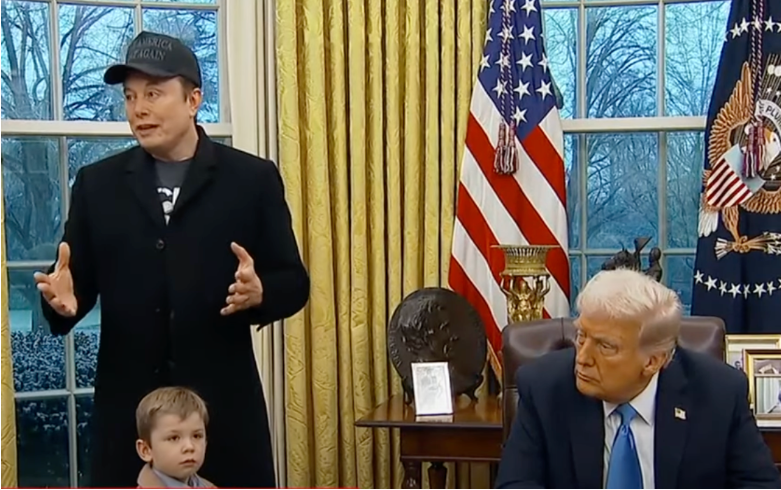

Source: YouTube
Elon Musk’s recent appearance at the White House alongside President Donald Trump has reignited questions about the billionaire’s growing influence in Washington. As Musk addressed the media from the Oval Office, observers couldn’t help but notice the power dynamics at play. The scene was a clear response to a recent Time Magazine cover showing Musk seated at the Resolute Desk—a symbolic gesture that some believe irked Trump. This public show of unity has sparked debates: Does Donald Trump need Elon Musk more than Elon Musk needs Donald Trump?
Elon Musk’s Role in Trump’s Administration
Musk’s role as head of the Department of Government Efficiency (DOGE) gives him unprecedented sway over federal operations. During the Oval Office event, Musk passionately defended sweeping government cuts, dismissing claims of overreach and conflicts of interest. He insisted that the DOGE initiative is about saving democracy by eliminating wasteful spending. However, critics argue that Musk’s proximity to power poses risks, especially given his companies’ extensive government contracts.
Trump, sitting stoically behind the Resolute Desk, allowed Musk to dominate the spotlight, a rare sight for a president known for commanding attention. While some may argue that Trump tolerates Musk’s showmanship due to his public influence, it’s clear that Musk’s growing criticism and headline-grabbing antics could overshadow Trump, causing more harm than good.
What is MAGA’s Opinion on Musk?
MAGA supporters have mixed feelings about Elon Musk. On one hand, his aggressive push to dismantle federal agencies like USAID and the Consumer Financial Protection Bureau aligns with their anti-government sentiments. Musk’s rhetoric about draining the swamp and exposing bureaucratic inefficiencies resonates deeply with Trump’s base. However, Musk’s flamboyant personality and his tendency to overshadow Trump have caused unease among some supporters. While they appreciate his contributions to the administration’s goals, there is growing concern that Musk’s influence could undermine Trump’s authority. The billionaire’s unapologetic dominance during the Oval Office appearance, coupled with his too-casual demeanor, such as perching his son X on his shoulders, felt out of place in the traditionally solemn setting of American democracy.
Trump’s Calculated Alliance
Despite these concerns, the President appears to value Musk’s contributions. Trump’s recent executive order empowering DOGE to make significant workforce cuts reflects his trust in the billionaire’s vision to pare down government spending. He likely sees Musk as an asset in his mission to reshape the federal government, even at the cost of sharing the spotlight.
But there might be another factor at play: Musk has been a major financial supporter of Trump’s campaign, contributing large sums that could explain why the president seems beholden to him. This financial backing could tie Trump’s hands and make it difficult to distance himself even when Musk’s actions become politically unpalatable.
Of course, this alliance is not without risks. Musk’s growing power could backfire if the aggressive government cuts begin to affect services that Trump’s base relies on, such as disaster relief through FEMA or student loan programs under the Department of Education. Additionally, Musk’s potential conflicts of interest—given his businesses’ ties to federal contracts—could become a political liability.
Beyond this, the broader issue looms: a billionaire businessman is now making decisions that affect the majority of the American public, despite never being elected and facing little accountability for his actions. Musk’s unchecked power raises fundamental questions about democratic oversight and the role of private interests in public governance.
The Big Question: Does Trump Still Need Musk?
In the short term, Trump benefits from Musk’s support. However, Musk’s increasing unpopularity and scene-stealing antics might be more of a liability than an asset. His meddling and apparent desire to dominate the spotlight could cost Trump valuable political capital and good PR. Musk is clearly using Trump to push his own agenda, and his take-no-prisoners approach could become problematic. If Musk’s policies start to alienate key voter groups or if his conflicts of interest lead to scandals, Trump might find himself in a difficult position.
Ultimately, while Musk is a powerful ally, he is also a potential rival for influence. Trump may need Musk’s resources and public appeal now, but the relationship could shift as the political landscape evolves.
Do you think President Trump truly needs Elon Musk? Or, is it the other way around? Tell us what you think!