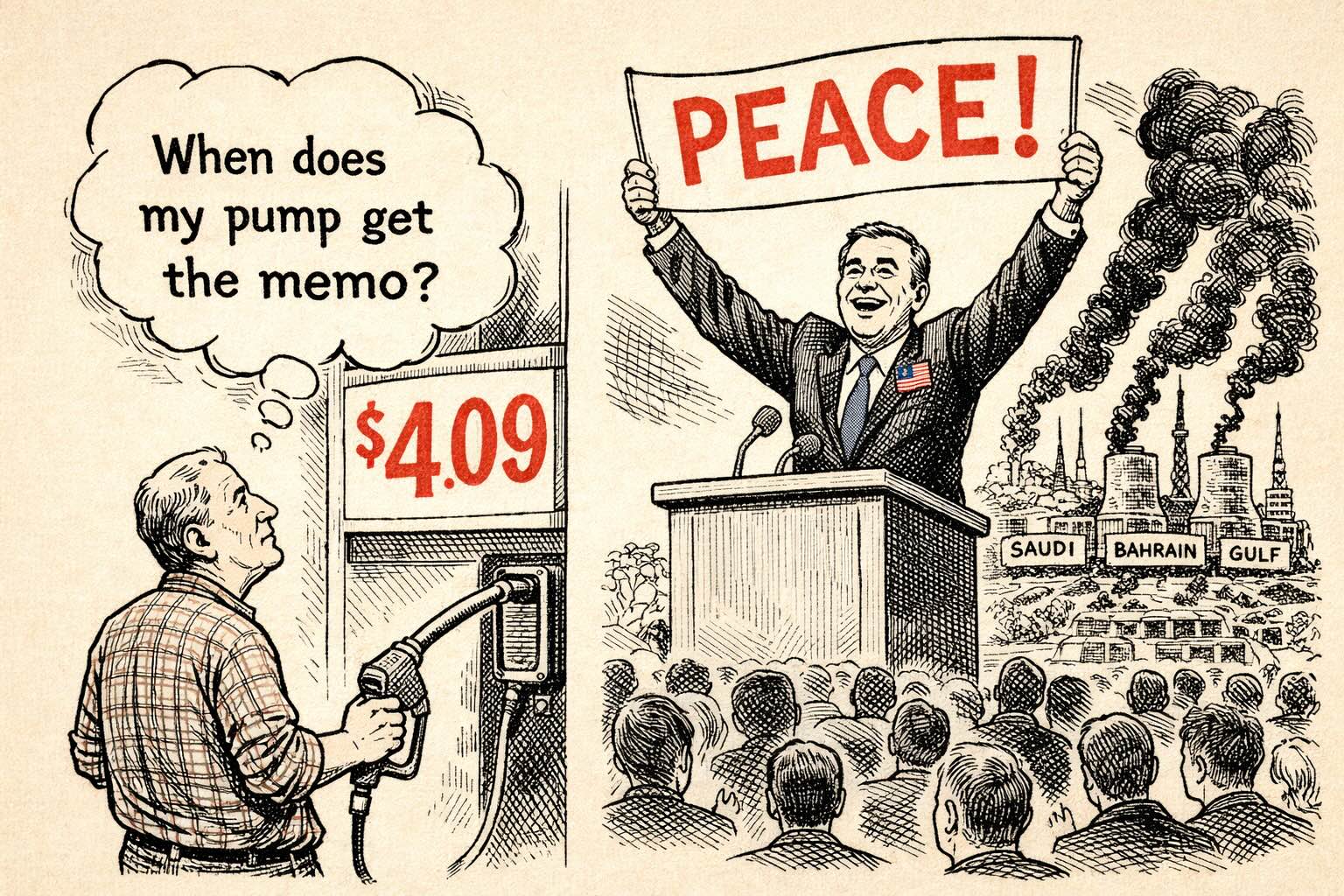

ARTICLE SUMMARY: Will gas prices drop during the Iran ceasefire? No, at least not by much. A 10-day Israel-Lebanon truce took effect Thursday, and Iran talks may restart this weekend, but pump prices are still $4.09 a gallon. Six weeks of Iranian retaliatory strikes damaged multiple Gulf Arab refineries, and Saudi Arabia cut production 20 percent on March 13. A ceasefire does not repair damaged refineries.
The question every driver is asking tonight is whether gas prices will drop during the Iran ceasefire. The honest answer is no, not by much, and the reason mainstream coverage is skipping has nothing to do with diplomacy.
A 10-day ceasefire between Israel and Lebanon went into effect early Thursday. President Trump said U.S. talks with Iran could restart this weekend. The cable news chyron says peace. Your pump says $4.09 a gallon. The peace is on paper only until the supply timeline catches up.
If you want the full picture on how this conflict is reshaping energy markets and what it means for American drivers, consumers, and investors beyond the 10-day ceasefire window, here is a recommended resource that breaks it down in depth.

The Iran ceasefire story has three separate moving parts, and only one of them has anything to do with diplomacy. Trump brokered the ceasefire. That is real. Iran still controls who passes through the Strait of Hormuz and is currently letting China, Russia, India, Iraq, and Pakistan through while blocking Western shipping. Saudi Aramco and the other Gulf producers own the damaged infrastructure. Their force majeure declarations are still in effect.
What Did the Iran Ceasefire Actually Change?
The diplomatic timeline and the supply timeline are two different clocks. A ceasefire announcement is not a supply recovery. It is a political signal that can reverse within days. Israel’s continued strikes on Hezbollah in Lebanon have already tested the agreement. Iran has said those strikes breached the terms.
The physical damage behind your fuel bill is real, and it is measurable. Ras Tanura, Saudi Aramco’s largest crude processing plant, handles 550,000 barrels per day and halted after a drone attack before restarting. The Satorp refinery, 460,000 barrels per day, went offline after April 7-8 incidents. Bapco Energies in Bahrain, 400,000 barrels per day, declared force majeure. The Manifa and Khurais production facilities in Saudi Arabia each lost roughly 300,000 barrels per day of capacity. A drone strike on a pumping station cut East-West pipeline flows by 700,000 barrels per day. On March 13, Saudi Arabia cut total production 20 percent, from 10 million barrels per day to 8 million.
Iran’s own oil terminal at Kharg Island is undamaged. The U.S. deliberately spared it. Iran’s oil revenue actually rose 21 percent in March, from $115 million per day in February to $139 million per day. The supply shortage is not Iran’s problem. It is the West’s.
Will Gas Prices Drop During the Iran Ceasefire? Don’t Count on It.
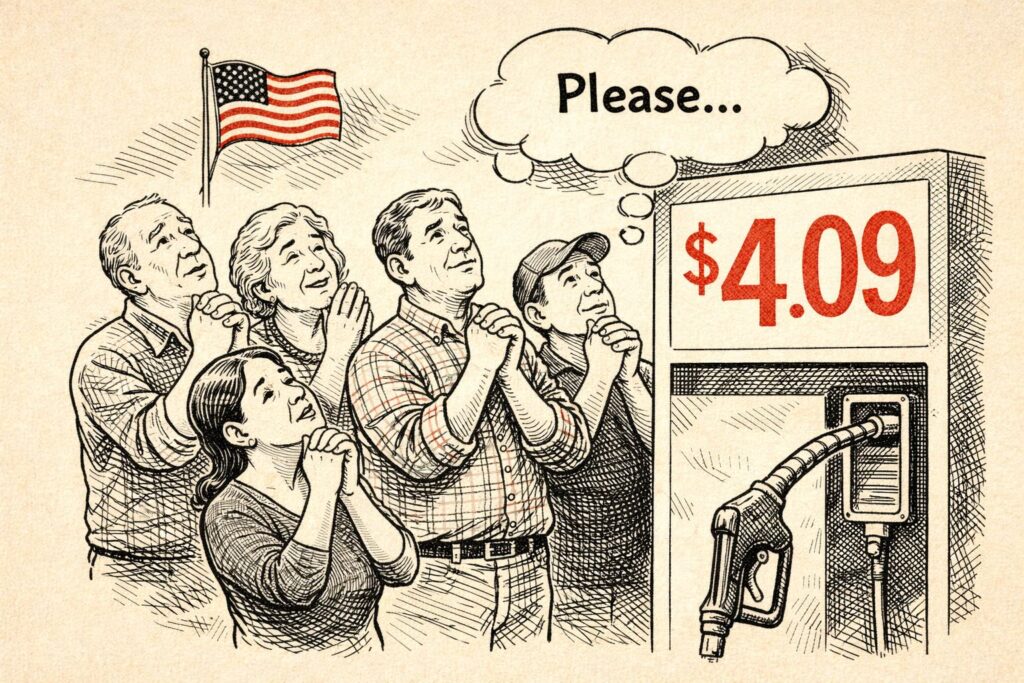
The national average is $4.09 a gallon, down 7 cents last week but still $1.11 above the $2.98 price on the day the war started last February 28. Diesel averages $5.61, and that flows straight into grocery prices through freight. The American Farm Bureau reports 70 percent of farmers cannot afford fertilizer at current prices. That shows up on your grocery receipt within weeks.
A Pew Research survey conducted March 23 to 29 found 69 percent of Americans are worried about higher gas prices from the Iran war. Newsweek interviewed drivers across five states in March. Francisco Castillo, a 43-year-old factory worker and Trump voter in Iowa, summed up what plenty of others are feeling. “He said he was going to bring gas down, but the war in Iran is now making everything worse.” A retired Republican in the same Newsweek piece put it this way: politicians’ promises are not going to pay the bills.
Treasury Secretary Scott Bessent told reporters this week he is optimistic about $3 gas prices by summer, as long as the Strait of Hormuz stays open. Moody’s chief economist Mark Zandi disagrees. He told USA Today there is no going back to pre-war prices this year.
Frequently Asked Questions
Will Gas Prices Drop During the Iran Ceasefire?
No, not by much. The ceasefire is a diplomatic event, and the supply shortage is a physical one. Multiple Gulf refineries remain under force majeure or reduced capacity from Iranian retaliatory strikes. A truce does not repair damaged infrastructure, and damaged infrastructure is what sets the floor on pump prices right now.
When Will Gas Prices Drop Back to Pre-War Levels?
Not in 2026, according to most analysts. Treasury Secretary Scott Bessent says $3 gas by summer is possible if the Strait of Hormuz stays open. Moody’s chief economist Mark Zandi disagrees, saying prices will not return to the $2.98 pre-war average this year. The truth depends on ceasefire durability.
How Is the Iran Ceasefire Affecting Grocery Prices?
Diesel averages $5.61 per gallon, which raises freight costs on every truckload of food. The American Farm Bureau found 70 percent of farmers cannot afford fertilizer at current fuel-driven prices. That pressure shows up in grocery prices within weeks, especially on produce, meat, and anything shipped long distances.
Is the Strait of Hormuz Open or Closed Right Now?
Both, depending on the ship’s flag. Iran is allowing ships from China, Russia, India, Iraq, and Pakistan to transit while blocking U.S., Israeli, and Western-allied shipping. U.S. Central Command says its blockade of Iranian ports is fully implemented. Western-bound oil, which matters most for U.S. pump prices, is not moving normally.