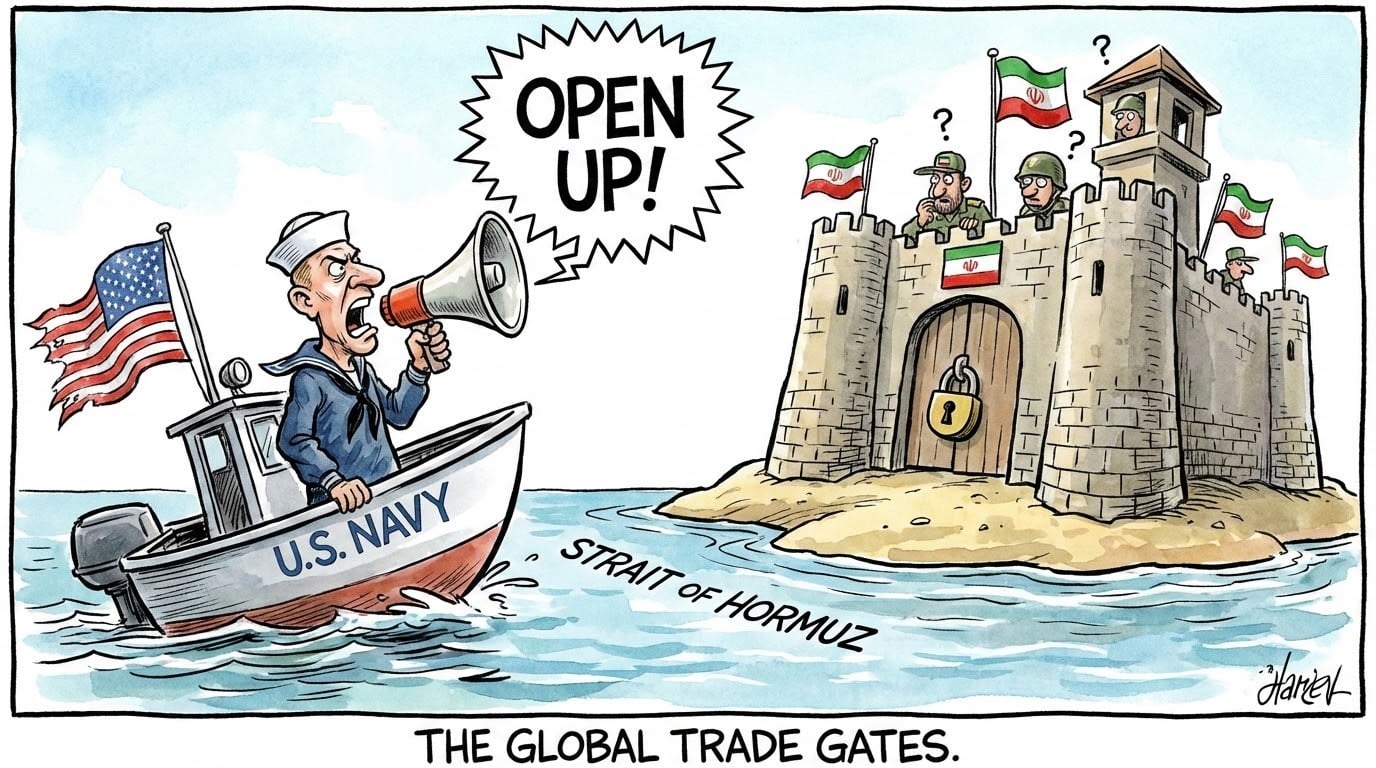

Quick Summary: Tonight at 8 p.m. Eastern, President Trump’s deadline for Iran to reopen the Strait of Hormuz expires. If no deal is reached, Trump has threatened strikes on every Iranian power plant and bridge within hours. Iran rejected the U.S. ceasefire proposal this morning, formed human chains around its power plants, and warned of consequences that will “stretch beyond the region.” Oil is trading above $113 a barrel. Your gas is at $4.11 a gallon. The answer to whether the Strait of Hormuz reopens tonight will be known in hours. What it means for your wallet is already clear.
The Strait of Hormuz is a 21-mile-wide waterway between Iran and Oman through which roughly 20% of the world’s daily oil supply normally flows. On February 28, the U.S. and Israel launched coordinated strikes on Iran under Operation Epic Fury, killing Supreme Leader Ali Khamenei and targeting nuclear sites and military facilities. Iran responded by effectively closing the Strait, cutting off roughly 20 million barrels of oil per day from global markets. Within days, tanker traffic dropped 70%. Within weeks, it was near zero. The International Energy Agency has called it the largest energy supply disruption in the history of the global oil market, larger than the 1970s oil embargo that put Americans in gas lines around the block.
How Does the Strait of Hormuz Closure Affect Your Gas Prices?
Before the war, U.S. crude oil was trading around $68 a barrel. It is above $113 today, a surge of nearly 70% in five weeks. The national average gas price was $2.98 before hostilities began. It is $4.11 today according to AAA. This is not a refinery problem or a domestic supply issue. American oil production has not changed. What changed is that the global market lost access to the oil that normally transits the Strait of Hormuz, forcing buyers worldwide to compete for whatever is available elsewhere. That competition is what you are paying for every time you fill your tank.This is not the first time a foreign conflict has hit American gas prices this hard. When the EU began pushing for a Russian oil ban in 2022, U.S. gas prices spiked as markets priced in the supply loss before a barrel was cut, a pattern playing out again today. What is different now is the scale and duration. Five weeks of Strait of Hormuz closure have done damage that a single policy announcement never could.According to NBC News live coverage this morning, Iran urged its citizens to form human chains around power plants ahead of tonight’s deadline, the King Fahd Causeway linking Saudi Arabia to Bahrain closed over Iranian attack threats, and Iranian drones injured 15 American service members at a Kuwait air base overnight. This is not a situation winding down ahead of an 8 p.m. deadline.
What Does the Strait of Hormuz Standoff Mean for Your Grocery Bill and Retirement?
 Gas prices are the number on the sign. They are not the full story. Petroleum is an input in the production and shipping of nearly everything Americans buy. Fertilizer prices have surged because roughly 30% of internationally traded fertilizers normally transit the Strait of Hormuz, and global fertilizer prices are running 15% to 20% higher in the first half of 2026 as a result. Aluminum and steel costs are climbing. Shipping surcharges are being applied across supply chains.Goldman Sachs has raised its 2026 U.S. inflation forecast to 3.1% andcut GDP growth projections while raising recession odds to 30% as a direct result of the conflict. Oxford Economics has modeled that if oil averages $140 a barrel for two months, the U.S. nears a temporary economic standstill while the eurozone, the U.K., and Japan tip into mild recession.For anyone within a decade of retirement, the math is specific. The Federal Reserve Bank of Dallas has modeled that even one additional quarter of Strait of Hormuz closure would lower global GDP growth by an annualized 2.9 percentage points. That is not an abstraction. That is the value of your 401(k), the purchasing power of your Social Security check, and the cost of everything in your cart between now and when this ends.
What Are the Two Outcomes Tonight and What Does Each Mean for You?
Trump has repeatedly extended his Strait of Hormuz deadlines, and Iran has repeatedly rejected temporary ceasefire proposals, insisting on a permanent end to the war, sanctions relief, and reconstruction funding before any discussion of reopening the waterway. As recently as this morning, a senior Iranian security source told CNN that the Strait “will not return to its previous condition unless the war is permanently stopped.”There are two scenarios after 8 p.m. tonight. In the first, Trump follows through on strikes against Iranian power plants and bridges. Energy analysts warn that scenario pushes oil toward $140 a barrel or higher, the level Oxford Economics says would create an economic standstill in the United States. In the second, Trump extends the deadline again or a partial framework is reached, markets get a temporary relief rally, and the standoff continues. Pakistani and Egyptian mediators are still working the phones. Iran is open to a 45-day ceasefire only if it guarantees a path to a permanent end to the war, according to Egyptian officials briefed on the talks.Here is what both scenarios share: even if the Strait of Hormuz reopens tomorrow, gas prices will not snap back to $2.98 next week. Eurasia Group analyst Henning Gloystein estimated Monday that shipping companies would need at least two months to resume normal operations after any ceasefire, and that damaged energy infrastructure across the Gulf could take months longer to repair. The damage to your wallet is already done. Tonight determines how much more is coming.You can’t control what happens at 8 p.m. You can control whether your tank is full.
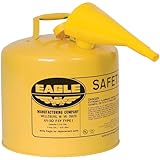
- Fits Your Needs - Type I safety cans have a single opening for filling and pouring fluids. They are used to safely store, transport, and dispense flammable liquids.
- Easy to Use - Comes with a funnel to help with filling and pouring. The gasketed spout cap self-closes to prevent leaks or spills, and the cap assembly opens automatically to vent internal vapors
- Safe - Features a fixed handle, double interlock no-weld bottom seam, and a non-sparking flame arrestor that helps prevent liquid inside the can from igniting and keeps flames from spreading
- Compliant - Meets OSHA Standard 1910.106 and NFPA code 30 requirements, FM, UL and ULC approved; lead-free technology featuring environmentally friendly hot dipped 24-gauge galvanized steel
- Made in America - US-Made from galvanized steel which resists rust, dents, and certain chemicals. Has a baked on powder-coat finish that resists scratches, chipping, fading, and other wear

(As an Amazon Associate, we earn from qualifying purchases.)
Frequently Asked Questions About the Strait of Hormuz Deadline
What is the Strait of Hormuz and why does it matter to Americans?
The Strait of Hormuz is a 21-mile-wide waterway between Iran and Oman and the only sea route out of the Persian Gulf. Roughly 20% of the world’s daily oil supply transits it. Iran closed it following U.S. and Israeli airstrikes on February 28, 2026, triggering the largest energy supply disruption in the history of the global oil market and driving U.S. gas prices from $2.98 to $4.11 per gallon.
What is Trump’s Strait of Hormuz deadline tonight?
President Trump has set 8 p.m. Eastern on Tuesday, April 7, 2026, as his deadline for Iran to reopen the Strait of Hormuz. If no deal is reached, Trump has threatened military strikes on Iranian power plants and bridges. Iran rejected the U.S. ceasefire proposal this morning and warned of severe retaliation if civilian infrastructure is targeted.
How high could gas prices go if the Strait of Hormuz stays closed?
U.S. gas prices rose from $2.98 to $4.11 per gallon because the Strait of Hormuz closure removed roughly 20 million barrels per day from global supply. American production has not changed. The increase reflects global buyers competing for whatever supply remains outside the Persian Gulf, with oil now trading above $113 a barrel.
Will gas prices go down if a deal is reached tonight?
Not immediately. Eurasia Group estimates shipping companies would need at least two months to resume normal operations after any ceasefire. Damaged Gulf energy infrastructure will take longer still. Relief is possible in the medium term, but no major energy analyst expects a return to pre-war gas prices in the near term.
Tonight’s Strait of Hormuz deadline will either start bringing your gas prices down or push them higher by morning. Which way do you think it goes? Vote in the poll above and tell us what you think in the comments.