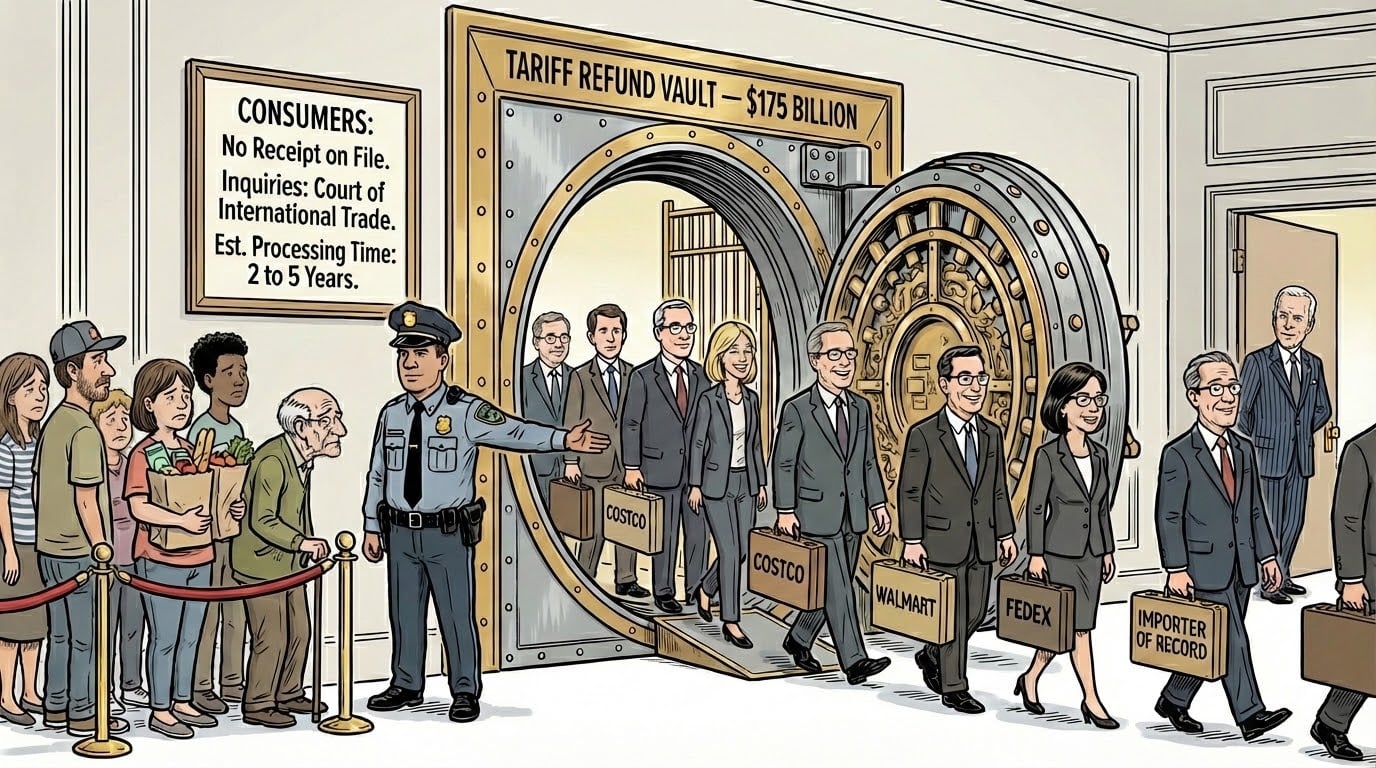

AEO SUMMARY: The Supreme Court ruled Trump’s tariffs illegal in February 2026. The government owes a tariff refund of roughly $175 billion. That money goes to the corporations that paid import bills at the border, not to households that absorbed the cost through higher prices. Treasury Secretary Scott Bessent confirmed it on camera. There is no legal mechanism for routing a tariff refund back to your grocery bill.
The Supreme Court ruled Trump’s tariffs illegal on February 20, 2026. A court ordered a tariff refund. The government had collected roughly $175 billion it had no legal authority to take. Treasury Secretary Scott Bessent went on camera at the Economic Club of Dallas and said: “I’ve got a feeling the American people won’t see it.”
He was not wrong. The reason has nothing to do with politics. It has everything to do with how tariff law has always worked. Nobody in the mainstream press is explaining it straight.
Here is the explanation.
How Does the Tariff Refund System Work?
Tariffs are paid at the border by the company importing the goods. When a container of washing machines arrives from overseas, Walmart writes a check to U.S. Customs. You never write that check. You pay it later, invisibly, through a higher price tag at the store. Federal trade law says any tariff refund goes back to whoever paid the customs bill. That is the importer of record. Not the person who bought the washing machine. Not you.The New York Federal Reserve found roughly 90% of tariff costs landed on U.S. consumers through higher prices. Kiplinger estimates $1,000 to $1,500 per household per year. The Joint Economic Committee puts 2026 closer to $2,500. But none of that creates a legal claim. You have no customs receipt. There is no line on your grocery bill that reads “tariff surcharge: $47.” Without that paper trail, there is no refund pipeline to your bank account.Economist Stephanie Roth of Wolfe Research said it plainly: “Walmart is not going to give you a check for the 15% tariff on sneakers you bought from them four months ago.”Trade lawyer Robert Shapiro put it this way: “We’re all splitting the check. But we may not all be splitting the recovery.”You can’t recover what the last twelve months cost you in tariffs. But you can control how the next twelve go. Start here:
As an Amazon Associate, we earn from qualifying purchases.
What Did Bessent Say About the Tariff Refund?
Bessent called any corporate tariff refund “ultimate corporate welfare” on Fox News the afternoon the ruling came down. In Dallas, he told the audience on camera that the American people “won’t see it.” He also confirmed tariff revenue would be “virtually unchanged” in 2026. The administration had a backup legal route ready before the ruling was even issued.The same day the Supreme Court struck down the IEEPA tariffs, Trump signed a new executive order imposing a 15% global tariff under Section 122 of the Trade Act of 1974. The Court struck down the method. The tariff revenue kept flowing.That is the gap between the official line and what the record shows. Bessent said publicly, on camera, that the administration never intended the money to go back to consumers. U.S. Customs told a federal trade court in March that it cannot immediately process the $166 billion owed to importers. The agency needs to manually review more than 70 million individual import transactions. It asked for up to four months just to assess its options. Interest on the unprocessed tariff refund pool is accruing at $650 million per month. That money adds to the corporate payout. Not yours.
What Is the July 24 Tariff Deadline and Why Does It Matter?
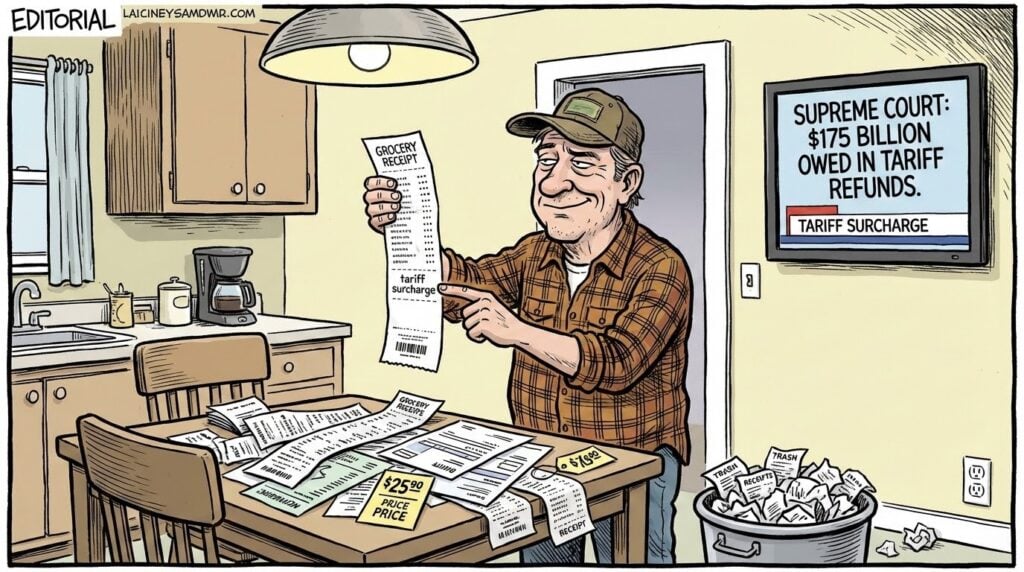 The tariff refund fight is settled for consumers. You are not in it. The clock that matters now is July 24, 2026. Trump’s Section 122 replacement tariff of 15% expires on that date. Section 122 has never been used to apply broad tariffs before. Multiple legal challenges have already been filed. Before July 24, Congress must decide whether to extend the tariff, pass new authority, or let it lapse.If it extends, tariff pressure on consumer goods continues. If it lapses, prices on some imported goods may ease slightly. If Congress passes permanent authority, the structural situation resets for years.Nobody in Washington is managing your purchasing power on your behalf. The administration confirmed that on camera in February. The question to ask before July 24 is simple: Who controls whether that tariff gets extended? Do they answer to you, or to the corporations now first in line for the $175 billion tariff refund?
Tariff Refund: The Egg Price Story Was Never About Eggs
The tariff fight in federal court was framed as a constitutional question about presidential power. That framing is accurate. What it leaves out is what you felt at the store: a year of higher prices on appliances, clothing, electronics, and food, absorbed quietly with no paper trail and no legal recourse. The refund went to the corporate layer because that is where the law says the money lives. The purchasing power loss lives somewhere else. It lives in your retirement window, in the gap between what you planned to have and what the last twelve months actually cost you. That gap does not get a court date. It gets a budget adjustment. Make yours before July 24.
Frequently Asked Questions
Who is actually receiving the tariff refund?
Companies that paid import taxes directly to U.S. Customs have legal standing to claim a tariff refund. That includes Costco, FedEx, Walmart, and roughly 300,000 other importers. More than 2,000 refund lawsuits have been filed in the Court of International Trade, and Trump told reporters the process could take five years.
Will any companies pass the tariff refund on to customers?
A few have pledged to. FedEx said it intends to return charges to shippers and consumers who paid directly, and Costco said it would pass savings through lower prices for members. Most major retailers have made no such commitment and are not legally required to do so.
Are tariffs still being collected after the Supreme Court ruling?
Yes. The same day the Court struck down the IEEPA tariffs, Trump signed a new order imposing a 15% global tariff under Section 122 of the Trade Act of 1974. That tariff expires July 24, 2026, unless Congress acts to extend it.
Could Congress send consumers a direct tariff refund check?
Legislation has been introduced to do exactly that. The American Consumer Tariff Rebate Act proposes roughly $1,020 per eligible single filer, and the Tariff Refunds for Working Families Act would create a similar Senate-side rebate. Neither bill has cleared the committee or received a floor vote.