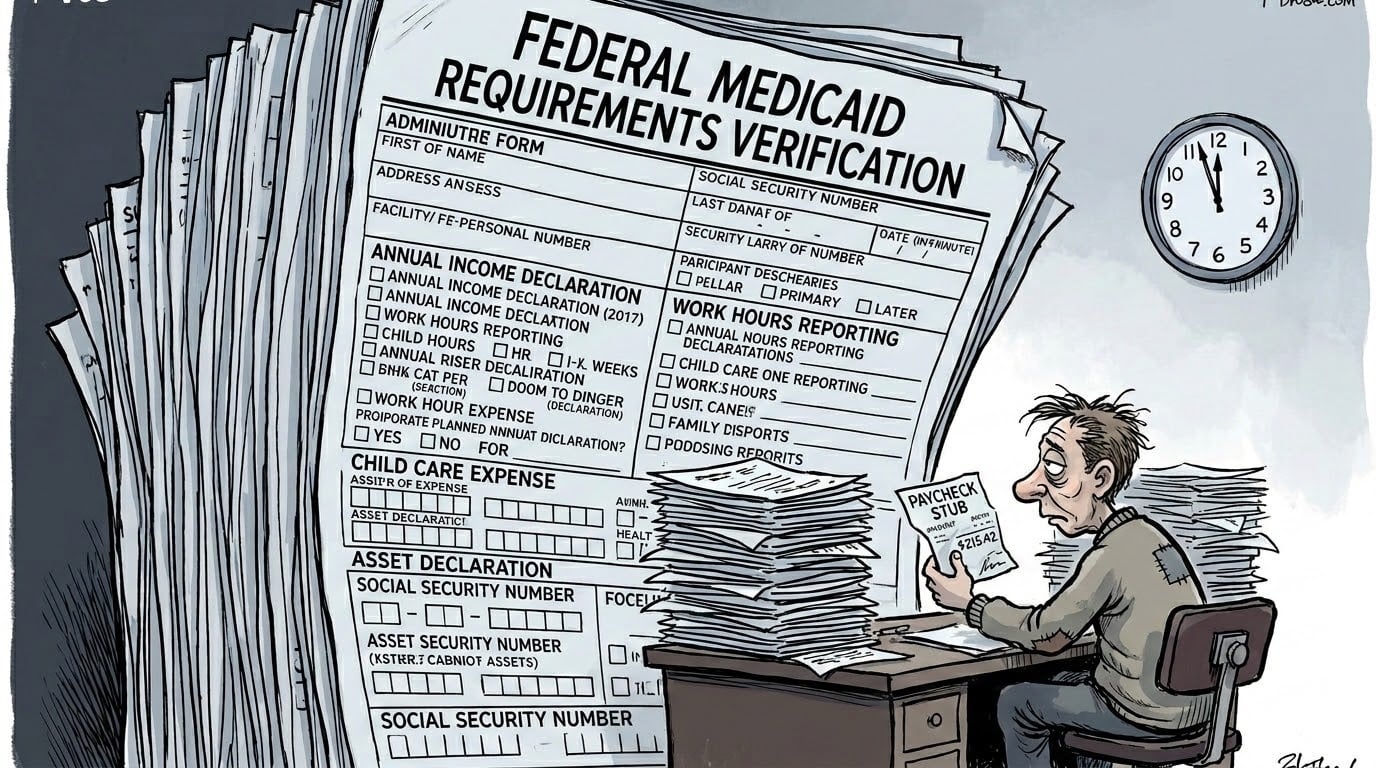

On June 2, Centers for Medicare and Medicaid Services Administrator Dr. Mehmet Oz released the official federal rule implementing Medicaid work requirements, meeting the statutory deadline set by last year’s One Big Beautiful Bill Act. The rule is not a proposal. It is not pending review. It is in effect. Forty-three states now have until January 1, 2027 to build the systems that will decide whether the people currently on their Medicaid rolls keep their coverage.
What the Medicaid Work Requirements Actually Mandate
The Medicaid work requirements rule applies to adults ages 19 to 64 who receive Medicaid through the ACA expansion and covers households earning up to 138% of the federal poverty line. In most states, that is roughly $20,800 for a single adult or $35,600 for a family of three.
To retain coverage, enrollees must document at least 80 hours per month of qualifying activity. Work counts. So do school, approved job training, community service, and certain caregiving arrangements. The keyword throughout is “document.” You don’t just need to work. You also need to submit proof to your state Medicaid office through systems that many states are still building. And you need to do so on a renewal schedule that now runs twice a year instead of once a year. Exemptions exist for pregnant women, parents or guardians of children under 14, veterans with service-connected disabilities, medically frail people, and several other categories. However, those exemptions are not automatic. You must apply for them and reapply at each of the twice-yearly eligibility checks.
The rule is in effect now. What determines whether people keep coverage is whether they can document compliance, not whether they are actually complying.
Nebraska Went First. Here Is What Happened.
Nebraska became the first state to implement Medicaid work requirements under the new law on May 1, eight months ahead of the federal deadline. Governor Jim Pillen and Dr. Oz announced the launch together in December. The state enrolled roughly 72,000 residents in the scope of the requirement.
The first group of Nebraska enrollees who could lose coverage is those with renewal dates ending July 31. They are being notified now. According to the Nebraska Department of Health and Human Services, people who do not submit their documentation within one month of notification may be denied or lose coverage. The Urban Institute projects that between 16,000 and 30,000 Nebraskans will lose coverage by 2028 from the work requirement and the new twice-yearly eligibility check combined. That is a decline of up to 35% of the Medicaid expansion population in the state. State officials say they have built safeguards and are monitoring closely. Advocates say the timeline was unnecessary and the systems are not ready.
Nebraska is the proof of concept and the warning. The first coverage losses under the new law begin in seven weeks.
Why Working People Lose Coverage Under These Rules

This is the part the national debate rarely explains clearly, so it is worth being direct.
The Congressional Budget Office projects that 5.2 million adults will lose Medicaid coverage by 2034 under the new work requirements. Research from the Urban Institute puts the range between 4.9 million and 10.1 million, depending on how hard each state works to minimize losses. Those are large numbers. But the more important number is this one: between 19% and 37% of the people projected to lose coverage are already meeting the work requirement. They work. They just cannot prove it.
The problem is documentation, not employment. Someone who works for a small landscaping company, a family-owned restaurant, or a home care agency often works for an employer who does not use a payroll system that integrates with state Medicaid verification databases. That person must manually document their hours, find the right form, submit it to the right state portal, and repeat the process twice a year, or their coverage stops.
Arkansas tried a version of this in 2018. In the first five months, more than 18,000 people lost coverage. Most were working. Most could not navigate the documentation system. A federal judge struck the program down in 2019. Georgia launched its version in 2023. By January 2024, only 6,500 adults had enrolled, a fraction of the 25,000 the state projected for the first year.
“After I had the baby, my Medicaid and food stamps were turned off,” one Georgia enrollee told Human Rights Watch in a 2026 report. “They said I failed to report that I was working.” That is not a failure of the work requirement principle. That is a failure of the documentation system. The principle and the system are two different things, and conflating them is how coverage losses happen to people who are doing exactly what the law asks.
Between 19% and 37% of the people projected to lose Medicaid coverage are already meeting the work requirement. They will lose coverage because of paperwork and not because they are not working.
What Your State Has to Do by January 1
Forty-three states and the District of Columbia have expanded Medicaid under the ACA and must now implement these requirements. The CMS rule released on June 2 is the official federal guidance states have been waiting for. States have been spending millions of dollars building new eligibility verification systems with an 18-month window that most Medicaid policy experts describe as extremely tight for an undertaking of this scale.
What states must build: systems to verify work status, process exemption claims, handle appeals, conduct twice-yearly eligibility checks for the entire expansion population, and provide enrollees with notice and a meaningful opportunity to demonstrate compliance before coverage is denied. All of this must be ready by January 1, and some of it involves integrating with employer payroll systems that do not currently communicate with state Medicaid databases.
Ten states have not expanded Medicaid and are not subject to these requirements. The ten non-expansion states are Alabama, Florida, Georgia, Kansas, Mississippi, South Carolina, Tennessee, Texas, Wisconsin, and Wyoming. If you live anywhere else, this rule applies to your state.
Forty-three states have less than seven months to build systems that will determine Medicaid eligibility for tens of millions of Americans. Most are still building.
What This Means If Someone in Your Household Is Covered
The people most at risk are not people who refuse to work. They are people who work for small employers without HR departments, people who work irregular hours, people who are in the complicated middle ground between medically frail and fully able-bodied, and people who have never had to navigate a government documentation system before.
If you have an adult child, a spouse, or a parent covered by Medicaid expansion in one of the 43 states, the practical question right now is not whether the policy is right or wrong. The practical question is: does that person know their state’s implementation timeline, know what documentation they need, and know whether they qualify for an exemption?
Medicaid covers more than 72 million Americans. For many households, it is the health coverage that bridges the gap between a job that does not offer insurance and Medicare at 65. A coverage loss does not come with a grace period. It comes with a bill. For households already operating without a financial cushion, that bill can be the difference between staying solvent and going under.
For further coverage of federal benefits cuts and what they mean for retirement-window households, see our reporting on Medicaid cuts and the CBO numbers and Medicare funding going to the war department budget.
Frequently Asked Questions:
What are the new Medicaid work requirements?
Adults ages 19 to 64 who receive Medicaid through the ACA expansion must document at least 80 hours per month of work, school, job training, or community service to keep their coverage. The rule was made official by CMS on June 2 under the One Big Beautiful Bill Act signed in July 2025.
Which states have to implement Medicaid work requirements?
Forty-three states and Washington D.C. have expanded Medicaid under the ACA and must comply with the new work requirements by January 1, 2027. Nebraska was the first state to implement, going live May 1.
Who is exempt from the Medicaid work requirements?
Exemptions apply to pregnant women, parents or guardians of children under 14, veterans with service-connected disabilities, people who are medically frail, and several other categories. Exemptions are not automatic and must be documented at each of the twice-yearly eligibility checks.
How many people could lose Medicaid coverage?
The Congressional Budget Office projects 5.2 million adults will lose coverage by 2034. Research from the Urban Institute puts the range between 4.9 million and 10.1 million. Between 19% and 37% of projected coverage losses involve people who are already meeting the work requirement but cannot document compliance.
When do Medicaid work requirements take effect?
The federal rule is in effect now. States must comply by January 1, 2027. Nebraska’s first affected enrollees face documentation deadlines starting July 31. Each state will set its own implementation schedule within the federal window.
What happens if I miss the documentation deadline?
If you fail to submit proof of qualifying activity within one month of notification, your Medicaid coverage may be denied or terminated. Nebraska enrollees with July 31 renewal dates are currently being notified. The rule requires states to provide notice and an opportunity to comply before coverage is cut.
Does the work requirement apply to everyone on Medicaid?
No. It applies only to adults ages 19–64 enrolled through the ACA Medicaid expansion. Children, seniors, and people on traditional Medicaid are not subject to the 80-hour requirement.What counts as qualifying activity under the 80-hour rule? Qualifying activities include employment, school enrollment, approved job training programs, community service, and certain caregiving arrangements such as caring for a child or a family member with a disability. Documentation of all activities must be submitted to your state Medicaid office on the twice-yearly schedule.