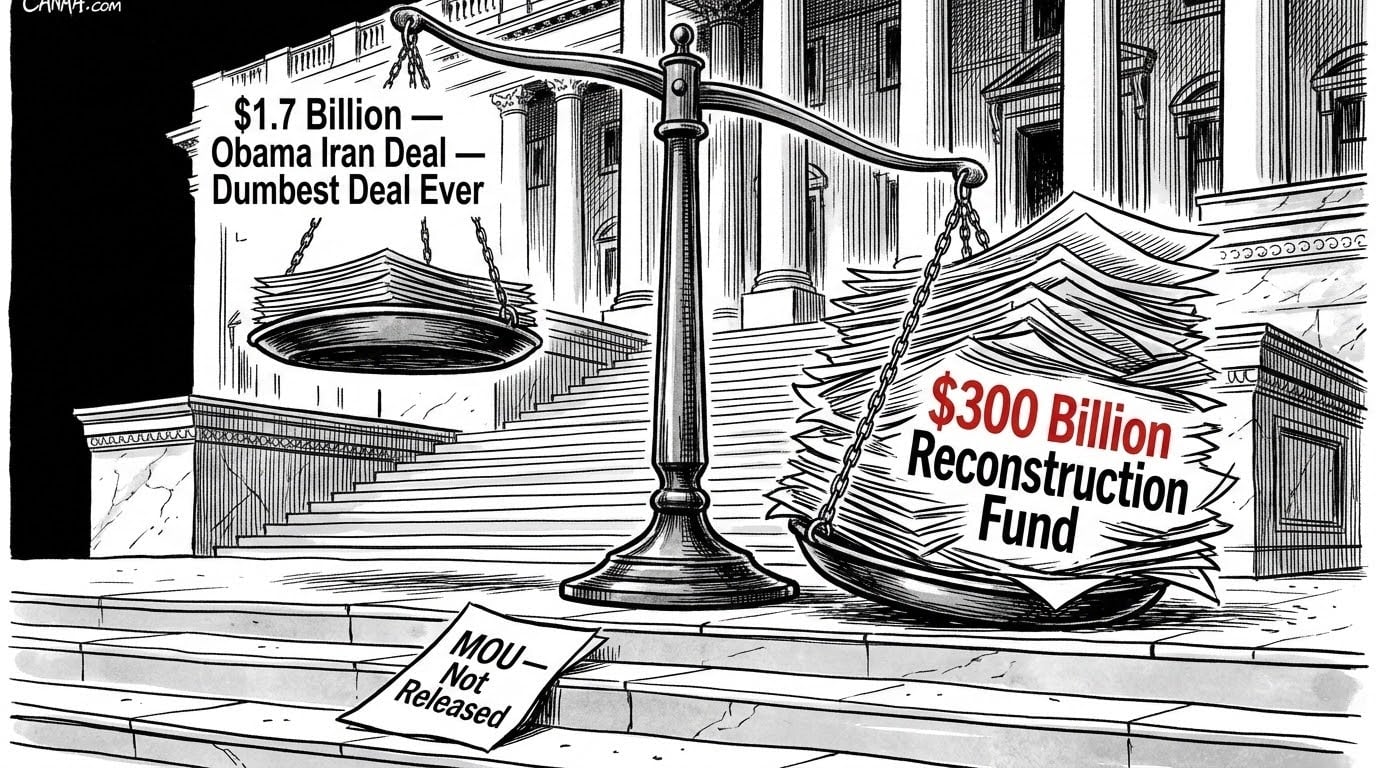

Vice President JD Vance confirmed on CBS News Monday that Iran could gain access to a $300 billion reconstruction fund if Tehran dismantles its nuclear program and accepts a stringent inspection regime. On the same day, President Donald Trump posted on Truth Social that the story about the United States’ plans to pay Iran 300 billion dollars is “fake news put out by the Dumocrats.” Both statements are on the record. Both cannot be fully true at the same time. Here’s what the primary sourcing actually shows.
What Does the Plan to Pay Iran $300 Billion Actually Include?
The US-Iran memorandum of understanding, signed digitally over the weekend and set for formal signing in Switzerland on Friday, includes a framework for a private investment fund that Reuters, citing a source with direct knowledge of the agreement, reported is valued at $300 billion. The fund, tentatively named the Reconstruction and Development Fund, would not include government money or grants. Companies from the United States, Gulf Arab states, South Korea, Japan, Singapore, Malaysia, South America, and Africa have reportedly committed capital, with Reuters reporting more than half the total already pledged.
Senior US officials have stated that zero dollars have flowed to Iran. The fund would activate only after a final deal is reached covering Iran’s nuclear program, sanctions relief, and regional security arrangements. The current memorandum opens a 60-day negotiating period toward that final agreement.
Vance’s CBS statement is the clearest on-record confirmation from a named US official. “Iran could have access to a reconstruction fund backed by Gulf states so long as they honor their end of the obligation,” Vance told CBS News Monday morning.
By Monday evening, Vance offered a different framing across multiple Fox News appearances. “Not a single cent of American money goes to Iran — not $300 billion, not $24 billion, not any of the money,” Vance told Sean Hannity. Asked whether the US signed off on Gulf states paying the fund, Vance said the agreement does not commit American dollars and that outside countries would invest in Iran only if Tehran meets all conditions. The full MOU text, which would clarify precisely what was signed, has not been released publicly.
Fox News host Mark Levin made that point on X: “If you want people to stop speculating about the MOU, release the MOU.”
What Did Trump Say About Far Smaller Iran Payments Under Obama?
The institutional record here is documented and specific.
In September 2015, Trump wrote that the Obama Iran nuclear deal meant “Iran receives a windfall of $150 billion which will no doubt fund terrorism around the world.” In August 2020, campaigning in Yuma, Arizona, Trump called the same deal “the dumbest deal I’ve ever seen.” Speaking on Fox News the following day, he added: “The Iran nuclear deal signed by President Obama gave them $150 billion, and that’s when the real terror started.”
What Obama’s deal actually involved: Iran’s own assets, frozen in foreign banks under sanctions, were unfrozen. The US Treasury Department put the accessible figure at approximately $56 billion. The US separately settled a decades-old arms dispute for $1.7 billion. Trump consistently described that combined figure as $150 billion.
The current framework involves a $300 billion private investment fund — not Iran’s frozen assets, but new capital commitments from private companies — contingent on a final nuclear agreement. It is approximately 175 times the $1.7 billion settlement Trump called a ransom payment and double the $150 billion figure he repeatedly used to condemn the Obama deal as an act of weakness.
Trump’s current position is that the fund is not a US payment. His 2015 position was that unfreezing Iran’s own assets constituted funding terrorism. The gap between those two positions and the documented figures is a question the public is entitled to ask. The primary documents are the place to look for answers — and those documents have not been released.
What Does the US Intelligence Community Say About Iran’s New Leverage?
The strategic context behind the deal’s terms matters for understanding why the figures are what they are.
According to the International Energy Agency’s March 2026 Oil Market Report, Brent crude rose more than 40 percent in the first 16 days of the US-Israel war with Iran alone, reaching $103.90 per barrel by March 15 before easing. The Strait carries approximately 20 percent of the world’s oil supply.
CNN, citing three unnamed US intelligence sources, reported this week that the intelligence community has assessed Iran now has the effective ability to shut down the Strait of Hormuz at will. This assessment, reported rather than independently confirmed by BNA, represents a significant shift in the balance of leverage that existed when the war began in February. One source familiar with the assessment told CNN: “We have now handed Iran de facto control over the strait — a weapon more powerful than any nuke.”
A senior Iranian source told Reuters that Tehran originally sought $400 billion in war damage compensation from the United States. Washington declined. The $300 billion private investment fund emerged from those negotiations as an alternative structure. The mechanics reflect the negotiating position both sides brought to the table.
Should the U.S. Actually Pay Iran 300 Billion Dollars to Stop the War?
The memorandum of understanding is a framework, not a final agreement. The 60-day period that opens Friday is intended to produce a comprehensive deal covering Iran’s nuclear program, sanctions structure, and regional security arrangements. What Iran’s nuclear obligations will specifically require, what the inspection regime will look like, and what triggers disbursement from the investment fund remain under negotiation.
The MOU text has not been released to the public. Multiple Republican figures, including Levin, have called for its release. Senator Cory Booker pressed Secretary of State Marco Rubio in a Senate Foreign Relations Committee hearing this month on whether the terms differed substantively from the Obama-era deal Rubio had criticized. Rubio disputed the comparison without releasing the document.
President Donald Trump said on Truth Social the deal is complete and Iran has agreed to never have a nuclear weapon. The 60-day negotiating period suggests the details of how that commitment will be verified are still being worked out.
Researched and fact-checked by the BreakingNewsAlerts.com editorial team. Primary documents verified. Anonymous-source-only claims flagged. See our editorial standards.
Frequently Asked Questions
Will the United States pay Iran $300 billion?
The United States government has stated no taxpayer money is in the fund. The $300 billion figure refers to a private investment fund outlined in the US-Iran framework agreement, to be financed by companies from the US, Gulf states, and Asia. Vice President Vance confirmed its existence on CBS News Monday morning, then clarified on Fox News the same evening that “not a single cent of American money goes to Iran.” The full memorandum of understanding has not been released publicly.
Did VP Vance confirm or deny the $300 billion fund?
Both, within the same day. On CBS News Monday morning, Vance confirmed Iran “could have access” to the fund if it meets its obligations. On Fox News Monday evening, he said “not a single cent of American money goes to Iran — not $300 billion, not $24 billion, not any of the money.” The MOU text that would clarify the precise terms has not been publicly released.
How does this compare to Obama’s Iran deal?
Obama’s 2015 nuclear deal unfroze approximately $56 billion in Iranian assets held in foreign banks — money that belonged to Iran and had been frozen under sanctions. Trump described that figure as $150 billion and called it the dumbest deal ever made. The current framework involves a $300 billion private investment fund of new capital commitments, not Iran’s frozen assets, contingent on a final nuclear agreement.
Has the deal been finalized?
No. The memorandum of understanding signed over the weekend opens a 60-day negotiating period. A formal signing ceremony is expected in Switzerland on Friday. The terms covering Iran’s nuclear obligations, inspection regime, and sanctions relief structure remain under negotiation.
Why is the fund $300 billion?
A senior Iranian source told Reuters that Tehran originally demanded $400 billion in war damage compensation. Washington declined that framing. The $300 billion private investment fund emerged as an alternative structure giving both sides an economic incentive to conclude a final agreement.
What is the Strait of Hormuz and why does it matter to this deal?
The Strait of Hormuz is a waterway between Iran and Oman through which approximately 20 percent of the world’s oil supply passes. The US blockaded it after the war began in February. According to the IEA’s March 2026 Oil Market Report, Brent crude rose more than 40 percent in the first 16 days of the war alone. CNN, citing three US intelligence sources, reported Iran now has the effective ability to shut the Strait down at will — a shift in leverage that shaped the terms both sides were willing to accept.