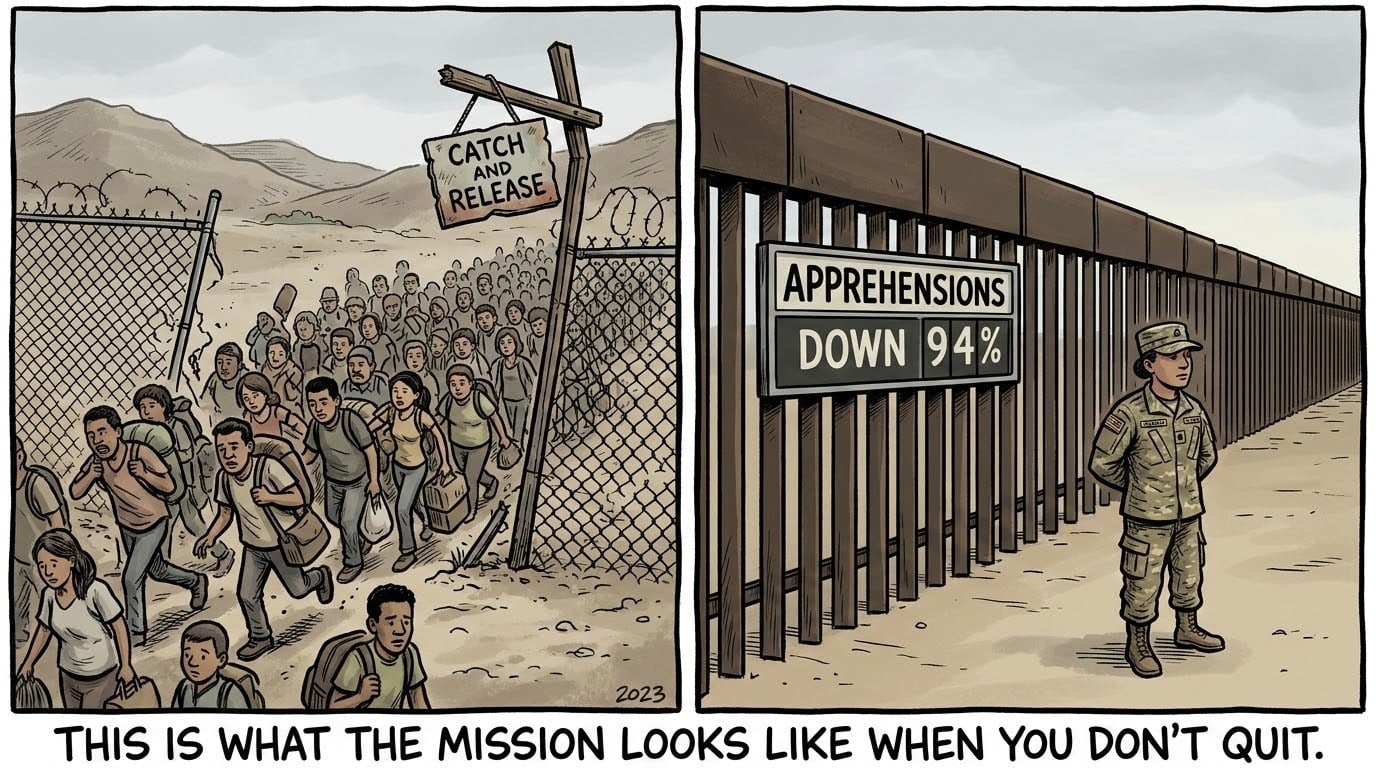

U.S. Customs and Border Protection recorded 9,998 southwest border apprehensions in May 2026, down 94 percent from the monthly average under the Biden administration. FY2025 full-year apprehensions came in at 237,538, the lowest total since 1970. President Donald Trump’s administration has now delivered 13 consecutive months of zero catch-and-release. Those are not projections. Those are the official government numbers.
The response to those numbers: expand the military presence anyway.
Illegal Border Crossings Are at Their Lowest Point in Over Half a Century
CBP recorded 9,998 southwest border apprehensions in May 2026, down 94 percent from the Biden monthly average and the lowest full-year total since 1970.
To understand what produced this result, start with the scale of the deployment. When President Donald Trump took office, fewer than 2,000 active-duty troops were stationed at the southern border. That number has grown to more than 8,000, with authorization to go to 10,000. The mission is not supplemental to civilian law enforcement. It is integrated with it. Troops deployed under Operation Ardent Vanguard work alongside Customs and Border Protection, running surveillance, operating unmanned aircraft systems, and managing National Defense Areas where military jurisdiction applies.
Those NDAs are now expanding. Defense Secretary Pete Hegseth directed the Air Force to take control of nearly 200 additional miles of federal land along the southern border, bringing previously civilian-administered land under military jurisdiction. One stretch covers 250 miles of the Rio Grande in Texas, transferred from the International Boundary and Water Commission to Joint Base San Antonio. Another 140-mile stretch near Yuma, Arizona now falls under Navy jurisdiction. Within these zones, trespassers face federal charges in addition to immigration charges, and troops are authorized to detain individuals until civilian law enforcement takes custody.
DHS Secretary Markwayne Mullin stated the administration’s position plainly in the June 19 CBP release: “Thirteen straight months of ZERO releases at the border. The days of catch and release are over.”
Sustained Pressure Is What Keeps Illegal Border Crossings Down
The crossings fell because pressure held. They will stay low because pressure is increasing. That is the documented sequence.
The mainstream press has framed the military expansion as a question worth asking: why expand when the numbers are already this low? It is the wrong question, and Border Patrol Chief Mike Banks answered it directly last fall when apprehensions were already at historic lows.
“Even if you make it past us down here,” Banks said, “you should fear that you’re still going to be apprehended in this country if you’re here illegally and then deported.” That is the doctrine. Deterrence does not work when enforcement is visibly pulling back. Every previous administration that declared the border under control and began scaling down learned this at the cost of the numbers reversing. The Trump administration is not making that mistake.
The drug numbers confirm the border is not simply quieter. It is more productive on every enforcement metric. CBP seized 56 percent more drugs in the current fiscal year through May than during the same period in FY2024. Fentanyl seizures alone jumped 72 percent in May 2026 compared to April. The cartels have not stopped operating. What has changed is that more of what they are moving is being intercepted. That is what operational control of the border looks like in practice.
CBP seized 56 percent more drugs this fiscal year through May than the same period in FY2024. Fentanyl seizures alone jumped 72 percent in May 2026.
The Military Is Expanding Because Deterrence Requires Permanence
Every administration that declared victory and scaled back enforcement watched the numbers reverse. This one is not.
The mainstream framing treats the expansion as a paradox. It is not. It is the lesson of every previous enforcement cycle applied. When Border Patrol signaled in previous administrations that its presence was being reduced, crossing numbers climbed within months. The Trump administration has explicitly rejected that pattern. Hegseth’s NDA expansion is not a reaction to a crisis. It is a structural commitment to prevent the next one.
The Border Funding Is Locked In Through 2029
The Secure America Act locked in approximately $69.5 billion for ICE and CBP through 2029 via reconciliation funding. Congress cannot quietly cut this in the next budget cycle.
Results matter. So does the architecture that sustains them. The Secure America Act, signed by President Donald Trump on June 10, locked in approximately $69.5 billion for ICE and Customs and Border Protection enforcement operations through 2029 via reconciliation funding, roughly $38 billion for ICE and $26 billion for CBP, with the remainder designated for contingency operations. This is not an annual appropriation subject to the next budget negotiation. It is not leverage for a continuing resolution fight. It cannot be quietly zeroed out when political winds shift after the midterms.
That distinction matters to anyone who remembers how enforcement gains evaporated under previous administrations. Annual funding can be cut in a single appropriations bill. Reconciliation funding through 2029 requires a specific legislative action to undo. The barrier to reversing this is structural, not political. CBP enforcement statistics confirm the sustained trajectory.
What the Border Looks Like When Enforcement Actually Works
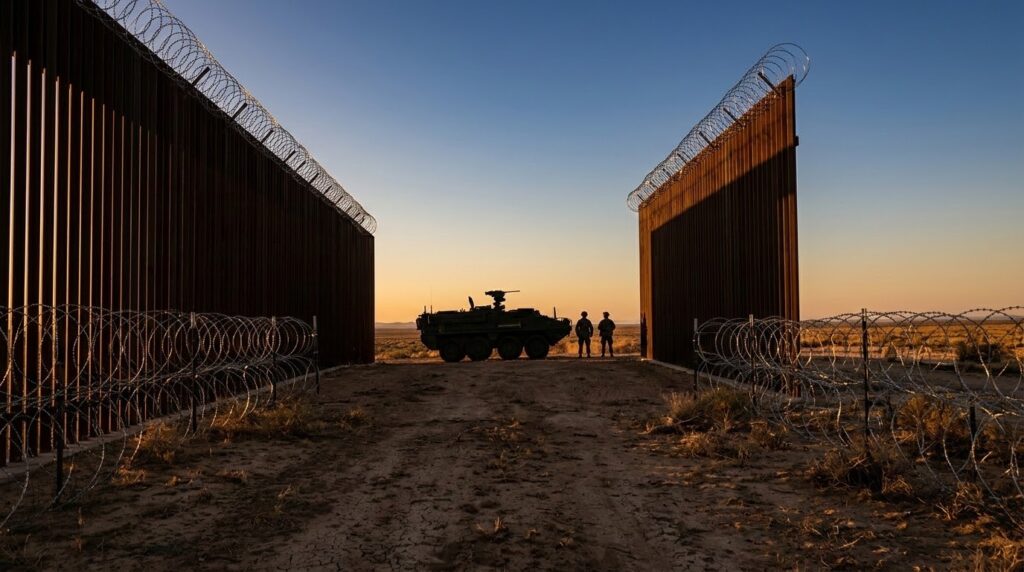
In September 2021, more than 15,000 migrants camped under the International Bridge in Del Rio in a matter of days. In May 2026, Border Patrol recorded fewer than 10,000 apprehensions across the entire southwest border for the full month.
“There was a time when they shut the bridge down here because the population of immigrants was so big, they were afraid that there may be a rush to the border,” said Leo Martinez, a Del Rio, Texas resident who has lived on the border through multiple enforcement cycles. Del Rio was the epicenter of the Haitian migrant surge in September 2021, when more than 15,000 people camped under the International Bridge in a matter of days. That scene, which played out on national television for a week, is now a reference point for what the border used to look like.
In May 2026, Border Patrol recorded fewer than 10,000 apprehensions across the entire southwest border for the month. The mission produced the result. The administration is pressing the advantage while it holds. Illegal border crossings are at a 55-year low, the military footprint is growing, and the funding is locked in. The question the mainstream press is not asking is the one that matters: what happens if this pressure ever lets up?
The administration has already answered it. It is not letting up.
Frequently Asked Questions
How low are illegal border crossings right now?
CBP recorded 9,998 southwest border apprehensions in May 2026, down 94 percent from the monthly average under the Biden administration. FY2025 full-year apprehensions came in at 237,538, the lowest annual total since 1970.
Why is the military expanding at the border if crossings are already at a record low?
The Trump administration’s position, stated by Border Patrol Chief Mike Banks, is that sustained pressure is what produced the low numbers in the first place. Previous administrations scaled back enforcement after declaring success and watched crossings reverse. The current expansion is designed to lock in the gains rather than declare victory and pull back.
What are National Defense Areas and what do they mean for the border?
National Defense Areas are stretches of federal land placed under military jurisdiction, effectively treated as military installations. Defense Secretary Pete Hegseth has expanded these zones by nearly 200 additional miles. Within NDAs, individuals who cross face federal trespassing charges on top of immigration charges, and troops are authorized to detain them until civilian law enforcement takes custody.
What is Operation Ardent Vanguard?
Operation Ardent Vanguard is the active military mission integrating U.S. troops with Customs and Border Protection at the southern border. Soldiers operate surveillance systems, unmanned aircraft, and support National Defense Areas where military jurisdiction applies alongside civilian immigration enforcement.
Is the border enforcement funding permanent?
The Secure America Act, signed by President Donald Trump on June 10, 2026, locked in approximately $69.5 billion for ICE and CBP through 2029 via reconciliation funding, not annual appropriations. It cannot be quietly cut in a budget negotiation or continuing resolution fight.
Are drug seizures up or down with the new border enforcement?
Up significantly. CBP seized 56 percent more drugs in the current fiscal year through May than during the same period in FY2024. Fentanyl seizures jumped 72 percent in May 2026 alone compared to April.
What happened in Del Rio, Texas in 2021 and how does it compare to today?
In September 2021, more than 15,000 migrants camped under the International Bridge in Del Rio in a matter of days, forcing officials to shut down the bridge entirely. In May 2026, Border Patrol recorded fewer than 10,000 apprehensions across the entire southwest border for the full month.
How many troops are currently deployed at the southern border?
As of mid-2026, more than 8,000 active-duty troops are stationed at the southern border, up from fewer than 2,000 when President Donald Trump took office in January 2025. Authorization exists to expand that deployment to 10,000.