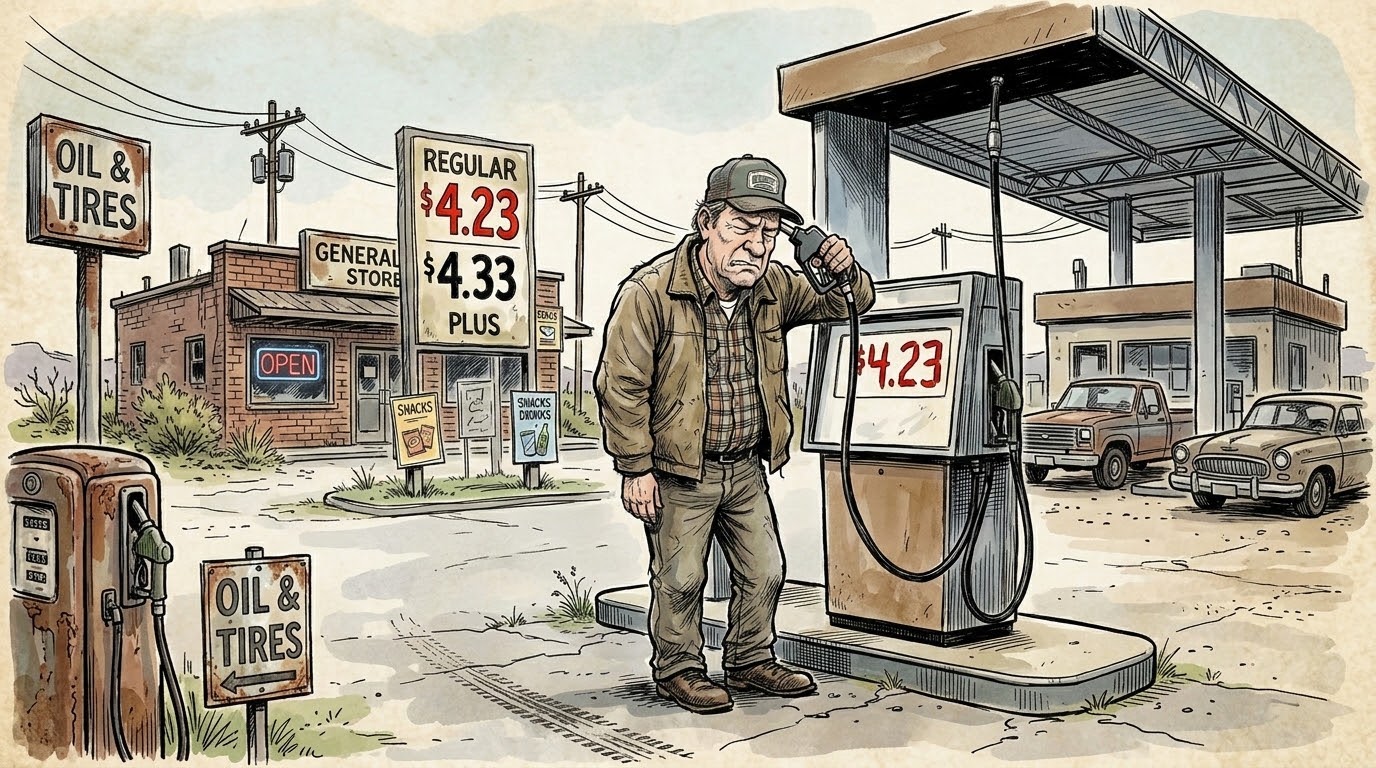

QUICK SUMMARY: The Iran war enters its third month today. The Strait of Hormuz stays closed. American gas prices hit $4.23 a gallon on Wednesday, a four-year high and more than 40% above pre-war. The administration cannot agree on when prices will come down: the President says soon, his own Energy Secretary said 2027. Either way, the average household is paying hundreds more at the pump this year. Here is what that means for your budget.
The Iran war hits its two-month mark today, entering month number three. American gas prices climbed to $4.23 a gallon on Wednesday, a fresh four-year high per AAA. The Strait of Hormuz stays closed. Brent crude topped $114.60 a barrel, up nearly 25% from the recent low on April 17. The President meets with his national security team in the Situation Room today on Iran’s latest offer to reopen the Strait. Three ships transited on Monday. Before the war, hundreds did every day.
The naval blockade of Iranian ports has been in place since April 13. Peace talks broke down in Islamabad, restarted, broke down again. American gas prices are now the political receipt the administration is trying to outrun.
Why The Strait Of Hormuz Sets The Global Oil Price
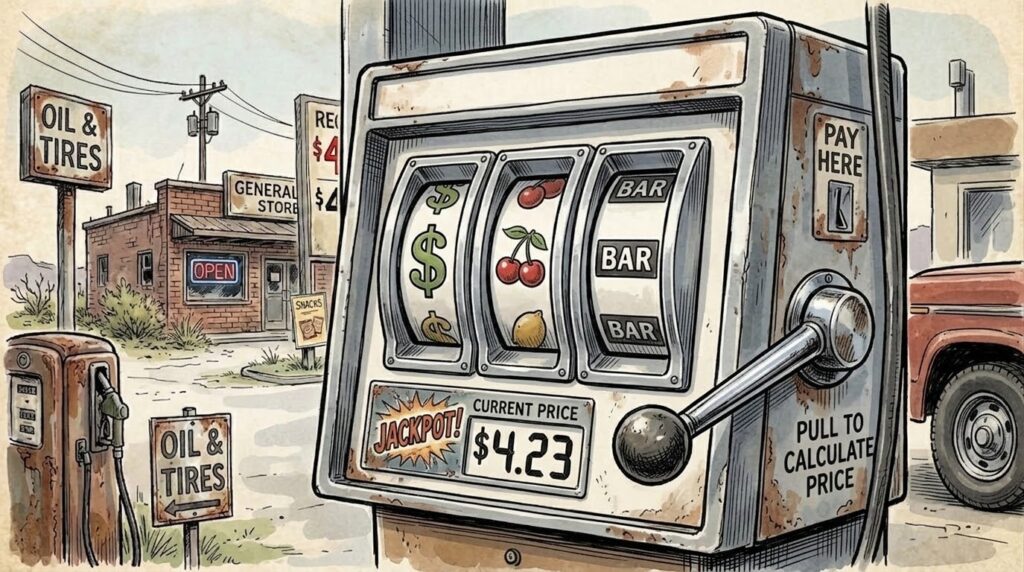
Roughly 25% of the world’s seaborne crude oil moves through one waterway off the southern Iranian coast. There is no second route. There is no overland workaround at scale. Saudi, UAE, and Iraqi pipelines exist but carry roughly half the volume the Strait normally handles.
Pre-war, hundreds of tankers transited the Strait every day. This week, the count is in single digits. The World Bank, in its latest Commodity Markets Outlook, called the disruption the largest oil supply shock on record.
This is geography, not weather. One waterway. One outcome at the pump. Close the Strait for any reason: war, blockade, mines, brinksmanship, and the global oil price moves. That is the structural force behind every gas price headline this spring. The Strait closure is not a Trump story or an Iran story. It is a choke-point story that was always going to produce this outcome the moment shipping stopped.
The Pump Math of American Gas Prices At $4.23 A Gallon
AAA reports the U.S. average at $4.23 a gallon on Wednesday, a new high for 2026. Pre-war, the average was $2.98. That is a $1.25 jump per gallon, or more than 40%. Diesel averaged $3.50 in January. Today it is around $5.65 — a 61% jump that hits anyone hauling, farming, contracting, or running a small business with a truck on the road.
For a household with two cars and two fill-ups a week, the math is roughly $20 to $25 more per fill-up. That is $80 to $100 a month coming out of the budget that used to cover something else.
The cumulative number is worse. Researchers at Brown University’s Climate Solutions Lab calculate that the war has so far cost American households $210 each in inflation impact. Roger Pielke Jr., a senior fellow at the American Enterprise Institute, a conservative think tank, puts the monthly per-household hit at $410 once grocery, heating, and travel costs roll in. An economist using oil futures data projects the average American driver will pay an extra $235 at the pump over the next year alone — and that projection was built before Wednesday’s $4.23 reading. The real number is now higher.
Heating oil is up 30.7% year over year. Grocery prices are next, because fertilizer is made from natural gas, and natural gas supply is constrained for the next two years, per the International Energy Agency.
A community advocate working with families absorbing the hit summarized it bluntly: “People are having to make these difficult choices between paying for medical care or paying for gas the next few weeks.”
That is the daily reality behind the headline number.
The Officials Behind The Blockade And The Strait of Hormuz Closure
The President authorized the war on Feb. 28. The President ordered the naval blockade on April 13. The President is meeting with his national security team in the Situation Room today on whether to accept Iran’s offer to reopen the Strait in exchange for lifting the blockade.
Iranian President Masoud Pezeshkian is the public negotiator on the Iranian side. He says Iran will not enter forced negotiations and that the U.S. naval blockade must end before any deal. Iran’s parliament speaker Mohammad Bagher Ghalibaf said Tuesday that reopening the Strait of Hormuz is impossible while the U.S. blockade continues.
Mojtaba Khamenei was named Iran’s new Supreme Leader after his father was killed on Day 1 of the war. He has not been seen publicly since.
Secretary of State Marco Rubio publicly rejected Iran’s latest Strait offer on Fox News, calling it an attempt to charge tolls on an international waterway. Defense Secretary Pete Hegseth faces Congressional questioning Wednesday — the first time he has appeared on the Hill since the war began. Energy Secretary Chris Wright and Treasury Secretary Scott Bessent disagree publicly on when American gas prices come down.
Every move from here traces to a decision by one of these officials. “The administration” is not a mechanism owner. These names are.
The Administration Cannot Agree on When American Gas Prices Will Come Down
On April 14, the President told Fox Business that gas prices would go down tremendously once the war ends. Two days earlier, on the same network, he told a different host that prices could be the same, or maybe a little bit higher.
On April 19, the Energy Secretary told CNN that gas prices may not drop below $3 per gallon until later this year or 2027. The Treasury Secretary said earlier in April that consumers could see gas with a three in front of it by summer — a window that technically includes $3.99.
On April 21, the President called his own Energy Secretary totally wrong in a phone interview.
On April 16, asked by a reporter how much longer Americans would face high pump prices, the President said: “Well, they are not very high.”
The clearest statement came not from the White House but from Mark Zandi, chief economist at Moody’s Analytics: “I think the damage has already been done, in part because there’s no going back on oil prices, at least not any time in the near future.”
This is the moment to plan for the longest of the four timelines, not the shortest. If your household budget assumes $2.98 gas by Memorial Day, that budget is already wrong by $1.25 per gallon.
The “State Of Collapse” Claim
The President posted on Truth Social Tuesday that Iran “informed us that they are in a ‘State of Collapse'” and wants the Strait reopened immediately. The post named no source. It cited no document. It described no channel through which the message was delivered.
Hours later, Iran’s parliament speaker said publicly that the Strait will stay closed until the U.S. blockade ends. The Iranian foreign ministry has rejected forced negotiations.
Both are claims. Neither is verified by an outside source. Brent crude at $114.60 is verified as it trades on a public exchange. The AAA $4.23 average is verified as it tracks transactions at real pumps. Three ships through the Strait Monday is verified as satellite tracking confirmed them.
Treat the verifiable numbers as your planning data. Treat both governments’ positioning as positioning.
The Retirement-Window Math In 2026
This is the year the retirement math stops working without an adjustment.
- The 2026 Social Security cost-of-living adjustment is 2.8%. For the average retiree, that is $56 more a month, moving the average benefit from $2,015 to $2,071.
- Medicare Part B premiums rose 9.7% this year, from $185 to $202.90. That $17.90 increase comes out of the Social Security deposit before it ever lands in the account.
- Net COLA after Medicare: roughly $38 a month.
- Average extra fuel cost from the war at $4.23 gas: now north of $25 a month minimum, before grocery and heating spillover hit later this year.
For a reader 8 years from full Social Security, that is the math of a 2.8% raise getting eaten by 9.7% Medicare and a 40% gas hike in the same year. The COLA was supposed to protect purchasing power. In 2026, it is not. Inflation came in at 3.3% for the 12 months ending in March. Food prices are projected to climb further as fertilizer constraints work through the supply chain. The long tail the economists keep mentioning is the part that outlasts the ceasefire by 6 to 12 months.
Planning The Next Six Months Of Pump Costs
The pump price is the receipt for a political decision made in February and a blockade order made in April. There is nothing the average reader can do about Hormuz. There is something the average reader can do about a household budget built on $2.98 gas and a 2.8% raise that Medicare ate.
Plan for the longest timeline the administration has named: 2027 for sub-$3 gas. Run the next six months on that assumption. If a deal lands tomorrow and prices drop in July, that is a windfall. If they do not, you are not the household scrambling in October.
Watch the Wednesday Hegseth Congressional hearing for the first independent accounting of where this war goes from here. Watch today’s Situation Room outcome — if a deal is signed, expect Brent to drop 8 to 10% overnight. If talks collapse, $118 Brent is back on the table, and pump prices follow within a week.
The Iran war is two months old today. The Strait is still closed. American gas prices are the receipt for a political decision made in February. Plan accordingly.
Frequently Asked Questions
When will American gas prices come down?
The administration is publicly split on this. The Energy Secretary said it could be 2027 before gas drops below $3. The Treasury Secretary said summer. The President said his own Energy Secretary is totally wrong. Independent economists say the damage to oil prices is already done and ceasefire-day pump prices will not be ceasefire-week pump prices. Plan for the longest timeline.
Is the Strait of Hormuz actually closed?
Effectively yes. Three ships transited on Monday versus hundreds per day pre-war. The U.S. Navy is blockading Iranian ports. Iran is restricting traffic in retaliation. Even when a deal is signed, analysts say it could take months for shipping to return to normal levels and pump prices to normalize.
How much is this costing my household?
Roughly $235 extra at the pump over the next year for the average driver, per oil futures data — and that projection was built before Wednesday’s $4.23 high, so the real number is now higher. The American Enterprise Institute, a conservative think tank, puts the broader monthly hit at $410 per household when grocery, heating, and travel costs are included. Households 8 years from retirement are also absorbing a 9.7% Medicare Part B premium hike that eats most of the 2.8% Social Security COLA.
Is Iran really collapsing as the President said?
That claim came from a Trump Truth Social post on Tuesday with no source named, no channel cited, and no document attached. Iranian officials publicly contradict it. Until either side produces verifiable evidence, treat it as a claim, not a fact. The verifiable numbers — $114.60 Brent, $4.23 gas, three ships through the Strait — are what to plan around.