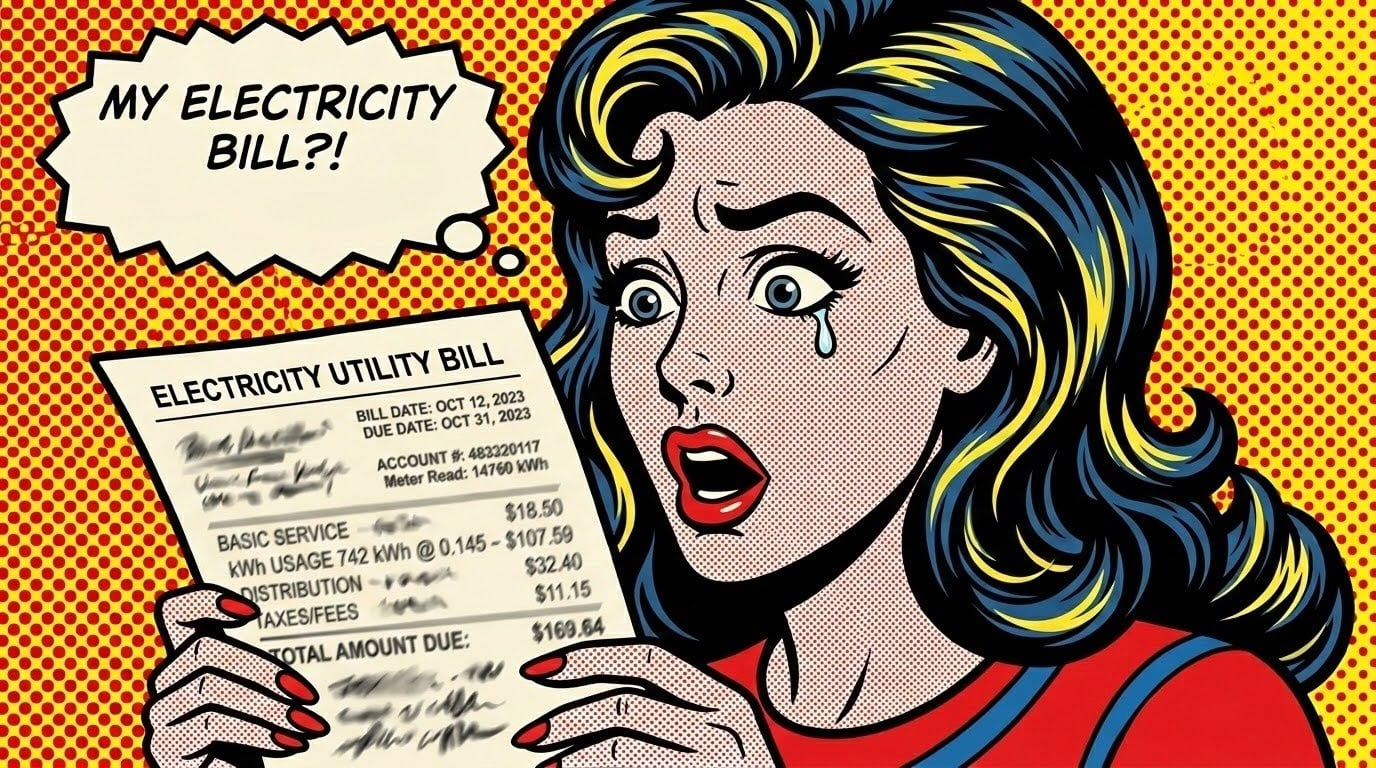

QUICK SUMMARY: The average American household electricity bill climbed roughly 21 percent in five years. The federal government’s own forecast says the increases aren’t slowing down. For Americans on a fixed retirement income, this is the household cost that can’t be cut by driving less or switching grocery brands. It’s the bill you open and pay because you have no other choice, and the worst part is that the current number is the floor, not the peak.
The U.S. Energy Information Administration tracks the residential price of electricity in cents per kilowatt-hour. Five years ago, the national average sat at 14.92 cents. As of April 2026, it has risen to 18.05 cents. That’s a 21 percent increase across all 50 states.
The 12-month change is just as telling. Residential electricity is up 9.5 percent over the last year alone, well outpacing general inflation. In Maine, the year-over-year jump hit 17.6 percent. In California, Massachusetts, and Hawaii, residential rates now sit above 30 cents per kilowatt-hour, nearly double the national average.
The EIA forecasts another 8.5 percent wholesale electricity price increase through the rest of 2026. Wholesale prices feed into retail prices, which feed into the bill at your front door. The trajectory is set.
The Bill You Cannot Escape
Gas, you can ride out. You can also skip your annual road trip. Then, drive to the grocery store once instead of twice. Carpool to church. Even with gas prices spiking, there’s still room to adjust your driving. Groceries you can substitute. Trade chicken for beef. Store brand for name brand. Pasta night when steak is $13 a pound.
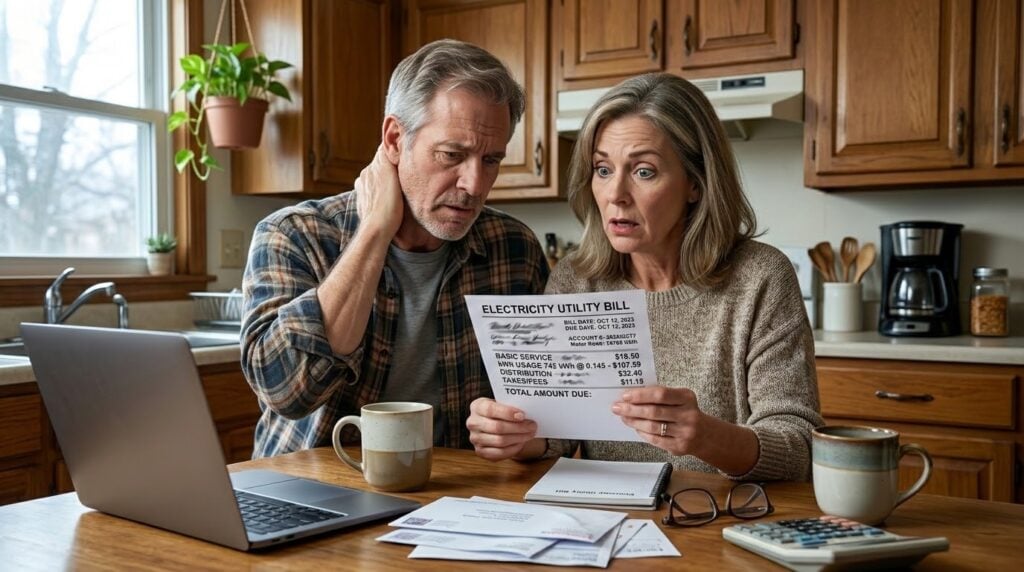
Heating in January and air conditioning in July aren’t optional. Especially for older Americans, where temperature control isn’t a comfort question but a health question. A retired Texas resident named Peter, interviewed by AARP Texas in March, put it as plainly as it can be put. “After my mortgage, it is my single largest expense,” he said. “Sometimes it’s right even with it.” Peter relies entirely on Social Security. His electricity bills, he said, doubled in less than four years.
That’s the math that doesn’t get covered when the news talks about inflation. The expense most households can’t opt out of has already doubled for some people on fixed income, and the federal forecast says the next phase is more of the same.
What’s Driving Your Electricity Bill Higher in 2026?
The structural reasons aren’t a one-year story. They’ve been building for the better part of a decade.
The American electric grid is aging. Utilities are replacing transmission lines, substations, and generation infrastructure that in many cases dates to the 1960s and 1970s. The Edison Electric Institute has documented that utilities plan to spend up to $1.4 trillion on infrastructure between 2025 and 2030. That money is recovered from ratepayers through the bill that arrives every month.
Natural gas is the second structural driver. About 40 percent of U.S. electricity is generated by burning natural gas, which means natural gas prices set power prices in most regional markets. When natural gas wholesale prices move, residential electricity prices follow on a lag. The Iran war and the broader energy market disruption have kept natural gas prices elevated in 2026.
Demand is the third driver. Electricity demand is rising for the first time in decades, after years of relatively flat consumption. Industrial users, data centers, and home electrification are all drawing more from the grid. New supply hasn’t kept pace with new demand, and basic supply-and-demand economics does the rest.
None of this is the result of a single decision by a single official. The grid is aging because grids age. Natural gas prices move because of global energy markets. Demand is rising because the economy is changing. These are structural forces playing out across multiple administrations, and they aren’t going to reverse in 2026.
How Will Rising Electricity Bills Affect Your Retirement Budget?
Run the math for a typical household. The U.S. average is 863 kilowatt-hours per month at 18.05 cents. That works out to roughly $156 a month, or about $1,870 a year. For households in higher-rate states, the number is significantly larger. A Reddit user in Pittsburgh reported an $800 monthly electricity bill earlier this year. Meanwhile, a TikTok user in Ohio posted her January bill at $1,013, which she said was eating into her grocery budget.
Now apply the EIA forecast trajectory. Another 8.5 percent on the wholesale side this year. Another round of approved rate cases is hitting in 2026 and 2027. The Center for American Progress tracker counted at least 242 utilities that have already implemented or proposed rate increases since January 2025, totaling roughly $93 billion across 49 states.
The Social Security cost-of-living adjustment for 2025 was 2.5 percent. The COLA adjusts for general inflation across the consumer basket. It doesn’t adjust faster for the household categories that are rising fastest. When electricity rises 9.5 percent in a year and Social Security rises 2.5 percent, the gap is real and it compounds.
A household paying $1,870 a year on electricity today is, on the EIA trajectory, paying noticeably more by 2030. The Social Security check isn’t catching up. That’s the planning reality.
How Can You Prepare for Higher Electricity Bills?
The honest position on a multi-year structural cost increase is preparation, not outrage. There’s no quick fix at the federal level. There’s no rate freeze on the horizon. The forces driving the increases are larger than any single policy reversal. So the question worth asking isn’t who to blame. It’s how to factor a permanent step-change into a household budget that’s already tight.
A 2026 AARP survey found that 69 percent of adults age 50 and older saw their electricity bills rise in the past year. Seventy-eight percent expressed concern about further increases. That’s not a fringe concern. It’s the central economic worry of a generation that’s now retired or approaching retirement.
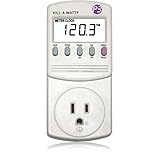
Two practical tools are worth knowing about. The first is a smart thermostat. These are programmable thermostats that learn when a household is home and when it isn’t, and adjust heating and cooling automatically.ENERGY STAR estimates a smart thermostat can cut heating and cooling costs by roughly 8 percent. On a $250 monthly bill, that’s real money over a year. The second is a plug-in electricity usage monitor. It tells you exactly which appliances are quietly running up the bill in the background. Phantom load draws from electronics, appliances, and chargers can account for 5 to 10 percent of household electricity use, and most homeowners have no way to see them otherwise.
Neither tool changes the rate the utility charges. Both give better information about what’s actually being paid for. That’s the brace-and-plan posture for a structural cost increase: better information, better tools, better positioning for what’s coming.
Disclosure: BreakingNewsAlerts.com participates in the Amazon Associates program. We may earn a commission on purchases made through links in this article at no extra cost to you. See our editorial standards.

Your electricity bill is not going down. The federal forecast says so. The rate cases pending across 49 states say so. The structural drivers say so. The honest move for every household watching this is to factor it into the plan now, while there’s still room in the budget to adjust.
Frequently Asked Questions
Are electricity rates expected to keep rising after 2026?
Yes. The U.S. Energy Information Administration forecasts wholesale electricity prices to rise another 8.5 percent through the rest of 2026, with continued upward pressure into 2027 and 2028. Utilities have committed to roughly $1.4 trillion in infrastructure spending through 2030, which will be recovered from ratepayers over the same period. The structural drivers, including aging grid replacement and rising electricity demand, aren’t expected to reverse in the near term
Why is my electricity bill rising faster than overall inflation?
Three reasons. First, electricity rates track natural gas wholesale prices, which have been volatile through 2025 and 2026. Second, utilities are recovering large infrastructure investments through residential rates, which adds delivery charges separate from generation costs. Third, demand growth from industrial users and data center construction is outpacing new supply in many regional markets, which pushes wholesale prices up.
Will the Social Security cost-of-living adjustment keep pace with rising electricity costs?
No, not consistently. The Social Security COLA adjusts for general inflation across the full consumer basket. It doesn’t adjust faster for individual household cost categories that are rising more sharply. The 2025 COLA was 2.5 percent. National residential electricity rose 9.5 percent over the same period. For households on fixed retirement income, the gap is real and it compounds year over year.
Which states are seeing the biggest electricity bill increases?
Maine led the country with a 17.6 percent year-over-year increase from January 2025 to January 2026. California, Massachusetts, and Hawaii now have residential rates above 30 cents per kilowatt-hour, nearly double the national average. The Center for American Progress utility tracker has counted rate increases proposed or implemented in 49 states and the District of Columbia since January 2025.
How much should I budget for electricity in retirement in 2026?
A typical U.S. household using 863 kilowatt-hours per month at the current 18.05 cents per kilowatt-hour national rate pays roughly $1,870 per year. Households in California, Massachusetts, or Hawaii, where rates exceed 30 cents per kilowatt-hour, can expect $3,100 or more annually before further 2026 increases land.
Will smart thermostats actually lower my electricity bill?
ENERGY STAR estimates a smart thermostat can reduce heating and cooling costs by approximately 8 percent. On a $250 monthly bill, that’s roughly $20 per month or $240 annually. Meaningful, but it’s not enough on its own to offset structural rate increases.
What is causing electricity demand to rise in 2026?
Three sources. First, industrial reshoring is bringing manufacturing back to the United States. Second, data center construction supporting AI infrastructure is adding large new commercial loads. Third, home electrification, including electric vehicles and heat pumps, is shifting household energy use from natural gas and gasoline onto the electric grid