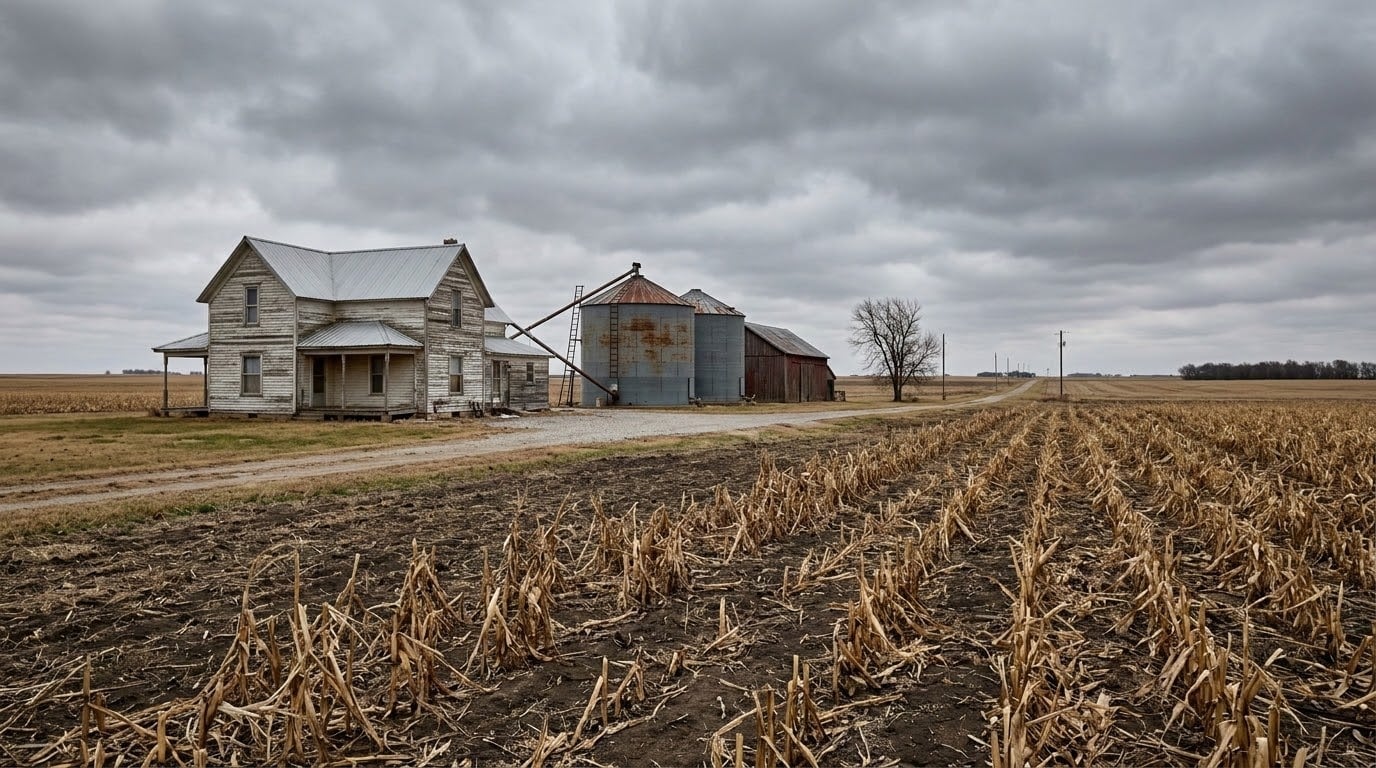

The number of American farm bankruptcies jumped 46% in 2025, the third straight annual increase, and the numbers got worse in the first quarter of 2026, with Minnesota leading the country in new filings as of this week. This is not a fringe statistic buried in an agricultural trade report. The American Farm Bureau Federation, which surveyed more than 5,700 farmers across all 50 states in April, put it plainly: we are in a new farm crisis. The last time it looked like this was the 1980s. The difference this time is that the damage is arriving faster, and the people who grow the food have fewer resources to absorb it.
The U.S. has lost more than 156,000 farms since 2017, according to Census data. From 2024 to 2025 alone, Chapter 12 bankruptcy filings jumped from 216 to 315. That 46% single-year increase is not the start of this problem. It is the third consecutive year of increases.
Chapter 12 was created after the 1980s farm crisis to give family farmers a path to reorganize debt without full liquidation. The fact that filings are climbing toward the levels that prompted Congress to create that provision in the first place is the data point that puts this in historical context. Farm Aid, which has tracked agricultural financial health since the 1980s, is not using cautious language: “We are experiencing a new farm crisis.” The AFBF economist who authored the bankruptcy report, Samantha Ayoub, described it this way: “It’s really this margin squeeze on an industry that already operates on extremely thin margins.”
What Input Costs Are Squeezing Farmers Out of Business?
Two things are hitting farmers at the same time, and they are moving in opposite directions.
Input costs are up sharply. Farm diesel prices jumped 46% since the end of February. Urea, the most widely used nitrogen fertilizer, is up 47% in the same period, the largest month-to-month percentage increase on record. Nitrogen fertilizer prices overall are up more than 30% since the U.S.-Iran conflict escalated and the Strait of Hormuz closed to normal shipping traffic.
Crop prices are down. Corn has dropped roughly 50% since 2022. Soybeans are down about 40%. The farmers selling the harvest are getting paid 2022 prices for their inputs and 1980s prices for their crops.
Oklahoma farmer Tommy Salisbury, speaking to CNBC in April, put it directly: “We are paying input prices of 2026, but getting crop prices of the ’70s and ’80s.”
The result: 70% of farmers surveyed by the AFBF in April said fertilizer prices are now too high to purchase what they need for the full 2026 growing season. In the South, that number jumps to 78%. Only 19% of Southern farmers secured fertilizer ahead of planting season, leaving most of them exposed to prices that had not yet peaked when they needed to buy.
Total farm debt is projected to break records this year at $625 billion, according to the USDA’s farm sector financial indicators report.
How Will American Farm Bankruptcies Drive Up Your Grocery Bill?
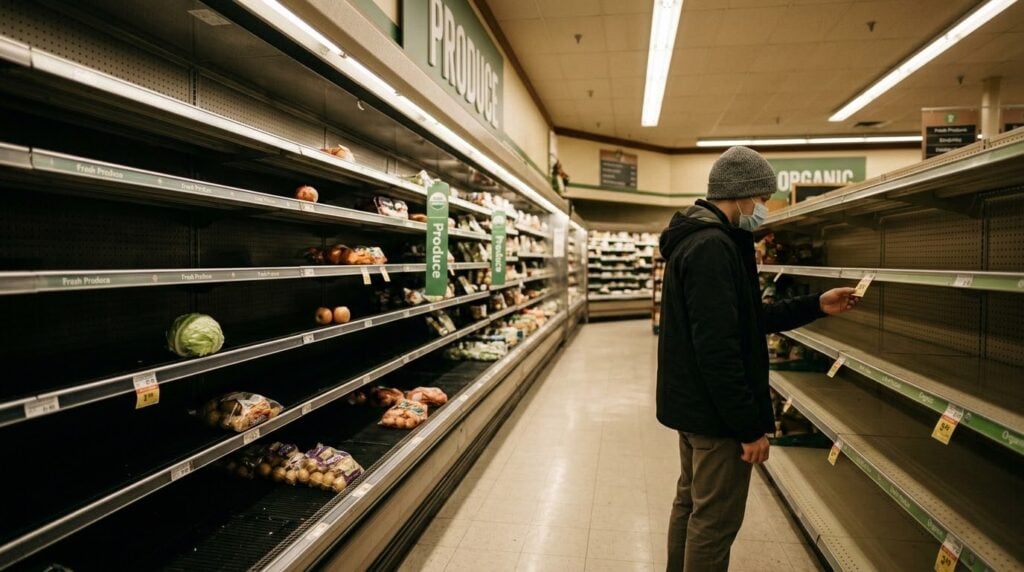
Here is the mechanism the mainstream press keeps leaving out of this story.
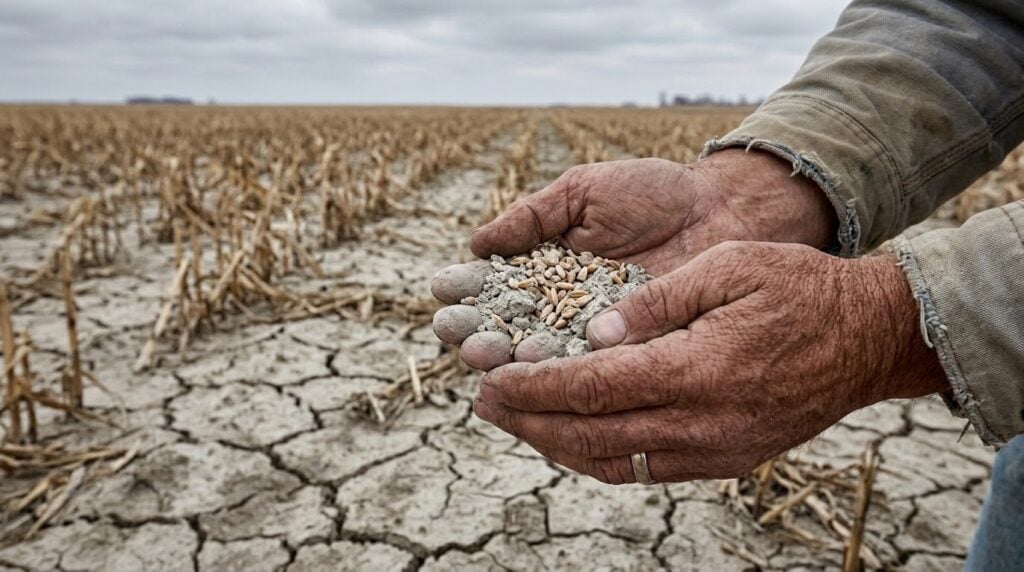
When farmers cannot afford full fertilizer application, they have three options: reduce how much fertilizer they use, shift to less fertilizer-intensive crops, or absorb the loss and plant anyway. All three reduce yields. Reduced yields mean less food in the supply chain. Less food in the supply chain means higher prices at the store.
AFBF President Zippy Duvall stated it without ambiguity: “When farmers cut back on planted acres and fertilizer use, it obviously reduces their yields. To put it simply, less food in the supply chain.”
The price signal is already showing up. According to the Kobeissi Letter’s analysis of producer price index data, food and beverage company inflation hit 7.9% year-over-year in March, the largest jump in at least 12 months. Analysts note that the full impact of the fertilizer and fuel cost increases has not yet reached store shelves. What consumers are seeing now is the leading edge.
Families paid 22% more for food at the end of 2024 than they did at the start of 2021, according to the Consumer Energy Alliance’s annual Farm-to-Table analysis. North Dakota State University’s agricultural economists project elevated fertilizer prices continuing through 2027 and 2028 under every scenario currently modeled, including a full Strait of Hormuz reopening.
What Is the Federal Government Actually Doing About the Farm Crisis?
USDA Deputy Secretary Stephen Vaden confirmed publicly that two companies currently control 90% of the key fertilizer inputs American farmers depend on. Both the Justice Department and the Federal Trade Commission have opened investigations into fertilizer market concentration and are issuing questions to those companies.
Agriculture Secretary Brooke Rollins announced $900 million in grant funding for independent fertilizer companies and permit streamlining in late April. President Trump announced an $11 billion bridge payment to farmers, of which approximately $9.7 billion has been disbursed.
Run the math: $9.7 billion disbursed against $625 billion in total projected farm debt, in a year when 70% of farmers cannot afford the fertilizer they need and bankruptcy filings are at a 40-year high.
The farm bill, the primary federal legislative tool for stabilizing agricultural markets, remains stalled in Congress.
Senator Tom Cotton, writing in Fox News last year, named the bottom line: “America’s farmers also play a critical role in our consumer economy. After all, food security is national security. Our adversaries would love nothing more than to see generations of farmers wiped out by economic hardship.”
What Does the Farm Bankruptcy Crisis Mean for Your Retirement Budget?
The pass-through from farm to table is not hypothetical. It is documented, multi-year, and not yet finished.
If you are within 10 years of retirement, you are running your household budget against a food inflation horizon that runs through at least 2028 by the most optimistic current projections. The farmers planting fewer acres and applying less fertilizer this spring are making decisions right now that will show up in your grocery bill in 2027.
The dollar cushion that was supposed to carry you through the transition to fixed income is being compressed from both ends: by the cost of the food you are buying today and by the depreciation of the savings carrying you to retirement.
That is the story the wire services are not connecting. The farm crisis and your retirement window are the same story.
Frequently Asked Questions
How many farms have gone bankrupt in recent years?
Chapter 12 farm bankruptcy filings jumped from 216 in 2024 to 315 in 2025, a 46% single-year increase and the third consecutive annual rise. The U.S. has also lost more than 156,000 farms since 2017.
What is causing American farm bankruptcies to increase?
A simultaneous squeeze from both directions: input costs have surged with fertilizer up 47% and diesel up 46%, while crop prices have collapsed with corn down roughly 50% from 2022 and soybeans down about 40%. Farmers are paying 2026 input prices while receiving prices comparable to the 1970s and 1980s for their harvests.
What is causing American farm bankruptcies to increase?
A simultaneous squeeze from both directions: input costs have surged with fertilizer up 47% and diesel up 46%, while crop prices have collapsed with corn down roughly 50% from 2022 and soybeans down about 40%. Farmers are paying 2026 input prices while receiving prices comparable to the 1970s and 1980s for their harvests.
When was the last farm crisis this severe?
The current situation is being compared to the 1980s farm crisis, which was severe enough that Congress created Chapter 12 bankruptcy specifically to give family farmers a restructuring path. The American Farm Bureau Federation has stated directly: “We are experiencing a new farm crisis.”
Will farm bankruptcies cause food prices to rise further?
According to AFBF President Zippy Duvall, when farmers cut back on acres and fertilizer use, yields fall and food supply tightens. North Dakota State University agricultural economists project elevated fertilizer prices continuing through 2027 and 2028 under every currently modeled scenario.
Disclosure: This article contains affiliate links. BreakingNewsAlerts.com may receive compensation if you request information from the companies listed below.